 Indietro
Chapter 8: Reactions of Alkenes – Mechanisms, Stereochemistry, and Applications
Guida di studio - Note intelligenti
 Appunti personalizzati basati sui tuoi materiali, ampliati con definizioni chiave, esempi e contesto.
Reactions of Alkenes
Introduction to Alkene Reactivity
Alkenes are hydrocarbons containing at least one carbon–carbon double bond. The reactivity of alkenes is largely determined by the presence of the pi (π) bond, which is more reactive than the sigma (σ) bond due to its higher electron density and accessibility. Most reactions of alkenes involve the addition of atoms or groups across the double bond, breaking the π bond and forming new σ bonds.
Bonding in Alkenes
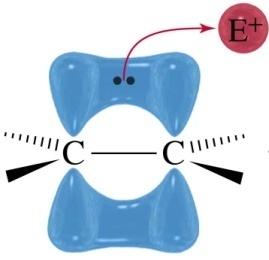
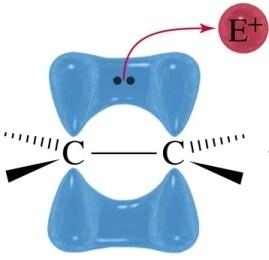
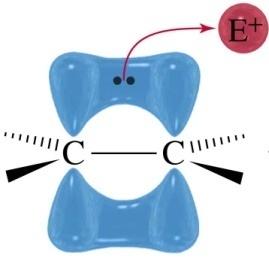
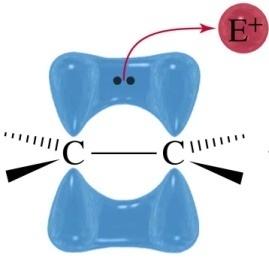
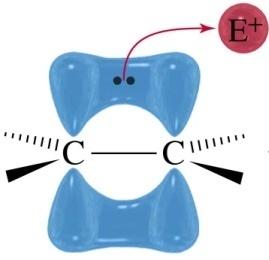
Pi (π) Bond: Formed by the sideways overlap of p orbitals above and below the plane of the carbon atoms. Electrons in the π bond are less tightly held and more reactive than those in the σ bond.
Sigma (σ) Bond: Formed by the head-on overlap of orbitals, holding the two carbon atoms together more tightly.
Nucleophilicity: The π bond acts as a nucleophile, attacking electrophilic species (E+).
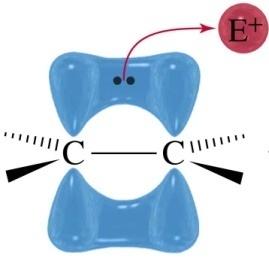
Types of Alkene Reactions
Alkenes undergo a variety of addition reactions, classified by the nature of the reagents and the products formed. The most common are electrophilic additions, where an electrophile adds to the double bond.
Type of Addition [Elements Added] | Product |
|---|---|
Hydration [H, OH] | Alcohol |
Hydrogenation [H, H] | Alkane |
Hydroxylation [HO, OH] | Glycol (diol) |
Oxidative cleavage [O, O] | Ketone, aldehyde, or acid |
Epoxidation [O] | Epoxide |
Halogenation [X, X] | Vicinal dihalide |
Halohydrin formation [HOX] | Halohydrin |
HX addition [HX] | Alkyl halide |
Cyclopropanation [CH2] | Cyclopropane derivative |
Electrophilic Addition Mechanism
General Mechanism
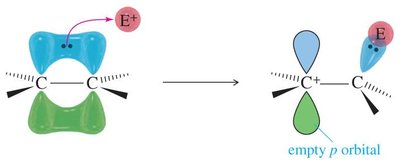
Electrophilic addition is the most common reaction of alkenes. The π electrons attack an electrophile, forming a carbocation intermediate, which is then attacked by a nucleophile.
Step 1: The π bond attacks the electrophile (E+), forming a carbocation on the more substituted carbon (Markovnikov's rule).
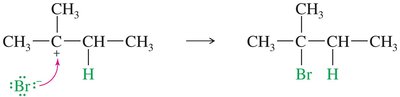
Step 2: The nucleophile (Nuc-) attacks the carbocation, yielding the addition product.
Markovnikov's Rule
Markovnikov's rule predicts the regioselectivity of electrophilic addition to unsymmetrical alkenes: the electrophile adds to the carbon with more hydrogens, generating the most stable carbocation intermediate.
Regioselectivity: The product distribution depends on the stability of the carbocation intermediate.
Carbocation Rearrangement: If a more stable carbocation can be formed by hydride or alkyl shift, rearrangement will occur.
Addition of Hydrogen Halides (HX) to Alkenes
Mechanism
Step 1: Protonation of the double bond forms the most stable carbocation.
Step 2: The halide ion (Br-, Cl-, I-) attacks the carbocation, forming the alkyl halide.
Reaction-Energy Diagram
The rate-determining step is the formation of the carbocation intermediate. The more stable the carbocation, the lower the activation energy and the faster the reaction.
Anti-Markovnikov Addition: Free-Radical Addition of HBr
Peroxide Effect
In the presence of peroxides (ROOR), HBr adds to alkenes via a free-radical mechanism, resulting in anti-Markovnikov orientation. This effect is unique to HBr due to the energetics of the radical steps.
Initiation: Peroxide bond breaks homolytically, generating radicals.
Propagation: Bromine radical adds to the double bond, forming the most stable carbon radical, which abstracts a hydrogen from HBr.
Hydration of Alkenes
Direct Hydration
Water adds to alkenes in the presence of acid (H2SO4 or H3PO4), forming alcohols. The reaction is reversible and follows Markovnikov's rule.
Mechanism: Protonation of the double bond, nucleophilic attack by water, and deprotonation to yield the alcohol.
Rearrangements: Carbocation rearrangements can occur, leading to more stable alcohol products.
Oxymercuration–Demercuration
This two-step process hydrates alkenes under milder conditions, yielding Markovnikov alcohols without carbocation rearrangement.
Step 1: Alkene reacts with mercuric acetate (Hg(OAc)2) and water, forming a mercurinium ion intermediate.
Step 2: Sodium borohydride (NaBH4) reduces the intermediate, replacing mercury with hydrogen.
Hydroboration–Oxidation
This method adds water across the double bond in anti-Markovnikov orientation, with syn addition of H and OH.
Step 1: Borane (BH3) adds to the less substituted carbon.
Step 2: Oxidation with hydrogen peroxide (H2O2, OH-) converts the boron group to an alcohol.
Addition of Halogens and Halohydrin Formation
Halogenation
Alkenes react with Cl2 or Br2 to form vicinal dihalides via anti addition. The reaction proceeds through a cyclic halonium ion intermediate.
Stereochemistry: Anti addition leads to trans products from cis alkenes and meso compounds from trans alkenes.
Halohydrin Formation
When halogenation occurs in the presence of water, a halohydrin is formed. Water acts as the nucleophile, attacking the more substituted carbon of the halonium ion.
Regioselectivity: The OH group attaches to the more substituted carbon.
Stereochemistry: Anti addition is observed.
Catalytic Hydrogenation
Mechanism and Stereochemistry
Hydrogenation reduces alkenes to alkanes using H2 gas and a metal catalyst (e.g., Pd, Pt, or Wilkinson's catalyst). Both hydrogens add to the same face of the double bond (syn addition).

Epoxidation and Dihydroxylation
Epoxidation
Alkenes react with peroxyacids (e.g., m-CPBA) to form epoxides in a single concerted step. The stereochemistry of the alkene is preserved (stereospecific reaction).
Dihydroxylation
Syn Dihydroxylation: OsO4 or cold, dilute KMnO4 adds two OH groups to the same side of the double bond, forming a syn-1,2-diol.
Anti Dihydroxylation: Acid-catalyzed opening of epoxides yields trans diols.
Oxidative Cleavage
Permanganate Cleavage
Warm, concentrated KMnO4 cleaves both the π and σ bonds of alkenes, forming ketones, carboxylic acids, or CO2 depending on substitution.
Ozonolysis
Ozone (O3) cleaves alkenes to form aldehydes and ketones. The reaction is milder than permanganate oxidation and does not further oxidize aldehydes. The ozonide intermediate is reduced by Zn or dimethyl sulfide (Me2S).
Summary Table: Types of Alkene Additions
Type of Addition | Reagents | Product | Orientation | Stereochemistry |
|---|---|---|---|---|
Hydration | H2O, acid | Alcohol | Markovnikov | Carbocation rearrangement possible |
Oxymercuration–Demercuration | Hg(OAc)2, H2O; NaBH4 | Alcohol | Markovnikov | No rearrangement |
Hydroboration–Oxidation | BH3, H2O2, OH- | Alcohol | Anti-Markovnikov | Syn addition |
Halogenation | Br2, Cl2 | Dihalide | — | Anti addition |
Halohydrin formation | Br2, H2O | Halohydrin | Markovnikov (OH to more substituted C) | Anti addition |
Hydrogenation | H2, catalyst | Alkane | — | Syn addition |
Epoxidation | RCO3H | Epoxide | — | Stereospecific |
Dihydroxylation | OsO4, KMnO4 | Glycol | — | Syn addition |
Oxidative cleavage | O3, KMnO4 | Ketone, aldehyde, acid | — | — |
Key Concepts and Applications
Regioselectivity: Markovnikov vs. anti-Markovnikov orientation is determined by the mechanism and reaction conditions.
Stereochemistry: Syn and anti additions lead to different stereoisomers; important in synthesis and biological activity.
Carbocation Rearrangement: Watch for hydride or alkyl shifts that yield more stable intermediates and unexpected products.
Oxidative Cleavage: Useful for determining the position of double bonds in unknown compounds.
