 Indietro
CHM 26100 Organic Chemistry: Course Introduction, Structure, and Bonding
Guida di studio - Note intelligenti
 Appunti personalizzati basati sui tuoi materiali, ampliati con definizioni chiave, esempi e contesto.
Course Overview
Introduction to Organic Chemistry (CHM 26100)
This course provides a comprehensive introduction to the principles of organic chemistry, focusing on the structure, bonding, and reactivity of organic molecules. Students will learn to apply fundamental chemical concepts to understand organic reactions, mechanisms, and molecular properties.

Course Structure and Schedule
Lecture Topics and Timeline
The course is organized into weekly lectures covering foundational topics in organic chemistry. The schedule includes key concepts such as bonding, acid-base chemistry, stereochemistry, reaction mechanisms, and spectroscopy.
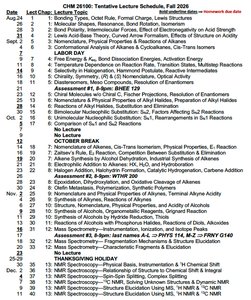
Weeks 1-2: Structure and Bonding, Lewis Structures, Electronegativity
Weeks 3-4: Acids and Bases, Functional Groups, Alkanes
Weeks 5-6: Stereochemistry, Chirality, Isomerism
Weeks 7-8: Alkyl Halides, Nucleophilic Substitution, Elimination
Weeks 9-10: Alkenes, Alkynes, Alcohols
Weeks 11-13: Alcohol Reactions, Spectroscopy (MS, NMR)
Weeks 14-16: Advanced NMR, Structure Elucidation
Assessment and Grading
Grading Breakdown
Student performance is evaluated through homework assignments, periodic assessments, and a comprehensive final exam. The grading scale ensures clarity in performance expectations.
Component | Points |
|---|---|
Homework (10 x 25 pts) | 250 |
Assessments (3 x 175 pts) | 525 |
Comprehensive Final | 350 |
Drop Lowest Assessment | -175 |
Total | 950 |
Grade Cut-offs: A: ≥ 870, B: 869–740, C: 739–600, D: 599–460, F: <460
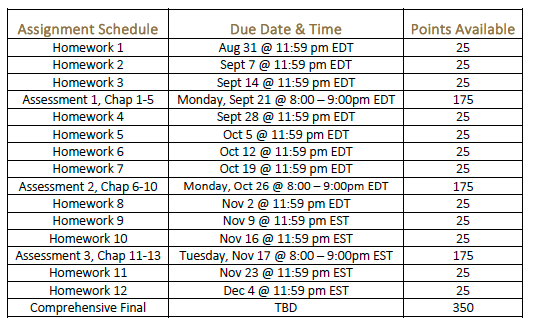
Assignment Schedule
Assignments are due weekly, with major assessments covering multiple chapters. The final exam is comprehensive.
Learning Outcomes
Core Competencies
Apply bonding, acid-base, kinetic, and thermodynamic principles to organic structures and reactions
Recognize recurring themes and patterns of reactivity in organic compounds
Classify molecules and understand structure-property relationships
Use spectrometric and spectroscopic techniques for structure determination
Plan multistep syntheses of organic molecules
Understand the role of organic chemistry in pharmaceuticals, materials, and industry

Reading and Practice Problems
Weekly Reading Assignments
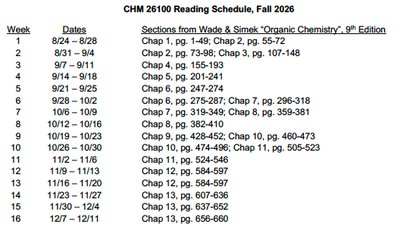
Students are expected to complete assigned readings from Wade & Simek's "Organic Chemistry" (9th Edition) before lectures. The reading schedule aligns with lecture topics for optimal learning.
Suggested Practice Problems
Practice problems are assigned from each chapter to reinforce key concepts and problem-solving skills.

Chapter 1: Structure and Bonding
Overview of Organic Chemistry
Organic chemistry is the study of carbon-containing compounds. Carbon's unique ability to form single, double, and triple bonds, as well as its intermediate electronegativity, allows for a vast diversity of molecular structures and functions.
Old Definition: Compounds derived from living organisms
Modern Definition: The study of the compounds of carbon
Over 10 million organic compounds have been identified, with about 1000 new ones discovered daily
Carbon forms strong bonds with H, O, N, and some metals

Importance of Organic Chemistry
Organic chemistry is foundational to the chemical sciences, providing molecular insights into biological, medicinal, and industrial processes. It is essential for the development of pharmaceuticals, materials, and solutions to global challenges such as energy and pollution.
Key industries: plastics, textiles, dyes, lubricants, food
Addresses grand challenges: sustainable energy, pollution abatement, pharmaceuticals

Atomic Structure and Electron Configuration
Understanding the arrangement of electrons in atoms is crucial for predicting chemical bonding and reactivity. The valence shell contains the electrons involved in bond formation.
Valence shell: Outermost electron shell of an atom
Valence electrons: Electrons in the valence shell, responsible for chemical bonding

Lewis Dot Structures
Lewis dot structures represent the valence electrons of atoms as dots around the element symbol. These structures help visualize bonding and lone pairs in molecules.
Each dot represents a valence electron
Pairs of dots between atoms represent shared electrons (bonds)
Unshared dots represent lone pairs

Bonding Types and the Octet Rule
Atoms bond to achieve a stable electron configuration, often resembling the nearest noble gas (octet rule). There are three main types of bonds:
Ionic bonds: Formed by transfer of electrons from one atom to another, resulting in oppositely charged ions
Covalent bonds: Formed by sharing pairs of electrons between atoms
Polar covalent bonds: Electrons are shared unequally, resulting in partial charges

Electronegativity
Electronegativity (EN) is a measure of an atom's ability to attract electrons in a bond. It generally increases from left to right across a period and from bottom to top within a group in the periodic table.
Pauling EN scale is commonly used
High EN: F, O, N; Low EN: Cs, Rb

Formal Charge
Formal charge is a bookkeeping tool to determine the distribution of electrons in a molecule. It helps identify the most stable Lewis structure and the location of charges in ions.
Formal charge formula:
Sum of formal charges in a molecule equals the overall charge
Example: In methane (CH4), all atoms have a formal charge of zero. In the hydronium ion (H3O+), oxygen has a formal charge of +1.
Common Bonding Patterns
Recognizing typical bonding patterns for main-group elements is essential for drawing correct structures and predicting reactivity.
Atom | Valence Electrons | Positively Charged | Neutral | Negatively Charged |
|---|---|---|---|---|
B | 3 | no octet | B | |
C | 4 | no octet | C | |
N | 5 | N | ||
O | 6 | O | ||
Halogens | 7 | Cl+ | Cl | :Cl: |
Additional info: Familiarity with these patterns helps in identifying unusual or incorrect structures in organic molecules.
