 Indietro
CHM 26100 Organic Chemistry: Structure and Bonding Study Guide
Guida di studio - Note intelligenti
 Appunti personalizzati basati sui tuoi materiali, ampliati con definizioni chiave, esempi e contesto.
Course Overview
Introduction to Organic Chemistry
Organic Chemistry is the study of the compounds of carbon, a field central to chemical, biological, and medicinal sciences. The course CHM 26100 covers fundamental principles, recurring themes, and mechanisms in organic chemistry, with a focus on structure-property relationships and spectroscopic techniques.

Course Structure and Schedule
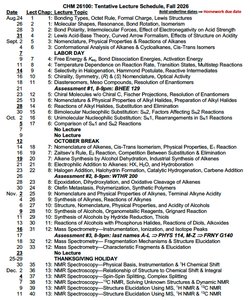
Lecture Topics and Sequence
The course is organized into weekly lectures covering the following major topics:
Structure and Bonding
Acids and Bases; Functional Groups
Structure and Stereochemistry of Alkanes
The Study of Chemical Reactions
Stereochemistry
Alkyl Halides; Nucleophilic Substitution
Structure and Synthesis of Alkenes; Elimination
Reactions of Alkenes
Alkynes
Structure and Synthesis of Alcohols
Reactions of Alcohols
Infrared Spectroscopy and Mass Spectrometry
Nuclear Magnetic Resonance Spectroscopy
Learning Outcomes
Key Skills and Knowledge
Apply bonding, acid-base, kinetic, and thermodynamic principles to organic structures and reactions
Recognize patterns of reactivity and shared reaction mechanisms
Identify classes of molecules and understand structure-property relationships
Use spectrometric and spectroscopic techniques for structure determination
Plan multistep syntheses of organic molecules
Understand the role of organic chemistry in industry and society

Grading and Assessment
Evaluation Components
Homework assignments (10 x 25 pts)
Assessments (3 x 175 pts)
Comprehensive Final Assessment (350 pts)
Lowest assessment score dropped
Grade cut-offs: A (≥ 870), B (869–740), C (739–600), D (599–460), F (0–459)
Assignment Schedule
Homework and Assessments
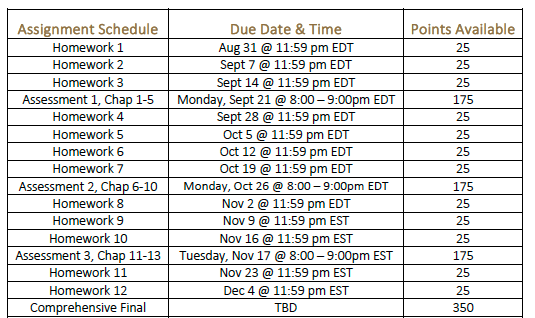
Assignments are scheduled throughout the semester, with due dates and point values clearly outlined. Three major assessments cover chapters 1–5, 6–10, and 11–13, with a comprehensive final at the end.
Assignment Schedule | Due Date & Time | Points Available |
|---|---|---|
Homework 1 | Aug 31 @ 11:59 pm EDT | 25 |
Homework 2 | Sept 7 @ 11:59 pm EDT | 25 |
Homework 3 | Sept 14 @ 11:59 pm EDT | 25 |
Assessment 1, Chap 1-5 | Monday, Sept 21 @ 8:00–9:00pm EDT | 175 |
Homework 4 | Sept 28 @ 11:59 pm EDT | 25 |
Homework 5 | Oct 5 @ 11:59 pm EDT | 25 |
Homework 6 | Oct 12 @ 11:59 pm EDT | 25 |
Homework 7 | Oct 19 @ 11:59 pm EDT | 25 |
Assessment 2, Chap 6-10 | Monday, Oct 26 @ 8:00–9:00pm EDT | 175 |
Homework 8 | Nov 2 @ 11:59 pm EDT | 25 |
Homework 9 | Nov 9 @ 11:59 pm EST | 25 |
Homework 10 | Nov 16 @ 11:59 pm EST | 25 |
Assessment 3, Chap 11-13 | Tuesday, Nov 17 @ 8:00–9:00pm EST | 175 |
Homework 11 | Nov 23 @ 11:59 pm EST | 25 |
Homework 12 | Dec 4 @ 11:59 pm EST | 25 |
Comprehensive Final | TBD | 350 |
Reading Assignments
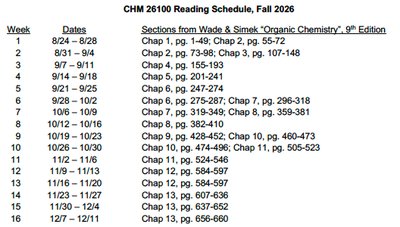
Weekly Reading from Wade & Simek
Students are expected to complete assigned readings before lectures. The schedule covers chapters 1–13, aligning with lecture topics and assessments.
Suggested Practice Problems
Chapter-Based Practice
Practice problems are recommended for each chapter to reinforce understanding and problem-solving skills. These problems cover key concepts such as bonding, structure, nomenclature, and spectroscopy.

Chapter 1: Structure and Bonding
Organic Chemistry Overview
Organic chemistry focuses on carbon compounds, which are central to life and industry. Carbon's ability to form single, double, and triple bonds, and its intermediate electronegativity, make it versatile in forming a wide variety of molecules.


Electron Configuration and Valence Electrons
The electron configuration of atoms determines their chemical behavior. The valence shell is the outermost electron shell, and valence electrons are those involved in bonding.

Lewis Dot Structures
Lewis dot structures represent atoms and their valence electrons. The element symbol stands for the nucleus and inner electrons, while dots indicate valence electrons. In molecules, valence electrons are distributed in available orbitals, often through hybridization.

Bonding Types and the Octet Rule
Atoms bond to achieve a stable electron configuration, often resembling the nearest noble gas. The main types of bonding are:
Ionic bond: Electrostatic attraction between an anion and a cation
Covalent bond: Sharing of electron pairs between atoms
Polar covalent bond: Unequal sharing of electrons, resulting in partial charges

Electronegativity
Electronegativity (EN) is a measure of an atom's ability to attract electrons. The Pauling scale is commonly used, and EN generally increases from left to right across a period and from bottom to top within a group.

Formal Charge
Formal charge is a bookkeeping method to determine the distribution of electrons in a molecule. It helps identify which atom bears the most charge. The calculation is:
Write the correct Lewis structure
Assign each atom all its nonbonding electrons and half its shared electrons
Compare this number to the atom's valence electrons in its neutral state
Formula:
Common Bonding Patterns
Organic compounds exhibit characteristic bonding patterns depending on the atom and its charge. Familiarity with these patterns is essential for recognizing unusual or incorrect structures.
Atom | Valence Electrons | Positively Charged | Neutral | Negatively Charged |
|---|---|---|---|---|
B | 3 | no octet | B | |
C | 4 | no octet | PROBLEM-SOLVING HINT | |
N | 5 | |||
Halogens | 7 | Cl+ | Cl | :Cl: |
Additional info: Work enough problems to become familiar with these bonding patterns so that you can recognize other patterns as being either unusual or wrong.
