 Indietro
Condensation Reactions of Carbonyl Compounds: Aldol and Claisen Condensations
Guida di studio - Note intelligenti
 Appunti personalizzati basati sui tuoi materiali, ampliati con definizioni chiave, esempi e contesto.
Condensation Reactions of Carbonyl Compounds
Overview of Condensation Reactions
Condensation reactions involving carbonyl compounds are fundamental transformations in organic chemistry, particularly in the synthesis of complex molecules. These reactions typically involve the combination of two carbonyl-containing molecules, resulting in the formation of a new carbon–carbon bond. The carbonyl group can act as both an electrophile and, after enolate formation, as a nucleophile.
Electrophilic carbonyl group: Reacts with nucleophiles.
Nucleophilic enolate ion: Reacts with electrophiles.
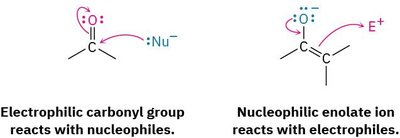
Additional info: These dual reactivities are central to the mechanisms of aldol and Claisen condensations.
Aldol Condensation
General Reaction and Mechanism
The aldol condensation is a base-catalyzed reaction between aldehydes or ketones possessing α-hydrogens. The reaction forms a β-hydroxy aldehyde or ketone (an aldol), which can further undergo dehydration to yield an α,β-unsaturated carbonyl compound.
Reactants: Aldehydes or ketones with α-hydrogens.
Catalyst: Typically NaOH or sodium ethoxide in a protic solvent.
Product: β-hydroxy aldehyde or ketone (aldol).
Reaction reversibility: Equilibrium depends on substrate structure and reaction conditions.
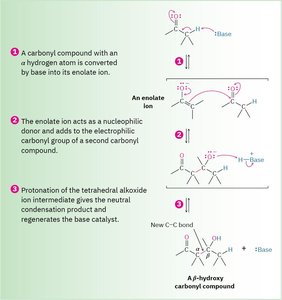
Additional info: The reaction proceeds via enolate formation, nucleophilic addition to another carbonyl, and protonation.
Mechanism Steps
Formation of the enolate ion: The base abstracts an α-hydrogen, generating an enolate.
Nucleophilic attack: The enolate attacks the electrophilic carbonyl carbon of another molecule.
Protonation: The alkoxide intermediate is protonated, yielding the aldol product.
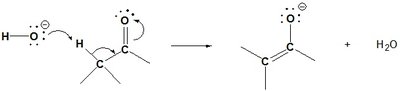
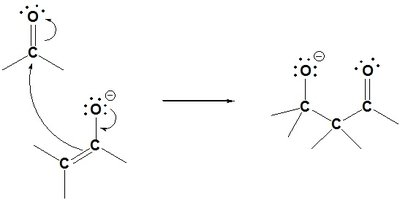
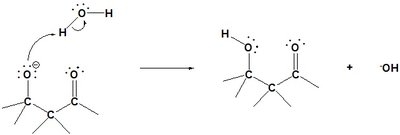
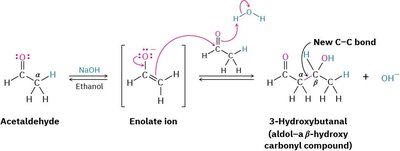
Example: Acetaldehyde reacts with another acetaldehyde molecule in basic solution to form 3-hydroxybutanal (aldol).
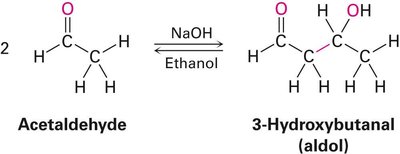
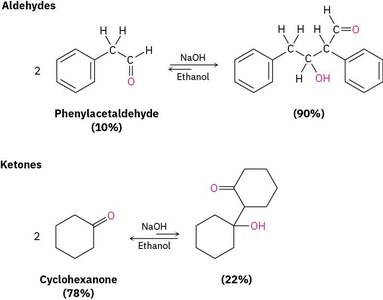
Additional info: The equilibrium favors condensation products for aldehydes without α-substituents, but favors reactants for disubstituted aldehydes due to steric effects.
Factors Affecting Aldol Condensation
Steric effects: Less substituted aldehydes favor product formation.
Substrate structure: Disubstituted aldehydes are less reactive.
Practice Example: Propanal Aldol Condensation
Draw the product of the aldol condensation of propanal.
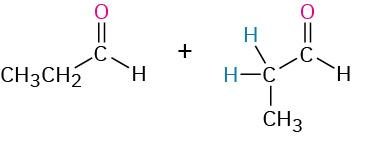
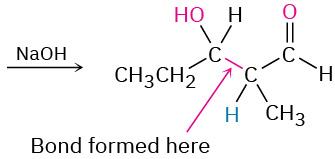
Dehydration of β-Hydroxy Aldehydes and Ketones
Formation of α,β-Unsaturated Carbonyl Compounds
Upon heating, β-hydroxy aldehydes or ketones undergo dehydration to yield α,β-unsaturated carbonyl compounds (enones or enals). This process can occur under acidic or basic conditions.
Base-catalyzed: Removal of α-hydrogen forms enolate, which eliminates -OH.
Acid-catalyzed: Protonation of -OH group facilitates water loss.
Product: Conjugated enone or enal, more stable than non-conjugated forms.
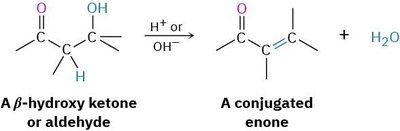
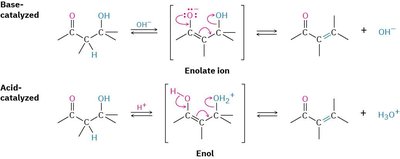
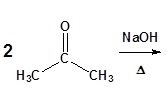
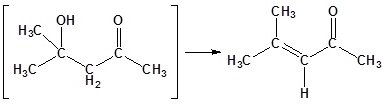
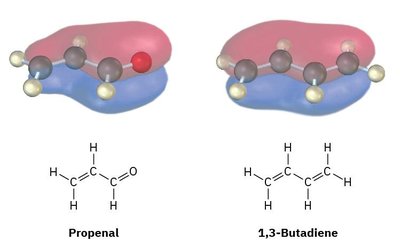
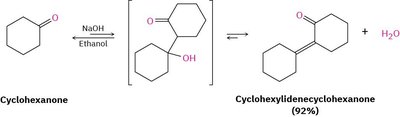
Example: The major product of aldol condensation is often the conjugated enone due to its stability.
Intramolecular Aldol Condensation
Formation of Cyclic Compounds
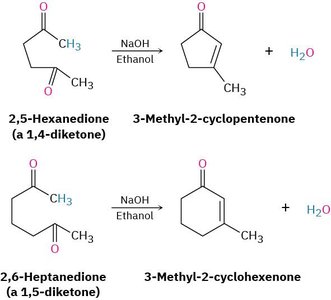
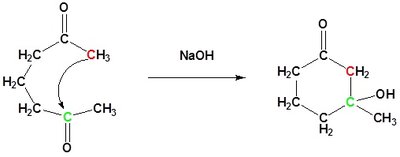
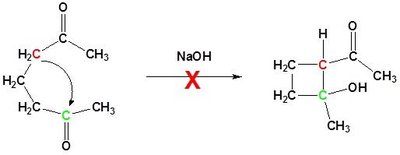
Intramolecular aldol condensation occurs when a single molecule contains two carbonyl groups, allowing ring formation upon treatment with base. Five- and six-membered rings are favored due to minimal angle strain.
Reactant: Dicarbonyl compound.
Product: Cyclic β-hydroxy carbonyl compound, often dehydrated to a conjugated cyclic enone.
Claisen Condensation
General Reaction and Mechanism
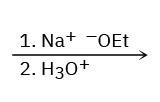
The Claisen condensation is a base-catalyzed reaction between two esters (or one ester and one ketone) with α-hydrogens, resulting in a β-keto ester. One ester acts as a nucleophile (enolate), the other as an electrophile. The base used is typically the alkoxide corresponding to the ester, not hydroxide.
Reactants: Esters with α-hydrogens.
Base: Alkoxide (e.g., sodium ethoxide).
Product: β-keto ester.

Mechanism Steps
Formation of ester enolate: Base abstracts α-hydrogen.
Nucleophilic addition: Enolate attacks another ester carbonyl.
Removal of leaving group: Alkoxide is expelled.
Protonation: Final product is protonated to yield β-keto ester.

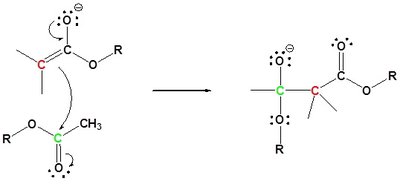
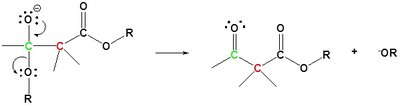
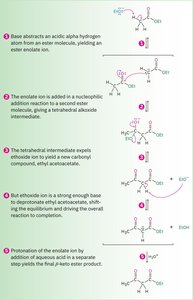
Example: Ethyl acetate undergoes Claisen condensation to form ethyl acetoacetate.
Mixed (Crossed) Claisen Condensation
Reaction Between Different Esters
Mixed Claisen condensation involves two different esters. Both can act as nucleophile and electrophile, often resulting in a mixture of products. To avoid this, one reactant should lack α-hydrogens.
Reactants: Two different esters.
Product: Mixture of β-keto esters unless one ester lacks α-hydrogens.
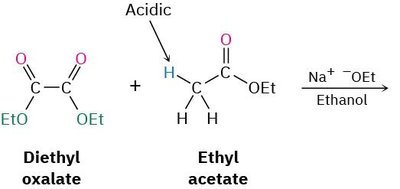
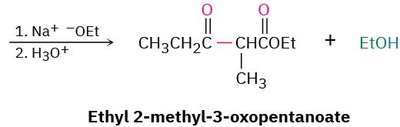
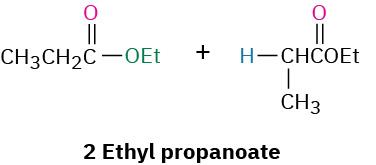
Example: Diethyl oxalate and ethyl acetate react to form ethyl 2-methyl-3-oxopentanoate.
Summary Table: Comparison of Aldol and Claisen Condensations
Reaction | Reactants | Base Used | Product | Key Mechanistic Step |
|---|---|---|---|---|
Aldol Condensation | Aldehyde or ketone with α-hydrogens | NaOH or sodium ethoxide | β-hydroxy aldehyde or ketone (aldol) | Enolate formation, nucleophilic addition |
Claisen Condensation | Ester with α-hydrogens | Alkoxide (matching ester) | β-keto ester | Enolate formation, nucleophilic addition, leaving group removal |
Additional info: Both reactions are important for C–C bond formation in organic synthesis and are widely used in constructing complex molecules.
Key Equations
Aldol condensation (general):
Claisen condensation (general):
