 Indietro
Conformations and Stability of Cyclohexane and Substituted Cyclohexanes
Guida di studio - Note intelligenti
 Appunti personalizzati basati sui tuoi materiali, ampliati con definizioni chiave, esempi e contesto.
Conformations and Stability of Cyclohexane and Substituted Cyclohexanes
Factors Affecting Stability of Acyclic Alkanes
The stability of acyclic alkanes is determined by several types of strain that arise from the spatial arrangement of atoms and bonds:
Steric Strain (van der Waals repulsion): Occurs when atoms are positioned close enough that their electron clouds repel each other, destabilizing the molecule.
Torsional Strain: Results from eclipsing bonds, where electron cloud repulsion between bonding orbitals increases the energy of the molecule.
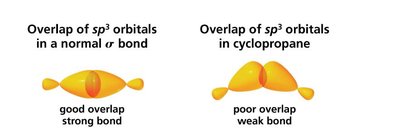
Angle Strain: Arises when bond angles are forced away from their ideal values, causing destabilization.
Example: Cyclopropane exhibits significant angle strain due to its 60° bond angles, far from the ideal tetrahedral angle of 109.5°.
Cyclohexane Conformations
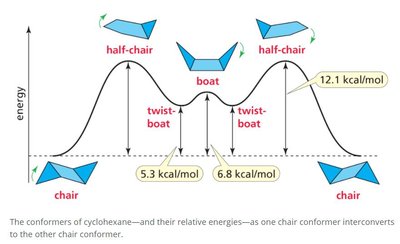
Cyclohexane adopts several conformations, with the chair conformation being the most stable due to minimized torsional and angle strain. Other conformations, such as the boat and twist-boat, are higher in energy due to increased strain.
Chair Conformation: All bond angles are close to 109.5°, and all hydrogens are staggered, minimizing strain.
Boat Conformation: Contains both torsional and steric strain, making it less stable.
Twist-Boat and Half-Chair: Intermediate conformations with varying degrees of strain.
The energy profile for cyclohexane conformational interconversion shows that the chair is the lowest energy form, while the boat and half-chair are much higher in energy.
Axial and Equatorial Positions in Cyclohexane
In the chair conformation, each carbon atom has one axial and one equatorial bond. Substituents prefer the equatorial position to minimize steric interactions, especially 1,3-diaxial interactions.
Axial Bonds: Point straight up or down relative to the ring plane.
Equatorial Bonds: Extend outward, roughly parallel to the ring plane.
Chair Flip: Interconverts axial and equatorial positions, affecting the stability of substituted cyclohexanes.
Example: Substituted cyclohexanes with bulky groups in the axial position experience destabilizing 1,3-diaxial interactions.
1,3-Diaxial Interactions and Gauche Interactions
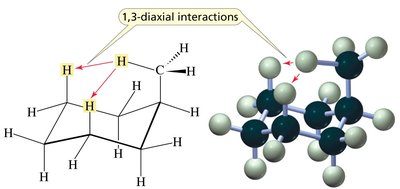
1,3-diaxial interactions occur when axial substituents on cyclohexane are close enough to interact sterically with other axial hydrogens or groups. This is analogous to gauche interactions in acyclic alkanes, where two groups are separated by a 60° dihedral angle.
Energy Cost: Each methyl/hydrogen 1,3-diaxial interaction costs approximately 0.9 kcal/mol.
Gauche Interaction: In butane, a methyl/methyl gauche interaction also costs about 0.9 kcal/mol.
Example: The equilibrium between axial and equatorial methylcyclohexane is governed by the number of 1,3-diaxial interactions.
Relative Energies of Substituted Cyclohexanes
The preference for substituents to occupy the equatorial position is quantified by the Gibbs free energy difference () between axial and equatorial conformers. Larger substituents have greater preference for the equatorial position due to increased steric strain in the axial position.
Formula:
Table of Substituent Preferences: (Values are approximate and may be inferred from the notes)
R group | (kcal/mol) |
|---|---|
–CH3 | -1.8 |
–F | -0.26 |
–CH2CH3 | -1.85 |
–Cl | -0.48 |
–CH(CH3)2 | -2.15 |
–Br | -0.43 |
–C(CH3)3 | -4.9 |
–I | -0.46 |
Example: tert-Butyl groups have a much greater preference for the equatorial position compared to methyl or isopropyl groups due to their size.
Isomerism in Cyclohexanes
Cyclohexanes can exhibit several types of isomerism:
Structural Isomers: Different connectivity of atoms.
Stereoisomers: Same connectivity, different spatial arrangement.
Conformational Isomers: Interconverted by rotation about single bonds (e.g., chair and boat forms).
Configurational Isomers: Cannot be interconverted by bond rotation (e.g., cis/trans isomers).
Geometrical Isomers: Isomerism at a double bond or ring, such as cis/trans 1,4-dimethylcyclohexane.
Example: Cis/trans labeling is especially useful for disubstituted cyclohexanes, where substituents are on the same or opposite sides of the ring.
Summary Table: Types of Isomerism
Type | Definition | Example |
|---|---|---|
Structural Isomers | Different connectivity | Butane vs. isobutane |
Stereoisomers | Same connectivity, different arrangement | Cis/trans cyclohexane |
Conformational Isomers | Interconverted by bond rotation | Chair/boat cyclohexane |
Configurational Isomers | Cannot be interconverted by bond rotation | Cis/trans 1,4-dimethylcyclohexane |
Practice and Application
Students should be able to:
Draw and label chair conformations, indicating axial and equatorial positions.
Assign relative energies to conformers and predict equilibrium constants for chair flips.
Identify and explain the effects of substituents on cyclohexane stability.
Classify isomers and understand their interconversion.
