 Indietro
Conjugated Systems: Structure, Stability, and Reactivity
Guida di studio - Note intelligenti
 Appunti personalizzati basati sui tuoi materiali, ampliati con definizioni chiave, esempi e contesto.
Conjugated Systems
Introduction to Conjugation
Conjugated systems are a fundamental topic in organic chemistry, involving molecules with alternating double and single bonds. These arrangements allow for electron delocalization, which imparts unique stability and reactivity to the compounds.
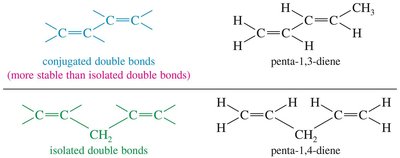
Conjugated double bonds are separated by one single bond, as seen in 1,3-pentadiene.
Isolated double bonds are separated by two or more single bonds, as in 1,4-pentadiene.
Cumulated double bonds are on adjacent carbons, such as 1,2-pentadiene.
Conjugated double bonds are more stable than isolated double bonds due to electron delocalization.
Stability of Conjugated Alkenes
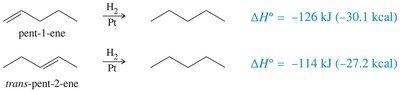
The stability of alkenes can be compared using heats of hydrogenation. Conjugated alkenes release less heat upon hydrogenation, indicating greater stability.
Heats of hydrogenation measure the energy released when hydrogen is added to a double bond.
The lower the heat released, the more stable the alkene.
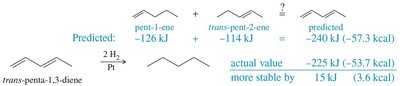
Conjugated double bonds have a heat of hydrogenation less than the sum of individual double bonds, showing extra stability.
Resonance Energy
Resonance energy, also known as stabilization or delocalization energy, quantifies the extra stability gained from electron delocalization in conjugated systems.
Resonance energy is the difference between the actual and predicted heats of hydrogenation.
For trans-1,3-pentadiene, the resonance energy is 15 kJ/mol.
Structure and Conformations of 1,3-Butadiene
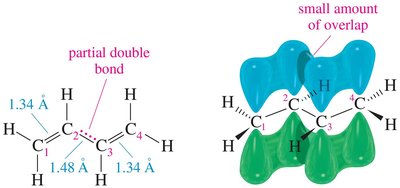
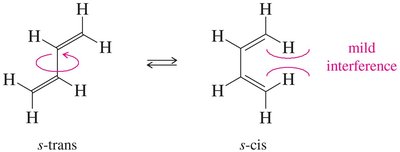
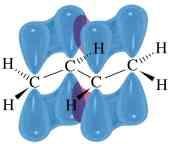
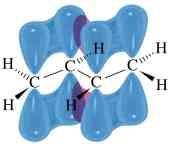
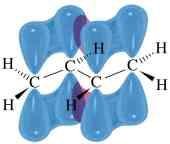
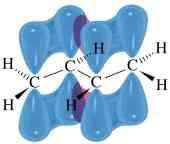
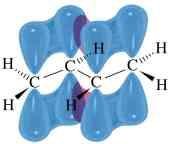
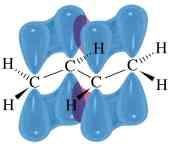
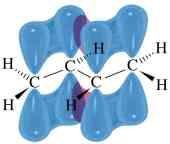
1,3-Butadiene is a prototypical conjugated diene. Its most stable conformation is planar, allowing maximum overlap of p orbitals and electron delocalization.
The single bond between the double bonds is shorter than a typical single bond (1.54 Å), indicating partial double bond character.
Electrons are delocalized across the molecule.
The s-trans conformer is more stable than the s-cis by 12 kJ/mol.
Conformers interconvert easily at room temperature.
Allylic Position and Allylic Cations
The Allylic Position
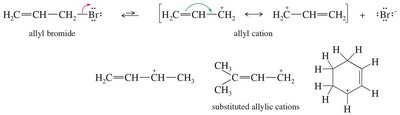
The allylic position refers to the carbon atom directly attached to an sp2 carbon in a double bond. This position is important for reactivity and stability in organic molecules.
Allylic carbons are found in compounds like allyl bromide, allyl alcohol, and allylbenzene.
Allylic cations are stabilized by resonance.

Stability of Allylic Cations
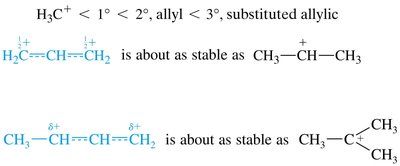
Allylic cations are more stable than nonconjugated carbocations due to resonance stabilization.
The positive charge is delocalized over two carbons.
Stability order: 1° allylic ≈ 2° carbocation; 2° allylic ≈ 3° carbocation.
Electrophilic Addition to Conjugated Dienes
1,2- and 1,4-Addition
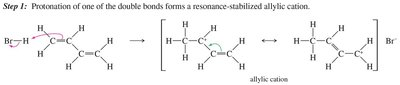
Electrophilic addition to conjugated dienes can yield two products: 1,2-addition and 1,4-addition. The intermediate formed is a resonance-stabilized allylic cation.
Nucleophile can add to either carbon 2 or 4, both bearing delocalized positive charge.
Example: Addition of HBr to buta-1,3-diene produces 3-bromobut-1-ene (1,2-addition) and 1-bromobut-2-ene (1,4-addition).
Kinetic vs. Thermodynamic Control
Reaction Control in Diene Addition
The outcome of addition reactions to conjugated dienes depends on temperature and the stability of intermediates and products.
Kinetic control (low temperature): The product that forms fastest (usually 1,2-addition) predominates.
Thermodynamic control (higher temperature): The most stable product (usually 1,4-addition) predominates after equilibrium is established.
Transition state for 1,2-addition has lower activation energy.
At higher temperatures, reversibility allows formation of the more stable (thermodynamic) product.
Allylic Radicals and Substitution
Stability and Formation of Allylic Radicals
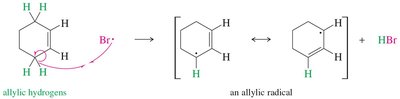
Allylic radicals are stabilized by resonance and are important intermediates in free radical reactions.
Stability order: 1° < 2° < 3° < 1° Allylic.
Substitution at the allylic position competes with addition to C=C double bonds.
Free radical formation is encouraged by light, heat, or peroxides.

Bromination Using NBS
N-Bromosuccinimide (NBS) is used to maintain a low, constant concentration of Br2 for selective allylic bromination.
NBS reacts with HBr by-product to regenerate Br2 and prevent unwanted addition reactions.
SN2 Reactions of Allylic Halides
Enhanced Reactivity of Allylic Halides
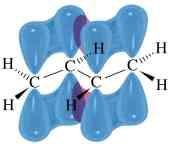
Allylic halides undergo SN2 reactions more rapidly than non-allylic halides due to stabilization of the transition state by conjugation.
Transition state is stabilized by overlap with p orbitals of the pi bond.
Lower activation energy leads to faster substitution reactions.
SN2 Reactions with Organometallics
Allylic halides and tosylates react efficiently with Grignard reagents and organolithiums, forming new carbon-carbon bonds.
Example:
Summary Table: Stability of Carbocations
The following table summarizes the relative stabilities of various carbocations, including allylic and substituted allylic types.
Carbocation Type | Relative Stability |
|---|---|
1° Alkyl | Least stable |
2° Alkyl | Moderately stable |
3° Alkyl | Most stable (non-allylic) |
1° Allylic | ≈ 2° Alkyl |
2° Allylic | ≈ 3° Alkyl |
Substituted Allylic | Most stable (overall) |
Practice and Application
Understanding conjugated systems is essential for predicting reactivity, product distribution, and stability in organic reactions. Key applications include electrophilic addition, free radical substitution, and nucleophilic substitution at allylic positions.
