 Indietro
Electrons, Bonds, and Molecular Properties: Foundations of Organic Chemistry
Guida di studio - Note intelligenti
 Appunti personalizzati basati sui tuoi materiali, ampliati con definizioni chiave, esempi e contesto.
Drawing and Representing Chemical Structures
Introduction to Chemical Structure Representation
Organic chemists use several conventions to represent molecules, each providing different levels of detail about atomic connectivity and geometry. Understanding these representations is essential for interpreting and communicating molecular structures.
Molecular Formula: Lists the number and type of atoms (e.g., C4H10O for 1-butanol) but does not show connectivity.
Lewis Structure: Shows all atoms, bonds, and lone pairs, explicitly indicating connectivity and electron pairs.
Condensed Structure: Groups atoms to show connectivity without drawing all bonds (e.g., CH3(CH2)2CH2OH).
Bond-Line (Skeletal) Structure: Simplifies organic molecules by representing carbon atoms at line ends and vertices, omitting most hydrogens except those on heteroatoms.
Heteroatoms (non-carbon, non-hydrogen atoms such as O, N, Cl) and hydrogens attached to them are always shown explicitly.
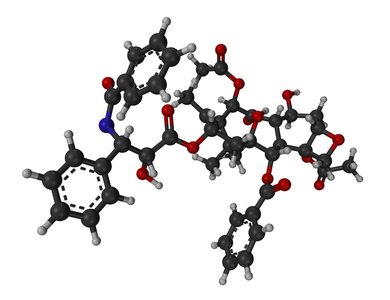
Example: Paclitaxel (Taxol) is a complex molecule used in cancer treatment, illustrating the need for simplified structural representations in organic chemistry.
Solid and Hatched Wedge Bonds
To depict three-dimensionality:
Solid wedge: Bond projects toward the viewer.
Hashed wedge: Bond projects away from the viewer.
Line: Bond lies in the plane of the paper.
This notation is crucial for representing stereochemistry and chirality.
Constitutional Isomers
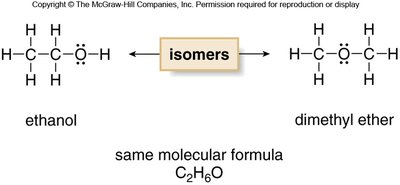
Constitutional isomers are compounds with the same molecular formula but different connectivity of atoms. For example, ethanol and dimethyl ether both have the formula C2H6O but differ in structure and properties.
Atomic Structure
Basic Atomic Model
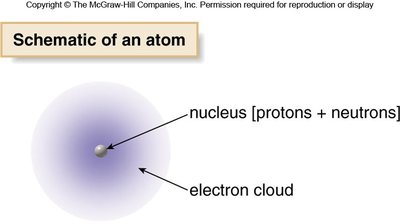
Atoms consist of a dense nucleus (protons and neutrons) surrounded by an electron cloud. Electrons occupy shells and subshells (orbitals) around the nucleus.
Atomic number (Z): Number of protons (equals electrons in a neutral atom).
Atomic mass: Number of protons plus neutrons.
Valence shell: Outermost electron shell, determines chemical reactivity.
The Periodic Table and Electron Configuration
The periodic table organizes elements by increasing atomic number. Elements in the same column (group) have similar valence electron configurations and chemical properties.
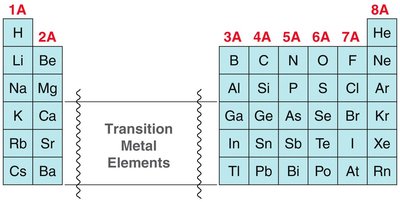
Row number = number of electron shells.
Column number = number of valence electrons (for main group elements).
Atomic Orbitals
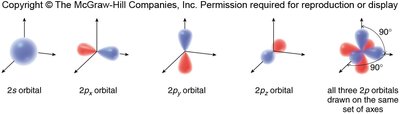
Electrons occupy orbitals, which are regions of space with high probability of finding an electron. The main types are:
s orbital: Spherical, lower in energy.
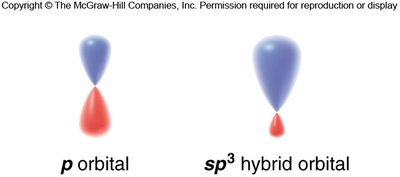
p orbital: Dumbbell-shaped, contains a node at the nucleus, higher in energy than s orbitals in the same shell.
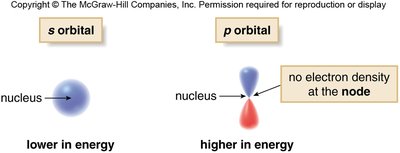
Each orbital can hold a maximum of two electrons.
Electron Configuration in the First and Second Rows
First row elements (H, He) fill the 1s orbital. Second row elements fill the 2s and 2p orbitals, with a maximum of eight valence electrons.

Bonding
Ionic and Covalent Bonds
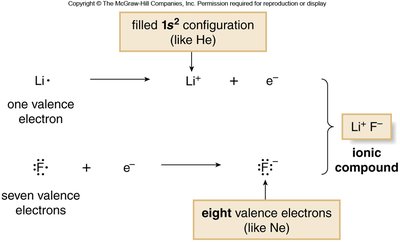
Atoms bond to achieve a stable electron configuration (octet rule for second-row elements):
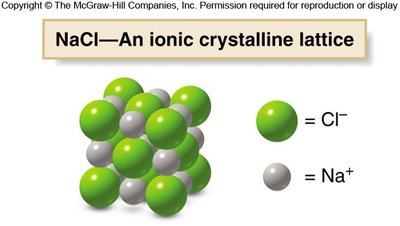
Ionic bonds: Formed by transfer of electrons from one atom to another, resulting in oppositely charged ions (e.g., NaCl).
Covalent bonds: Formed by sharing electrons between atoms (e.g., H2, CH4).
Bonding Patterns and the Octet Rule
Second-row elements form bonds to complete their octet:
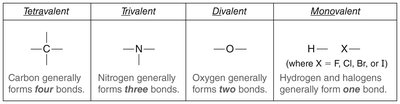
Atoms with 1–4 valence electrons form 1–4 bonds, respectively.
Atoms with 5–7 valence electrons form enough bonds to reach eight electrons (e.g., N forms 3, O forms 2).
Unshared pairs of electrons are called lone pairs.
Lewis Structures
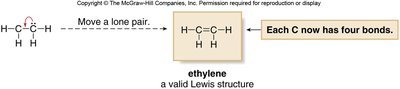
Lewis structures are electron-dot representations showing all valence electrons as bonds or lone pairs. Steps to draw Lewis structures:
Arrange atoms (H and halogens on the periphery).
Count total valence electrons (adjust for charges).
Distribute electrons to satisfy octet/duet rules.
Assign formal charges as needed.
Formal Charge
Formal charge helps identify the most stable Lewis structure. It is calculated as:

Atom | Number of valence electrons | +1 | 0 | -1 |
|---|---|---|---|---|
C | 4 | 3 bonds, 0 lone pairs | 4 bonds, 0 lone pairs | 3 bonds, 1 lone pair |
N | 5 | 4 bonds, 0 lone pairs | 3 bonds, 1 lone pair | 2 bonds, 2 lone pairs |
O | 6 | 3 bonds, 1 lone pair | 2 bonds, 2 lone pairs | 1 bond, 3 lone pairs |
Molecular Geometry & Hybridization
VSEPR Theory and Molecular Shapes
The geometry around an atom is determined by the number of groups (atoms or lone pairs) surrounding it. VSEPR (Valence Shell Electron Pair Repulsion) theory predicts the most stable arrangement is the one that minimizes repulsion.
Number of groups | Geometry | Bond angle |
|---|---|---|
2 | Linear | 180° |
3 | Trigonal planar | 120° |
4 | Tetrahedral | 109.5° |
Hybridization
Hybridization explains observed molecular geometries by combining atomic orbitals to form new, equivalent hybrid orbitals:
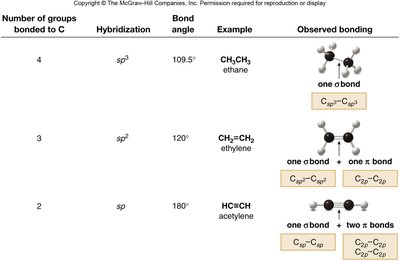
sp3 hybridization: Four groups, tetrahedral geometry (e.g., CH4).
sp2 hybridization: Three groups, trigonal planar geometry (e.g., C2H4).
sp hybridization: Two groups, linear geometry (e.g., C2H2).
Number of groups bonded to C | Hybridization | Bond angle | Example |
|---|---|---|---|
4 | sp3 | 109.5° | CH3CH3 (ethane) |
3 | sp2 | 120° | CH2=CH2 (ethylene) |
2 | sp | 180° | HC≡CH (acetylene) |
Bond Polarity
Electronegativity and Bond Polarity
Electronegativity is an atom's ability to attract electrons in a bond. Differences in electronegativity determine bond polarity:
Nonpolar covalent bond: Electrons shared equally (ΔEN = 0–0.5).
Polar covalent bond: Electrons shared unequally (ΔEN = 0.5–1.7).
Polar bonds have a dipole moment, with δ+ (partial positive) and δ– (partial negative) ends. The arrow points toward the more electronegative atom.
Intermolecular Forces, Melting & Boiling Points, Solubility
Types of Intermolecular Forces
Dipole-dipole interactions: Attractions between polar molecules (e.g., acetone).
Hydrogen bonding: Strong dipole-dipole interaction involving H bonded to N, O, or F.
London dispersion forces: Weak, transient attractions present in all molecules, especially significant in large, nonpolar molecules.
Physical Properties and Solubility
Boiling and melting points increase with stronger intermolecular forces.
"Like dissolves like": Polar compounds dissolve in polar solvents; nonpolar compounds dissolve in nonpolar solvents.
Soap molecules form micelles in water, allowing nonpolar oils to be solubilized and removed.
Summary Table: Common Bonding Patterns
Element | Typical Number of Bonds | Typical Number of Lone Pairs |
|---|---|---|
H | 1 | 0 |
C | 4 | 0 |
N | 3 | 1 |
O | 2 | 2 |
F, Cl, Br, I | 1 | 3 |
Additional info: This guide covers foundational concepts from the first lecture of a college-level Organic Chemistry course, including atomic structure, bonding, molecular geometry, hybridization, and intermolecular forces. These principles are essential for understanding the structure and reactivity of organic molecules.
