 Indietro
Electrophilic Addition Reactions and Stereochemistry of Alkenes
Guida di studio - Note intelligenti
 Appunti personalizzati basati sui tuoi materiali, ampliati con definizioni chiave, esempi e contesto.
The Reactions of Alkenes
Electrophilic Addition Reactions
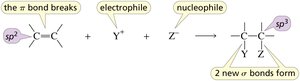
Alkenes undergo addition reactions in which the π bond breaks and two new σ bonds form. These reactions are central to organic synthesis, allowing transformation of alkenes into a variety of functional groups.
Key Point 1: The π bond of the alkene acts as a nucleophile, reacting with an electrophile (Y+) and a nucleophile (Z-).
Key Point 2: The result is the conversion of sp2 hybridized carbons to sp3, with two n l ew substituents added across the double bond.
Example: Addition of HBr to an alkene forms a bromoalkane.
Features of Electrophilic Addition Reactions
All electrophilic addition reactions share common mechanistic features, including the initial attack by the alkene on the electrophile, followed by nucleophilic capture.
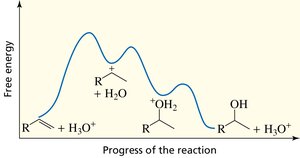
Key Point 1: The rate-limiting step is often the formation of a carbocation intermediate.
Key Point 2: The stability of the carbocation determines the major product.
Addition of Hydrogen Halides
Regioselectivity in Hydrogen Halide Addition
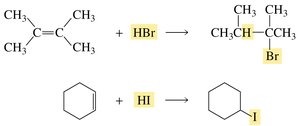
When a hydrogen halide (HX) is added to an alkene, the hydrogen attaches to the less substituted carbon, and the halide attaches to the more substituted carbon. This regioselectivity is governed by carbocation stability.
Key Point 1: The major product forms via the most stable carbocation intermediate.
Key Point 2: Primary carbocations are so unstable that they do not form.
Example: Addition of HBr to 2,3-dimethyl-2-butene yields a tertiary bromoalkane.
Mechanism of Hydrogen Halide Addition
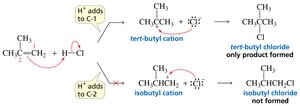
The mechanism involves protonation of the alkene to form a carbocation, followed by nucleophilic attack by the halide ion.
Key Point 1: The formation of the carbocation is the rate-limiting step.
Key Point 2: The regioselectivity is determined by which carbon becomes the carbocation.
Carbocation Stability and Rearrangement
Relative Stabilities of Carbocations
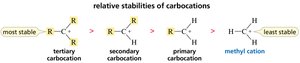
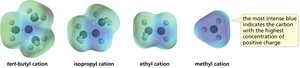
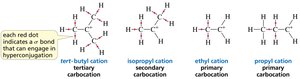
Carbocation stability increases with the number of alkyl groups attached to the positively charged carbon due to inductive effects and hyperconjugation.
Key Point 1: Tertiary carbocations are more stable than secondary, which are more stable than primary, which are more stable than methyl carbocations.
Key Point 2: Alkyl groups decrease the concentration of positive charge on the carbon.
Hyperconjugation
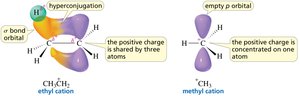
Hyperconjugation is the delocalization of electrons from adjacent σ bonds into the empty p orbital of the carbocation, stabilizing the positive charge.
Key Point 1: More adjacent σ bonds (from alkyl groups) provide greater stabilization.
Key Point 2: The positive charge is shared among more atoms, reducing its concentration.
Stabilization via Orbital Overlap
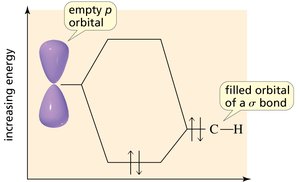
Stabilization is achieved when the orbital of a σ bond overlaps with an empty p orbital, allowing electron delocalization.
Key Point 1: This overlap lowers the energy of the carbocation.
Key Point 2: The more overlap, the greater the stabilization.
The Hammond Postulate
Transition State Structure
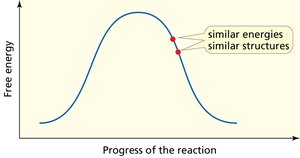
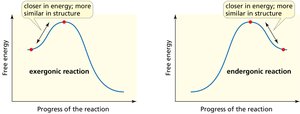
The Hammond Postulate states that the structure of the transition state resembles the species (reactant or product) to which it is closer in energy.
Key Point 1: In exergonic reactions, the transition state resembles the reactants.
Key Point 2: In endergonic reactions, the transition state resembles the products.
Application to Alkene Reactions
When an alkene reacts with H+, the transition state resembles the carbocation. The more stable the carbocation, the faster it forms.
Key Point 1: The major product is determined by the stability of the carbocation intermediate.
Regioselectivity in Electrophilic Addition
Definition and Degrees of Regioselectivity
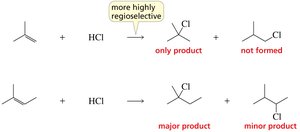
Regioselectivity refers to the preference for the formation of one constitutional isomer over another in a chemical reaction.
Key Point 1: Highly regioselective reactions produce only one product.
Key Point 2: Moderately regioselective reactions produce a mixture, but one product predominates.
Example: Addition of HCl to isobutene yields only tert-butyl chloride.
Rule for Electrophilic Addition
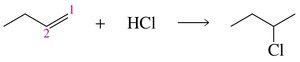
The electrophile adds preferentially to the less substituted sp2 carbon, forming the more stable carbocation.
Key Point 1: This rule explains the major product in most addition reactions.
Acid-Catalyzed Addition of Water
Mechanism and Regioselectivity
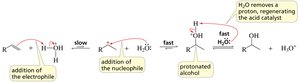
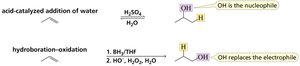
Acid-catalyzed hydration of alkenes forms alcohols, with the OH group attaching to the more substituted carbon.
Key Point 1: The reaction requires an acid catalyst, such as H2SO4.
Key Point 2: The mechanism involves carbocation formation, nucleophilic attack by water, and deprotonation.
Example: Hydration of 2-butene yields 2-butanol.

Biological Hydration Reactions
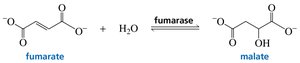
In biological systems, enzymes catalyze hydration reactions, such as the conversion of fumarate to malate in the citric acid cycle.
Key Point 1: Enzymes provide regio- and stereoselectivity.
Example: Fumarase catalyzes the hydration of fumarate.
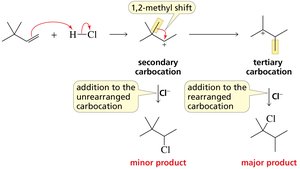
Carbocation Rearrangements
1,2-Hydride and 1,2-Methyl Shifts
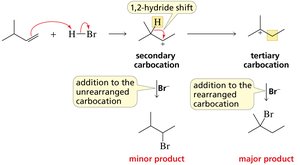
Carbocations can rearrange via hydride or methyl shifts to form more stable carbocations, affecting the product distribution.
Key Point 1: Rearrangement occurs only if it leads to a more stable carbocation.
Example: Hydride shift in the addition of HBr to 3-methyl-2-butene.
Hydroboration–Oxidation
Mechanism and Regioselectivity
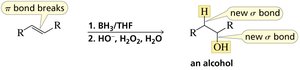
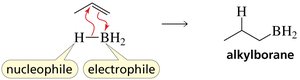
Hydroboration–oxidation converts alkenes to alcohols, with the OH group attaching to the less substituted carbon. The reaction proceeds via syn addition and does not involve carbocation intermediates.
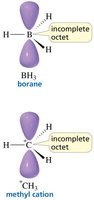
Key Point 1: BH3 acts as an electrophile, adding to the less substituted carbon.
Key Point 2: Oxidation replaces boron with OH.
Example: Hydroboration–oxidation of propene yields 1-propanol.
Summary Table: Carbocation Stability
The following table summarizes the relative stabilities of carbocations based on substitution:
Carbocation Type | Stability |
|---|---|
Tertiary | Most stable |
Secondary | More stable |
Primary | Less stable |
Methyl | Least stable |
Summary Table: Regioselectivity Degrees
The following table summarizes the degrees of regioselectivity in addition reactions:
Degree | Product Distribution |
|---|---|
Moderate | A little more of one product |
High | A lot more of one product |
Complete | Only one product forms |
Key Equations
General Electrophilic Addition:
Carbocation Stability Order:
Hydroboration–Oxidation:
Additional info: These notes expand on the original slides by providing academic context, definitions, and examples for each topic. The tables and equations are inferred from the content and standard organic chemistry knowledge.
