 Indietro
Electrophilic Addition Reactions of Alkenes: Mechanism, Regioselectivity, and Stereochemistry
Guida di studio - Note intelligenti
 Appunti personalizzati basati sui tuoi materiali, ampliati con definizioni chiave, esempi e contesto.
The Reactions of Alkenes
Introduction to Electrophilic Addition
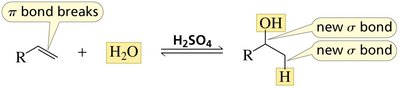
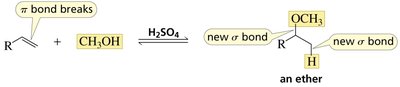
Alkenes are hydrocarbons containing carbon-carbon double bonds, which are sites of high reactivity. The most common reactions of alkenes are electrophilic addition reactions, where the π bond is broken and new σ bonds are formed. These reactions are fundamental in organic synthesis and are governed by both regioselectivity and stereochemistry.
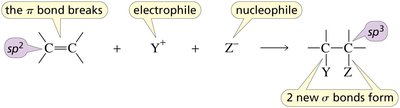
Electrophilic Addition Reactions
Mechanism of Addition of Hydrogen Halides
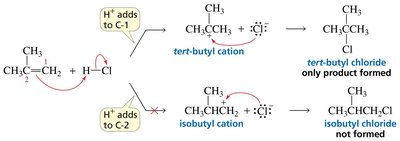
When a hydrogen halide (HX) reacts with an alkene, the π bond acts as a nucleophile and attacks the electrophilic hydrogen, leading to the formation of a carbocation intermediate. The halide then acts as a nucleophile and bonds to the carbocation, forming the final product.
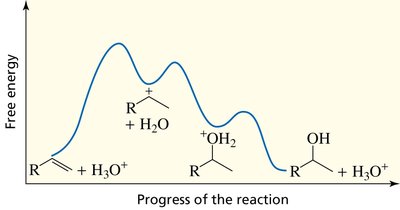
Step 1: Formation of carbocation (rate-limiting step)
Step 2: Nucleophilic attack by halide
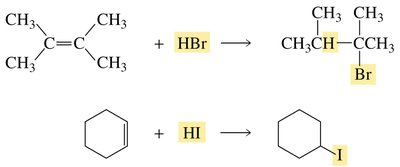
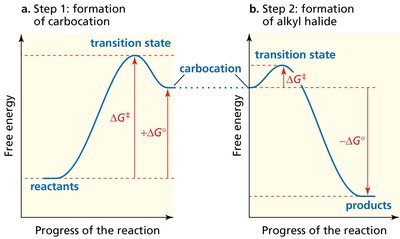
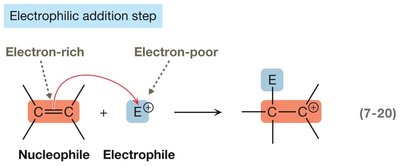
Electrophilic Addition Step
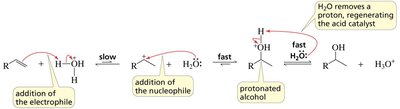
The π bond of the alkene donates electrons to the electrophile (E+), forming a new bond and generating a carbocation intermediate. This step is crucial for understanding the reactivity and selectivity of the reaction.
Regioselectivity in Electrophilic Addition
Markovnikov's Rule and Carbocation Stability
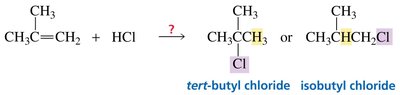
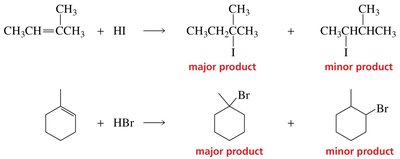
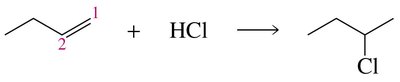
Regioselectivity refers to the preference for the formation of one constitutional isomer over another. In electrophilic addition, the major product is formed by the addition of the electrophile to the less substituted carbon, resulting in the more stable carbocation intermediate. This is known as Markovnikov's Rule.
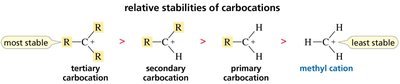
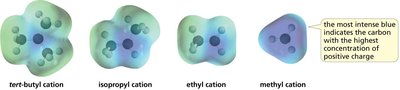
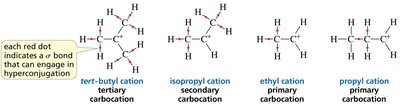
Carbocation stability order: tertiary > secondary > primary > methyl
Major product: Formed via the most stable carbocation
Hyperconjugation and Carbocation Stabilization
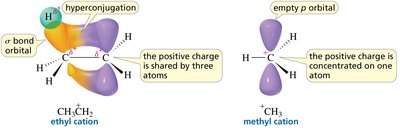
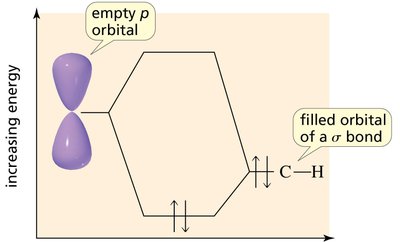
Hyperconjugation is a stabilizing interaction that occurs when σ bonds (usually C-H or C-C) adjacent to the carbocation overlap with the empty p orbital, delocalizing the positive charge. This effect increases with the number of alkyl groups attached to the carbocation center.
The Hammond Postulate
Transition State Structure
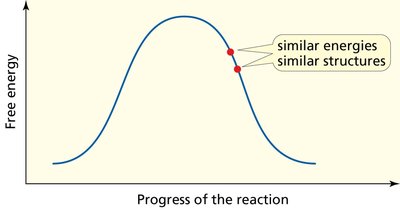
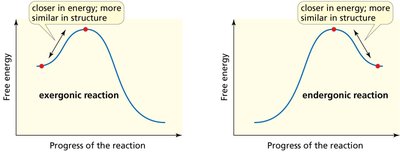
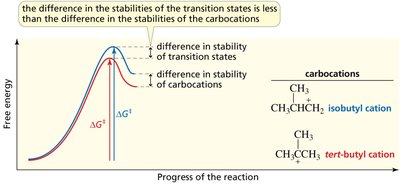
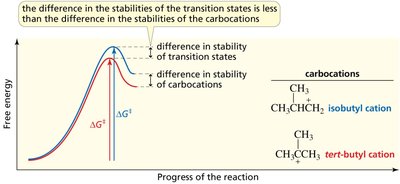
The Hammond Postulate states that the structure of the transition state resembles the species (reactant or product) to which it is closer in energy. In exergonic reactions, the transition state is more like the reactants; in endergonic reactions, it is more like the products.
Exergonic: Transition state resembles reactants
Endergonic: Transition state resembles products
Regioselectivity and Product Formation
Major and Minor Products
The major product of an electrophilic addition reaction is determined by the stability of the carbocation intermediate. Primary carbocations are so unstable that they rarely form, and the reaction is often highly regioselective.

Rule for Electrophilic Addition
The electrophile adds preferentially to the less substituted sp2 carbon, leading to the formation of the more stable carbocation and thus the major product.
Acid-Catalyzed Addition of Water and Alcohol
Hydration of Alkenes
Alkenes do not react with water alone, but in the presence of an acid catalyst (such as H2SO4), they undergo hydration to form alcohols. The mechanism involves the formation of a carbocation intermediate, followed by nucleophilic attack by water and deprotonation.

Biological Hydration Reaction
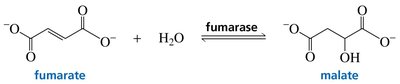
In biological systems, enzymes catalyze hydration reactions. For example, the conversion of fumarate to malate in the citric acid cycle is catalyzed by the enzyme fumarase.
Acid-Catalyzed Addition of Alcohol
Alkenes can also react with alcohols in the presence of acid to form ethers. The mechanism is similar to hydration, involving carbocation intermediates.

Carbocation Rearrangements
1,2-Hydride and 1,2-Methyl Shifts
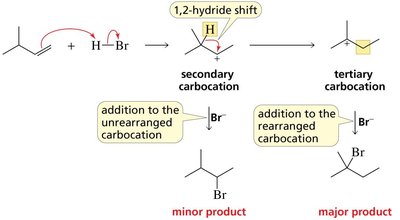
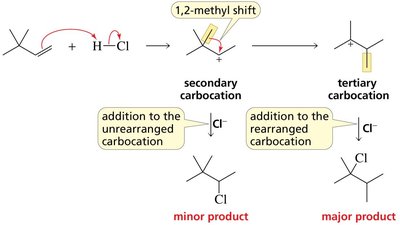
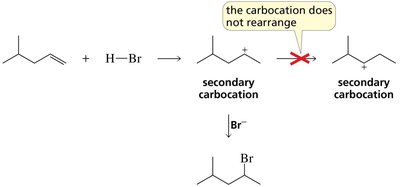
Carbocations can rearrange via 1,2-hydride or 1,2-methyl shifts to form more stable carbocations. This rearrangement affects the major product formed in the reaction.
1,2-Hydride shift: Migration of a hydride ion to the carbocation center
1,2-Methyl shift: Migration of a methyl group to the carbocation center
Regioselective, Stereoselective, and Stereospecific Reactions
Definitions and Examples
Organic reactions can be classified based on the selectivity of product formation:
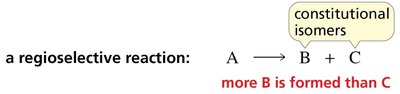
Regioselective: Forms more of one constitutional isomer than another
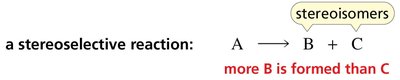
Stereoselective: Forms more of one stereoisomer than another
Stereospecific: Each stereoisomer of the reactant forms a different stereoisomer of the product

Stereochemistry of Addition Reactions
Formation of Chiral Centers and Stereoisomers
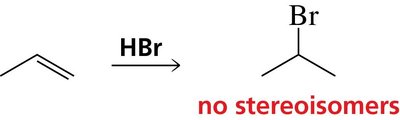
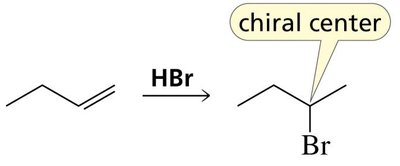
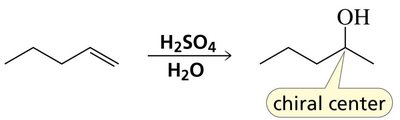
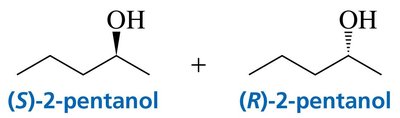
If the product of an addition reaction has a chiral center, it will have stereoisomers. When a reactant without a chiral center forms a product with one chiral center, the product is a racemic mixture.
Why Racemic Mixtures Form
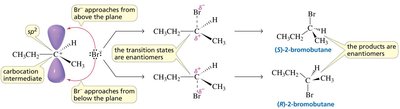
The nucleophile can attack the carbocation intermediate from either side of the plane, leading to the formation of enantiomers.
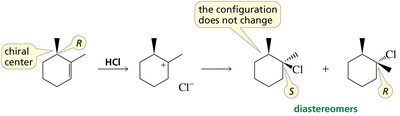
Formation of Diastereomers
If the reactant has a chiral center and the reaction forms a product with a new chiral center, the product will be a pair of diastereomers.
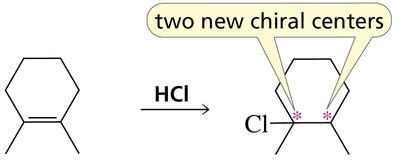
Reactions Forming Two Chiral Centers
When a reaction forms products with two chiral centers, the number and type of stereoisomers depend on the mechanism. If a carbocation intermediate is formed, four stereoisomers can result due to syn and anti addition.
Summary Table: Stereoisomers Formed in Electrophilic Addition
Table 6.1: Stereoisomer Outcomes
The table summarizes the types and numbers of stereoisomers formed when chiral centers are generated in electrophilic addition reactions involving carbocation intermediates.
Reactant | Product | Stereoisomers Formed |
|---|---|---|
No chiral center | One chiral center | Racemic mixture (2 enantiomers) |
One chiral center | Two chiral centers | Pair of diastereomers |
No chiral center | Two chiral centers | Four stereoisomers (2 pairs of enantiomers) |
Learning Objectives
Name and draw the structure of alkenes
Use curved arrows to identify bond-breaking and bond-making processes
Predict products from electrophilic addition reactions
Identify carbocations that will rearrange
Predict relative stabilities of carbocations
Predict stereoisomers obtained from electrophilic addition reactions involving carbocation intermediates
