 Indietro
Electrophilic Aromatic Substitution and Reactivity of Aromatic Compounds
Guida di studio - Note intelligenti
 Appunti personalizzati basati sui tuoi materiali, ampliati con definizioni chiave, esempi e contesto.
Reactions of Aromatic Compounds
Electrophilic Aromatic Substitution (EAS)
Electrophilic Aromatic Substitution is a fundamental reaction type for aromatic compounds, where an electrophile replaces a hydrogen atom on the aromatic ring. The aromatic system is preserved throughout the process, making these reactions distinct from typical addition reactions to alkenes.
Arene (Ar-H): Generic term for aromatic hydrocarbons.
Aryl group (Ar): Derived from arenes by removal of a hydrogen atom.
Electrophile: Species with a full or partial positive charge that attacks the aromatic ring.
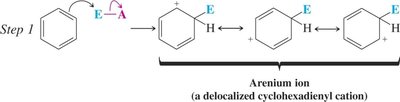
General Mechanism of EAS: Arenium Ion Intermediates
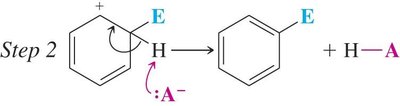
The mechanism involves two main steps:
Step 1: The aromatic ring uses two π electrons to react with the electrophile, forming an arenium ion (a delocalized cyclohexadienyl cation).
Step 2: A proton is removed from the arenium ion, regenerating the aromatic system.
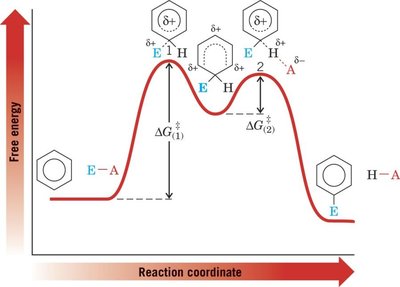
Energy Profile of EAS
The first step (formation of the arenium ion) is highly endothermic and rate-determining due to loss of aromaticity.
The second step (regeneration of aromaticity) is highly exothermic and fast.
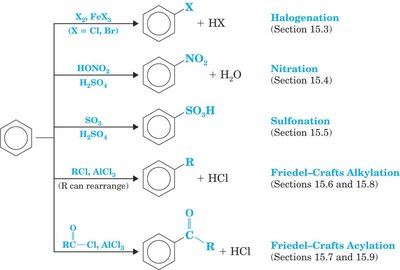
Major Electrophilic Aromatic Substitution Reactions
Halogenation of Benzene
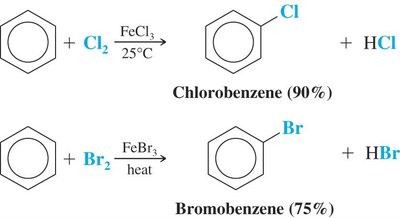
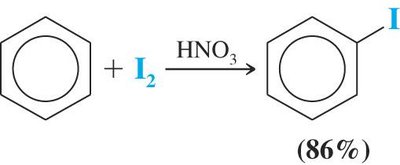
Halogenation requires a Lewis acid catalyst (e.g., FeCl3 or FeBr3) to generate the electrophilic halogen species. Fluorination is too rapid, and iodination requires special conditions.
Mechanism of Bromination
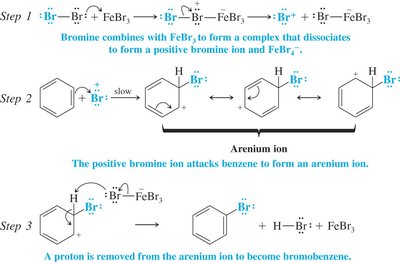
Bromine reacts with FeBr3 to form a positive bromine ion.
The bromine ion attacks benzene, forming an arenium ion.
A proton is removed, regenerating aromaticity and FeBr3.
Nitration of Benzene
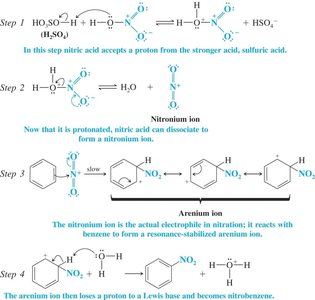
Nitration uses a mixture of concentrated nitric and sulfuric acids. The electrophile is the nitronium ion (NO2+).
Sulfonation of Benzene
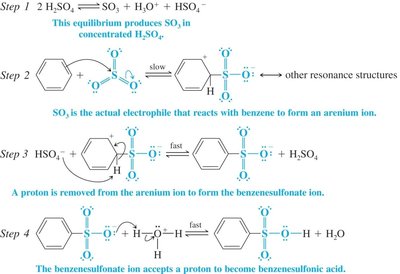
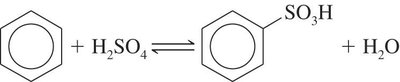
Sulfonation is performed with fuming sulfuric acid (contains SO3) or concentrated sulfuric acid. The reaction is reversible and equilibrium-driven.
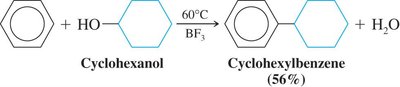
Friedel-Crafts Alkylation
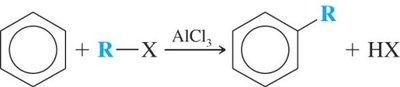
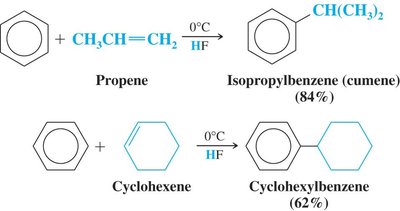
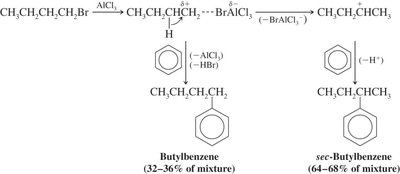
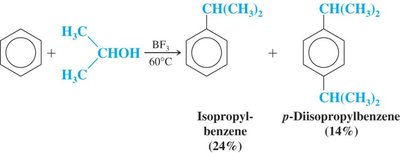
Alkylation of benzene is achieved using alkyl halides and a Lewis acid (AlCl3). Carbocation intermediates are generated, and primary alkyl halides may not form discrete carbocations.
Friedel-Crafts Acylation
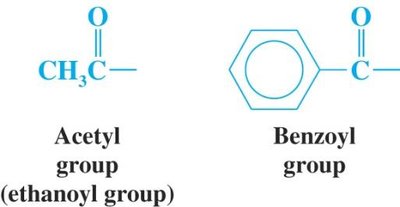
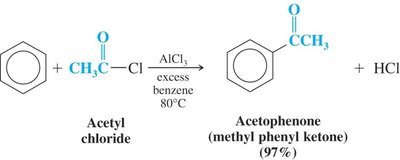
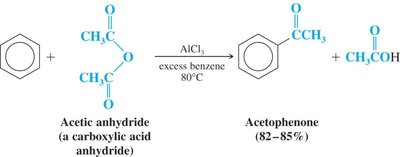
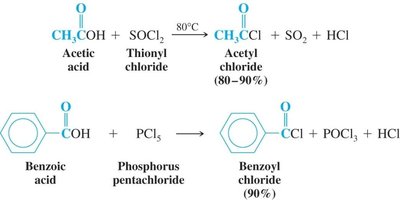
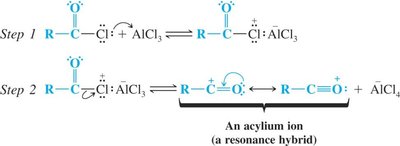
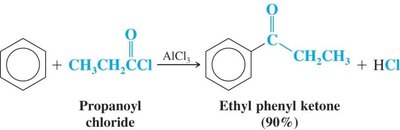
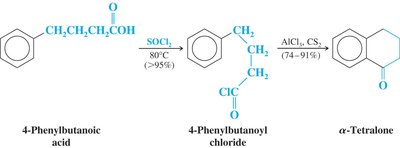
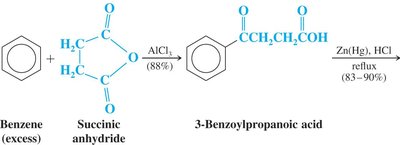
Acylation uses acid chlorides or anhydrides with AlCl3 to introduce acyl groups onto the aromatic ring. The electrophile is the acylium ion, stabilized by resonance.
Limitations of Friedel-Crafts Reactions
Carbocation rearrangement can occur, leading to mixtures of products.
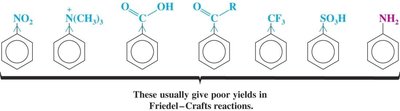
Strong electron-withdrawing groups and amino groups reduce reactivity.
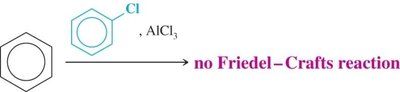
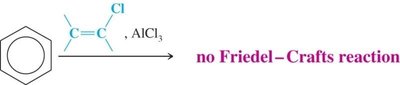
Aryl and vinyl halides do not undergo Friedel-Crafts reactions.
Polyalkylation is common, but polyacylation is not.
Synthetic Applications: Clemmensen Reduction
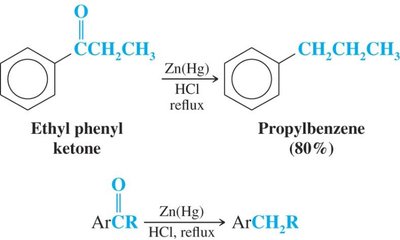
Clemmensen reduction converts phenyl ketones to methylene groups, allowing for the synthesis of unbranched alkylbenzenes.
Effects of Substituents on Reactivity and Orientation
Activating and Deactivating Groups
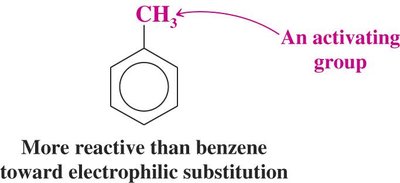
Activating groups: Increase reactivity and are ortho-para directors.
Deactivating groups: Decrease reactivity; strong deactivators are meta directors.
Halides: Mildly deactivating but ortho-para directors.
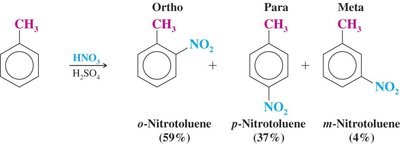
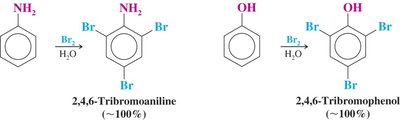
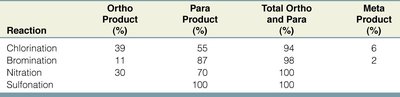
Product Distribution Table
Reaction | Ortho Product (%) | Para Product (%) | Total Ortho and Para (%) | Meta Product (%) |
|---|---|---|---|---|
Chlorination | 39 | 55 | 94 | 6 |
Bromination | 11 | 87 | 98 | 2 |
Nitration | 30 | 70 | 100 | 0 |
Sulfonation | 100 | 0 | 100 | 0 |
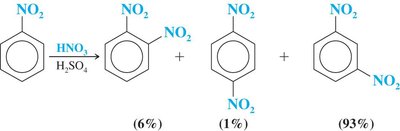
Classification of Substituents
Ortho–Para Directors | Meta Directors |
|---|---|
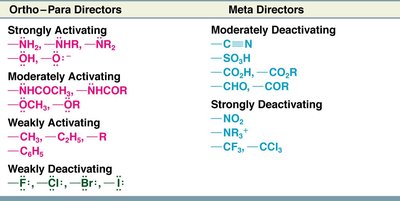
Strongly Activating: –NH2, –NHR, –NR2, –OH, –O– Moderately Activating: –NHCOCH3, –NHCOOR, –OCH3, –OR Weakly Activating: –CH3, –C2H5, –R, –C6H5 Weakly Deactivating: –F, –Cl, –Br, –I | Moderately Deactivating: –C≡N, –SO3H, –CO2H, –CO2R, –CHO, –COR Strongly Deactivating: –NO2, –NR3+, –CF3, –CCl3 |
Theory of Substituent Effects
Reactivity: Electron-Releasing vs. Electron-Withdrawing Groups
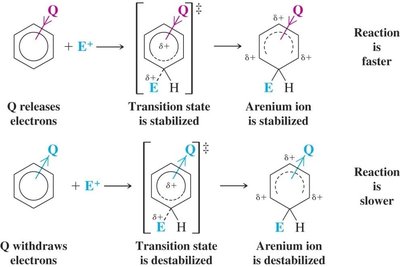
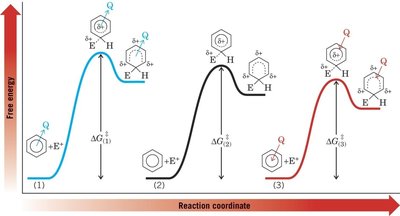
Electron-releasing groups: Stabilize the transition state and arenium ion, lower activation energy, and increase reaction rate.
Electron-withdrawing groups: Destabilize the transition state and arenium ion, raise activation energy, and decrease reaction rate.
Inductive and Resonance Effects
Inductive effect: Polarized bonds to substituents (e.g., halogens) can withdraw electron density, slowing the reaction.
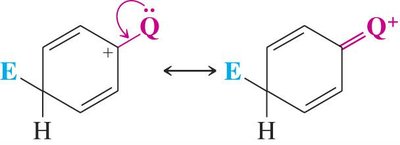
Resonance effect: Lone pairs on substituents can stabilize the arenium ion by contributing additional resonance forms.

Meta-Directing Groups: Mechanism
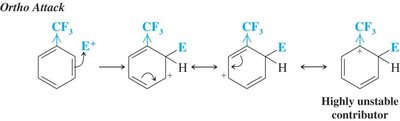
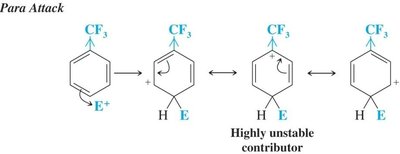
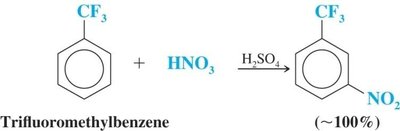
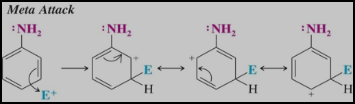
Meta-directing groups have a partial or full positive charge on the atom attached to the ring, destabilizing ortho and para arenium ions.
Meta substitution is favored due to less destabilization.
Ortho-Para Directing Groups
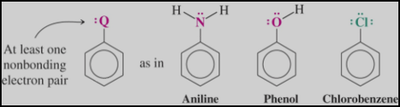
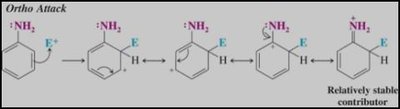
Groups with lone pairs (e.g., –NH2, –OH, –Cl) stabilize the arenium ion in ortho and para substitution via resonance.
These groups are activating and ortho-para directors.
Summary Table: Substituent Effects
Substituent | Effect | Direction |
|---|---|---|
–CH3, –NH2, –OH | Activating | Ortho-Para |
–NO2, –COOH, –SO3H | Deactivating | Meta |
–Cl, –Br | Deactivating | Ortho-Para |
Additional info:
All mechanisms and tables are expanded with academic context for clarity.
Images are included only when directly relevant to the explanation.
