 Indietro
Elimination Reactions: Mechanisms, Alkene Structure, and Stability
Guida di studio - Note intelligenti
 Appunti personalizzati basati sui tuoi materiali, ampliati con definizioni chiave, esempi e contesto.
Elimination Reactions in Organic Chemistry
General Features of Elimination
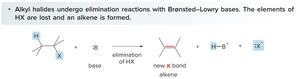
Elimination reactions are fundamental in organic chemistry, involving the removal of elements from a starting material to form a new bond, typically resulting in the formation of an alkene. Alkyl halides undergo elimination with Bronsted–Lowry bases, where the elements of HX are lost and an alkene is produced.
Definition: An elimination reaction removes atoms or groups from adjacent carbons, forming a double bond.
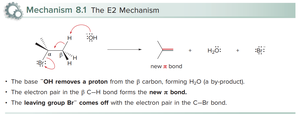
Key Point: The base abstracts a proton, and the leaving group departs, resulting in a new π bond.
Example: Dehydrohalogenation of alkyl halides.
Dehydrohalogenation: β Elimination
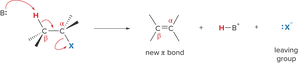
Dehydrohalogenation is a specific type of elimination where HX is removed from an alkyl halide. This process is a β elimination, as the base removes a proton from the β carbon, and the leaving group departs from the α carbon.
Mechanism: Four bonds are broken or formed: C–H, C–X, H–B, and B–X.
Curved Arrow Formalism: Illustrates electron movement during the reaction.
Common Bases for Dehydrohalogenation
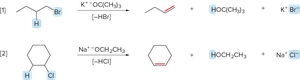
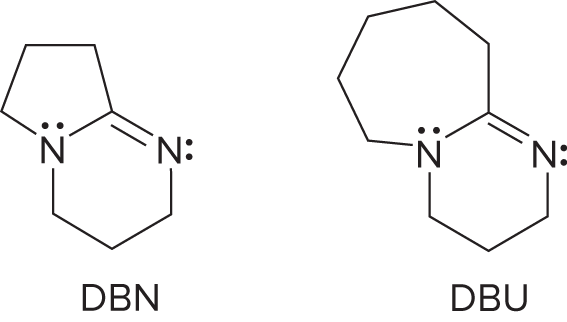
Negatively charged oxygen compounds, such as hydroxide (HO−) and alkoxides (RO−), are commonly used bases in elimination reactions. These bases facilitate the removal of HX from the substrate.
Examples: Sodium ethoxide (NaOCH2CH3), potassium tert-butoxide (KOtBu).
Alkene Structure and Classification
Alkene Hybridization and Geometry
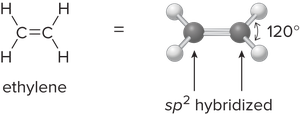
Alkenes are hydrocarbons containing a carbon–carbon double bond. Each carbon in the double bond is sp2 hybridized, resulting in a trigonal planar geometry with bond angles of 120°.
Key Point: The double bond consists of one σ bond and one π bond.
Example: Ethylene (C2H4).
Classification of Alkenes by Substitution
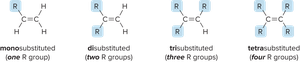
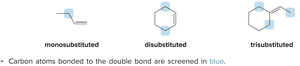
Alkenes are classified based on the number of carbon atoms (R groups) attached to the carbons of the double bond:
Monosubstituted: One R group
Disubstituted: Two R groups
Trisubstituted: Three R groups
Tetrasubstituted: Four R groups
Alkene Stereochemistry and Stability
Restricted Rotation and Stereoisomers
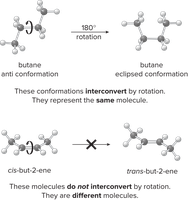
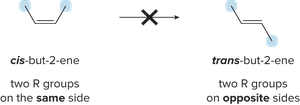
Unlike single bonds, double bonds restrict rotation, leading to the possibility of cis-trans (geometric) isomers. These isomers are diastereomers, not mirror images.
cis Isomer: R groups on the same side
trans Isomer: R groups on opposite sides
Requirements for cis-trans Isomerism
Cis-trans isomerism is possible when each carbon of the double bond has two different groups attached.
Key Point: Both X and X', and Y and Y', must be different for isomerism.

Stability of Trans Alkenes
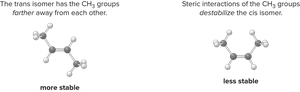
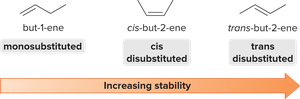
Trans alkenes are generally more stable than cis alkenes due to reduced steric interactions between substituents.
Key Point: Groups are farther apart in trans isomers, minimizing repulsion.
Alkene Stability and Substitution
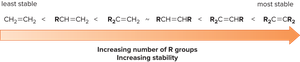
The stability of an alkene increases with the number of alkyl groups (R) attached to the double bond carbons. More substituted alkenes are more stable due to hyperconjugation and electron donation.
Order of Stability: Monosubstituted < Disubstituted < Trisubstituted < Tetrasubstituted
E2 Elimination Mechanism
Mechanism and Kinetics
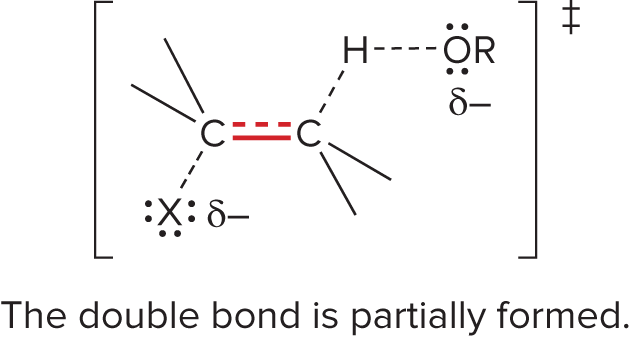
The E2 mechanism is the most common for dehydrohalogenation. It is a concerted, bimolecular process where the base and substrate both participate in the rate-determining step.
Rate Law:
Key Point: All bond breaking and forming occurs in a single step.


Effect of Leaving Group and Solvent
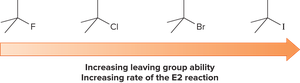
The rate of E2 reactions increases with better leaving groups and in polar aprotic solvents.
Order of Leaving Group Ability: F < Cl < Br < I
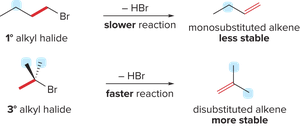
Effect of Alkyl Halide Structure
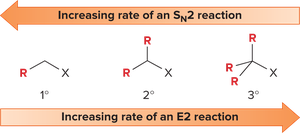
The rate of E2 reactions increases with more alkyl substitution at the carbon bearing the leaving group, due to increased stability of the transition state.
Key Point: Tertiary alkyl halides react faster than primary.
Regioselectivity and Stereoselectivity in E2 Reactions
Zaitsev's Rule and Regioselectivity
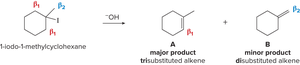
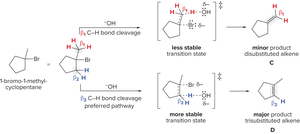
When multiple β hydrogens are available, the E2 reaction is regioselective, favoring the formation of the more substituted (and more stable) alkene, as predicted by Zaitsev's rule.
Major Product: Alkene with the most alkyl substitution.
Stereoselectivity of E2 Reactions
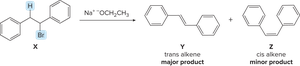
E2 reactions are stereoselective, preferentially forming the more stable stereoisomer when two or more are possible.
Key Point: Trans alkenes are favored over cis alkenes.
E1 Elimination Mechanism
Mechanism and Kinetics
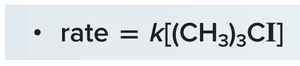
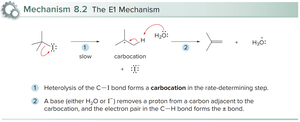
The E1 mechanism proceeds via a two-step process: first, the leaving group departs, forming a carbocation; then, a base removes a proton from the β carbon, forming the double bond. The rate-determining step is unimolecular.
Rate Law:
Key Point: Carbocation intermediate is formed.
Comparison of E2 and E1 Mechanisms
E2: Concerted, bimolecular, strong base required, no carbocation intermediate.
E1: Stepwise, unimolecular, weak base sufficient, carbocation intermediate formed.
Summary Table: Alkene Substitution and Stability
Type of Alkene | Number of R Groups | Stability |
|---|---|---|
Monosubstituted | 1 | Least stable |
Disubstituted (cis) | 2 | More stable |
Disubstituted (trans) | 2 | Most stable among disubstituted |
Trisubstituted | 3 | Even more stable |
Tetrasubstituted | 4 | Most stable overall |
Additional info: This summary integrates key mechanistic and structural concepts from elimination reactions, alkene classification, and stability, providing a comprehensive study guide for Organic Chemistry students.
