 Indietro
Enolate and Enol Chemistry: Reactions at the α-Carbon of Carbonyl Compounds
Guida di studio - Note intelligenti
 Appunti personalizzati basati sui tuoi materiali, ampliati con definizioni chiave, esempi e contesto.
Reactions at the α-Carbon of Carbonyl Compounds
Introduction to Enols and Enolates
Reactions at the α-carbon of carbonyl compounds are fundamental in organic synthesis. These reactions proceed via enol or enolate intermediates, enabling substitution of the α-hydrogen with various electrophiles. The chemistry of enols and enolates is central to understanding the reactivity of carbonyl compounds.
Keto-Enol Tautomerism
Definition and Equilibrium
Tautomers are constitutional isomers that differ in the position of a proton and a double bond. In carbonyl chemistry, the keto form (C=O) and the enol form (C=C–OH) are in equilibrium, a process known as tautomerization. For most simple carbonyl compounds, the equilibrium strongly favors the keto form.
Keto tautomer: Contains a C=O bond and an additional C–H bond.
Enol tautomer: Contains a C=C bond and an O–H group.
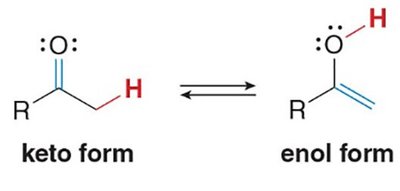
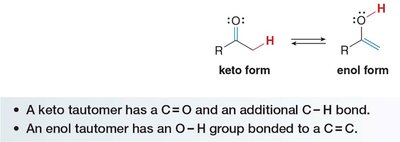
Example: For cyclohexanone, the keto form is present at >99%, while the enol form is <1% at equilibrium.

Mechanism of Tautomerization
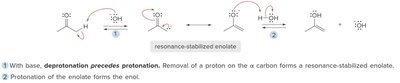
Tautomerization can be catalyzed by acids or bases. Enols are more electron-rich than alkenes due to the resonance donation from the OH group, making them highly reactive toward electrophiles.
Stabilization of Enols: 1,3-Dicarbonyl Compounds
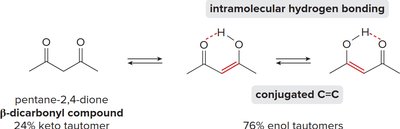
In β-dicarbonyl (1,3-dicarbonyl) compounds, the enol form can be more stable than the keto form due to conjugation and intramolecular hydrogen bonding. This stabilization is especially significant when a six-membered ring is formed.
Enolate Formation and Resonance Stabilization
Formation of Enolates
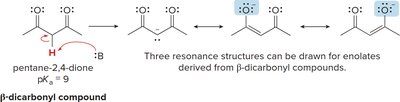
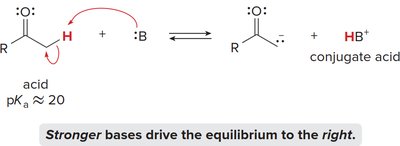
Enolates are formed when a base removes a proton from the α-carbon of a carbonyl compound. The resulting enolate is resonance stabilized, with the negative charge delocalized between the oxygen and the α-carbon.
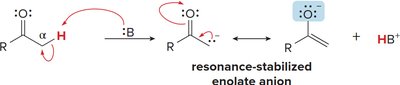
The α C–H bond in carbonyl compounds is more acidic (pKa ≈ 20) than most other sp3 C–H bonds.
Enolate anions are resonance stabilized, unlike alkoxide anions, which localize the negative charge on oxygen.
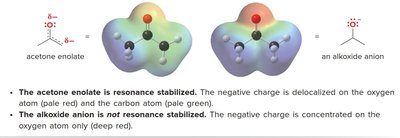
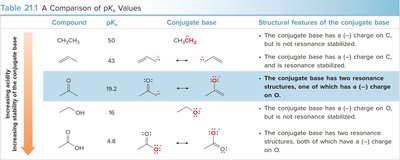
Acidity Comparison
The acidity of α-hydrogens varies with the functional group. β-Dicarbonyl compounds have especially acidic α-hydrogens due to additional resonance stabilization.
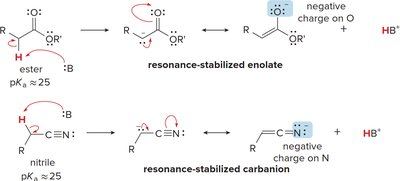
Equilibrium of Enolate Formation
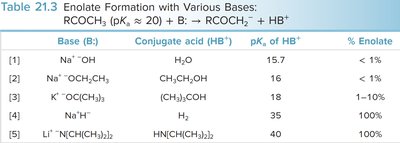
The extent of enolate formation depends on the strength of the base used. Stronger bases drive the equilibrium toward enolate formation.
Lithium Diisopropylamide (LDA)
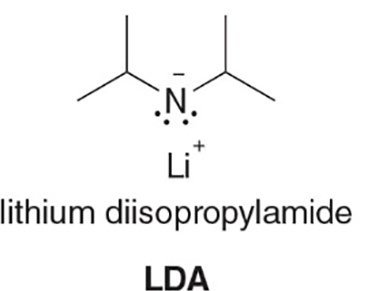
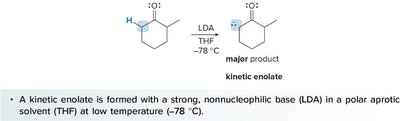
LDA is a strong, non-nucleophilic base commonly used to generate enolates quantitatively, even at low temperatures (−78°C) in THF solvent.
Kinetic vs. Thermodynamic Enolates
Regioselectivity in Enolate Formation
Enolate formation can be controlled to favor either the kinetic (less substituted, forms faster) or thermodynamic (more substituted, more stable) product.
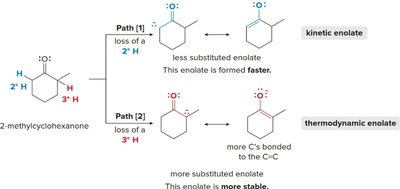
Kinetic enolate: Formed rapidly with a strong, bulky base (e.g., LDA) at low temperature in a polar aprotic solvent.
Thermodynamic enolate: Formed at higher temperature with a strong base, favoring the more substituted, stable enolate.
Reactivity of Enolates
Enolate as a Nucleophile
Enolates react with electrophiles at the α-carbon, enabling a variety of substitution and addition reactions.
Enolates can react with alkyl halides (alkylation) or halogens (halogenation).
They can also react with other carbonyl compounds in condensation reactions.
Halogenation at the α-Carbon
Mechanism and Selectivity
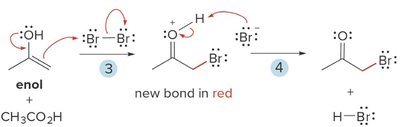
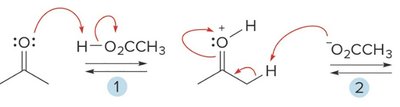
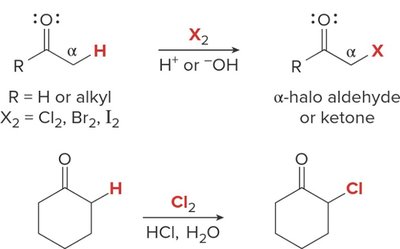
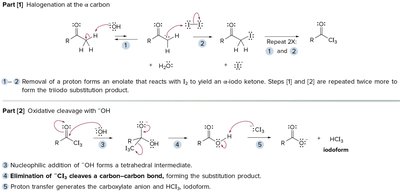
Halogenation can occur under acidic or basic conditions. Acidic halogenation proceeds via enol intermediates, while basic halogenation proceeds via enolate intermediates. In base, it is difficult to stop after the addition of just one halogen atom.

The Haloform Reaction
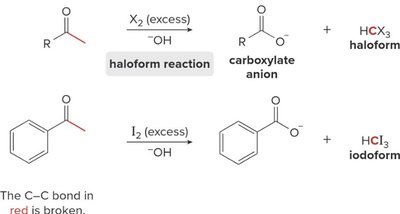
Halogenation of methyl ketones with excess halogen and base leads to cleavage of a C–C bond, forming a carboxylate anion and a haloform (CHX3). This reaction is a diagnostic test for methyl ketones.

Direct Enolate Alkylation
Mechanism and Scope
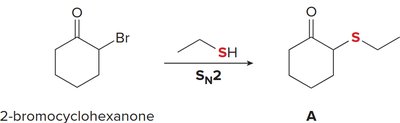
Enolates react with alkyl halides in an SN2 reaction to introduce alkyl groups at the α-carbon. This reaction is regioselective and follows the general rules of SN2 chemistry, favoring less hindered alkyl halides.

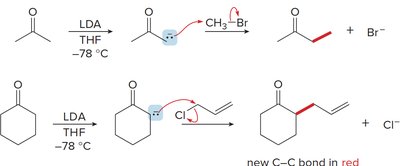
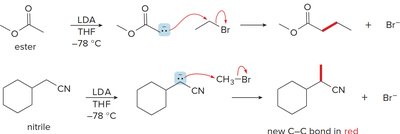
Regioselectivity in Unsymmetrical Ketones
Unsymmetrical ketones can be selectively alkylated to yield either the kinetic or thermodynamic product, depending on the reaction conditions.
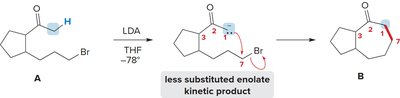
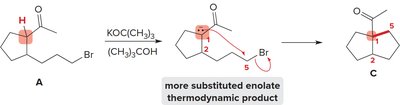
Application: Synthesis of Tamoxifen
Enolate alkylation is used in the synthesis of pharmaceuticals such as tamoxifen, a potent anticancer drug.

Malonic Ester Synthesis
Preparation of Substituted Carboxylic Acids
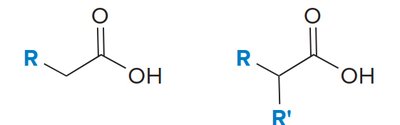
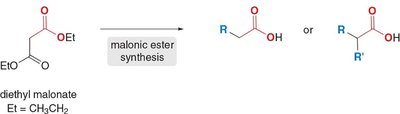
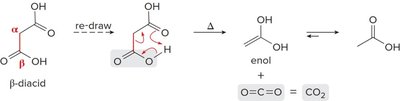
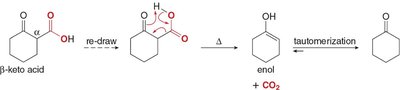
The malonic ester synthesis is a stepwise method for converting diethyl malonate into a carboxylic acid with one or two alkyl groups on the α-carbon. The process involves alkylation, hydrolysis, and decarboxylation.
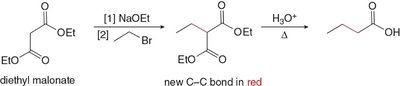
Intramolecular Malonic Ester Synthesis
Intramolecular versions of this reaction can be used to form rings of three to six atoms, provided the appropriate dihalide is used as the starting material.
Acetoacetic Ester Synthesis
Preparation of Methyl Ketones
The acetoacetic ester synthesis converts ethyl acetoacetate into a methyl ketone with one or two alkyl groups on the α-carbon. The process involves alkylation, hydrolysis, and decarboxylation, but the final product is a ketone rather than a carboxylic acid.
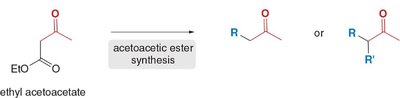
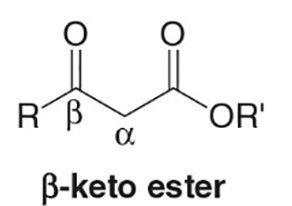


Comparison of Methods for Ketone Synthesis
Both acetoacetic ester synthesis and direct enolate alkylation can prepare similar ketones. Direct enolate alkylation requires a strong base like LDA, while acetoacetic ester synthesis uses NaOEt, which is less expensive and more accessible, though it involves more steps.
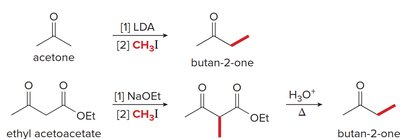
Summary Table: Key Reactions at the α-Carbon
Reaction Type | Intermediate | Product | Key Features |
|---|---|---|---|
Halogenation | Enol/Enolate | α-Halo carbonyl | Multiple halogenations possible in base |
Alkylation | Enolate | α-Alkyl carbonyl | SN2 mechanism, regioselective |
Malonic Ester Synthesis | Enolate | Substituted carboxylic acid | Hydrolysis and decarboxylation |
Acetoacetic Ester Synthesis | Enolate | Substituted methyl ketone | Hydrolysis and decarboxylation |
Additional info: The study of enolate chemistry is foundational for understanding many advanced synthetic strategies in organic chemistry, including aldol reactions, Claisen condensations, and Michael additions.
