 Indietro
Epoxide Formation and Carbonyl Addition Reactions: Mechanisms and Conditions
Guida di studio - Note intelligenti
 Appunti personalizzati basati sui tuoi materiali, ampliati con definizioni chiave, esempi e contesto.
Epoxide Formation and Reactivity
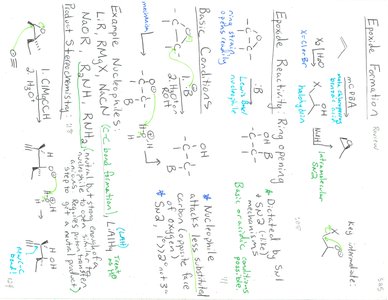
Epoxide Formation: Mechanisms and Conditions
Epoxides are three-membered cyclic ethers formed by the oxidation of alkenes or by intramolecular substitution reactions. Their strained ring structure makes them highly reactive toward nucleophilic attack.
Key Methods of Epoxide Formation:
Intramolecular SN2 Reaction: Halohydrins (compounds containing both a halogen and a hydroxyl group on adjacent carbons) can cyclize under basic conditions to form epoxides.
Oxidation of Alkenes: Alkenes can be converted to epoxides using peroxy acids (e.g., mCPBA).
Example Reaction:
Basic Conditions: The base deprotonates the alcohol, generating an alkoxide that attacks the adjacent carbon bearing the leaving group (halide), forming the epoxide ring.
Epoxide Ring Opening: Reactivity and Mechanism
Epoxides undergo ring-opening reactions with nucleophiles under both acidic and basic conditions. The regioselectivity and stereochemistry of the product depend on the reaction conditions.
Basic Conditions: Nucleophile attacks the less substituted carbon (less hindered site) via an SN2 mechanism.
Acidic Conditions: Protonation of the epoxide oxygen increases electrophilicity; nucleophile attacks the more substituted carbon (more stable carbocation-like transition state).
Example:
Carbonyl Addition Reactions
Nucleophilic Addition to Carbonyls
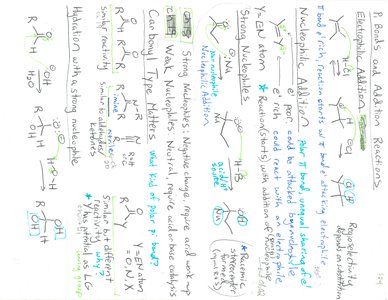
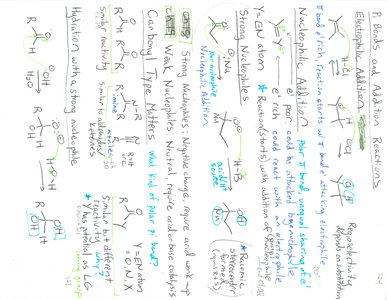
Carbonyl compounds (aldehydes and ketones) are highly reactive toward nucleophilic addition due to the polarization of the C=O bond. The carbonyl carbon is electrophilic, while the oxygen is nucleophilic.
General Mechanism:
Nucleophile attacks the carbonyl carbon, breaking the π bond and forming a tetrahedral intermediate.
Protonation of the oxygen yields the final addition product.
Examples of Nucleophiles:
Strong: (Grignard), , ,
Weak: , , ,
Example Reaction:
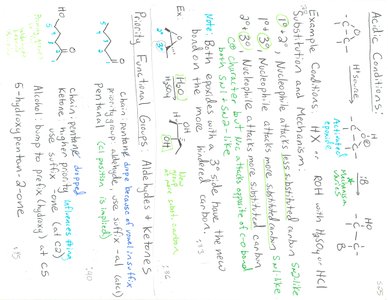
Acidic and Basic Conditions in Carbonyl Addition
The mechanism and outcome of nucleophilic addition to carbonyls depend on whether the reaction is performed under acidic or basic conditions.
Basic Conditions: Nucleophile attacks first, followed by protonation.
Acidic Conditions: Protonation of the carbonyl oxygen increases electrophilicity; nucleophile attacks after activation.
Example: (hemiacetal formation)
Electrophilic Addition to π Bonds
General Mechanism and Regioselectivity
Electrophilic addition reactions involve the addition of electrophiles to π bonds, such as those in alkenes and alkynes. The regioselectivity of the addition is often governed by Markovnikov's rule.
Step 1: Electrophile adds to the π bond, generating a carbocation intermediate.
Step 2: Nucleophile attacks the carbocation, yielding the addition product.
Markovnikov's Rule: The electrophile adds to the carbon with more hydrogens; the nucleophile adds to the more substituted carbon.
Example:
Hydration and Other Addition Reactions
Hydration of alkenes and alkynes introduces water across the π bond, forming alcohols. Other addition reactions include halogenation and hydrohalogenation.
Hydration:
Halogenation:
Summary Table: Nucleophilic Addition to Carbonyls
Condition | Order of Steps | Regioselectivity | Example Nucleophile |
|---|---|---|---|
Basic | Nucleophile attacks first | Less hindered carbon | , |
Acidic | Protonation first | More substituted carbon | , |
Additional info: The notes also briefly mention the use of protecting groups and the importance of stereochemistry in nucleophilic addition reactions, which are crucial for synthetic applications in organic chemistry.
