 Indietro
Esters and Hydrolysis: Structure, Synthesis, and Reactions
Guida di studio - Note intelligenti
 Appunti personalizzati basati sui tuoi materiali, ampliati con definizioni chiave, esempi e contesto.
Esters: Structure, Synthesis, and Naming
Introduction to Esters
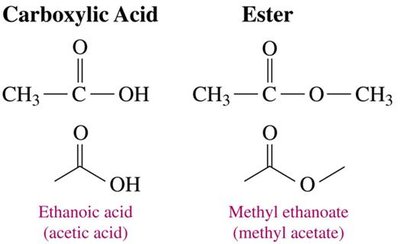
Esters are a class of organic compounds derived from carboxylic acids and alcohols. They are commonly found in fats, oils, and are responsible for the characteristic aromas and flavors of many fruits.
Structure: Esters contain the functional group -COOR, where R is an alkyl group.
Occurrence: Esters are present in natural products such as fruit flavors and fragrances.
Example: Ethanoic acid (acetic acid) reacts with methanol to form methyl ethanoate (methyl acetate).
Esterification: Formation of Esters
Esterification is the process by which esters are synthesized from carboxylic acids and alcohols in the presence of an acid catalyst and heat.
Reaction: The hydroxyl group (–OH) of the carboxylic acid is replaced by the alkyl group from the alcohol.
General Equation:
Example: Ethanoic acid reacts with methanol to produce methyl ethanoate and water.

Example: Esterification of Ethanoic Acid and 1-Propanol
Reaction: Ethanoic acid + 1-propanol → propyl ethanoate + water
Propyl ethanoate: Responsible for the smell of pears.

Naming Esters
Esters are named using a two-part system:
The first word is the alkyl group from the alcohol.
The second word is the carboxylate name from the acid, changing "-ic acid" to "-ate".
Example: Ethyl ethanoate (ethyl acetate), methyl propanoate (methyl propionate), ethyl benzoate.

Esters in Pharmaceuticals and Nature
Esters play important roles in pharmaceuticals and natural products.
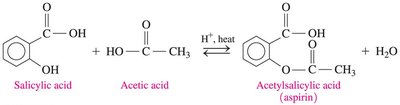
Aspirin: Acetylsalicylic acid is an ester formed from salicylic acid and acetic acid, used as a pain reliever and anti-inflammatory.
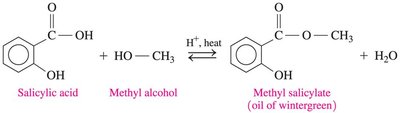
Oil of Wintergreen: Methyl salicylate is an ester with a minty odor, used in skin ointments and as a counter-irritant.
Esters Responsible for Fruit Flavors
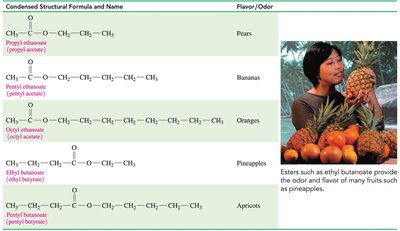
Many esters are responsible for the characteristic flavors and odors of fruits.
Examples: Propyl ethanoate (pears), isoamyl acetate (bananas), octyl ethanoate (oranges), ethyl butanoate (pineapples), propyl butanoate (apricots).
Condensed Structural Formula and Name | Flavor/Odor |
|---|---|
CH3COOCH2CH2CH3 (Propyl ethanoate) | Pears |
CH3COOCH2CH(CH3)2 (Isoamyl acetate) | Bananas |
CH3COOCH2CH2CH2CH2CH2CH2CH3 (Octyl ethanoate) | Oranges |
CH3CH2CH2COOCH2CH3 (Ethyl butanoate) | Pineapples |
CH3CH2CH2COOCH2CH2CH3 (Propyl butanoate) | Apricots |
Hydrolysis of Esters
Acid Hydrolysis
Acid hydrolysis is the reverse of esterification, where an ester reacts with water in the presence of an acid catalyst and heat to produce a carboxylic acid and an alcohol.
General Equation:
Example: Methyl ethanoate reacts with water to produce ethanoic acid and methanol.

Base Hydrolysis (Saponification)
Base hydrolysis, also known as saponification, involves the reaction of an ester with a strong base (such as NaOH) and heat to produce the salt of the carboxylic acid and an alcohol.
General Equation:
Example: Methyl ethanoate reacts with sodium hydroxide to produce sodium ethanoate and methanol.

Summary Table: Esterification and Hydrolysis
Reaction Type | Reactants | Products | Conditions |
|---|---|---|---|
Esterification | Carboxylic acid + Alcohol | Ester + Water | Acid catalyst, heat |
Acid Hydrolysis | Ester + Water | Carboxylic acid + Alcohol | Acid catalyst, heat |
Base Hydrolysis (Saponification) | Ester + Base | Carboxylate salt + Alcohol | Heat |
Practice Problems and Applications
Writing Balanced Equations
Example: Propanoic acid + methanol → methyl propanoate + water
Example: Methyl acetate + water (acid catalyst, heat) → acetic acid + methanol
Example: Methyl acetate + KOH (heat) → potassium acetate + methanol
Drawing Structural Formulas
Example: Condensed structural formula for ethyl propanoate: CH3CH2COOCH2CH3
Example: 3-bromobutanoic acid: BrCH2CH2CH2COOH
Applications
Pharmaceuticals: Aspirin (acetylsalicylic acid) is an ester used for pain relief.
Industry: Saponification is used in soap production.
Biology: Esters are found in fats, oils, and natural flavors.
Additional info: Saponification is a key industrial process for making soaps from fats and oils, which are triglyceride esters.
