 Indietro
Ethers, Epoxides, and Thioethers: Structure, Properties, and Reactions
Guida di studio - Note intelligenti
 Appunti personalizzati basati sui tuoi materiali, ampliati con definizioni chiave, esempi e contesto.
Chapter 14: Ethers, Epoxides, and Thioethers
Introduction to Ethers
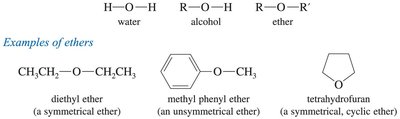
Ethers are organic compounds with the general formula R–O–R', where R and R' can be alkyl or aryl groups. Ethers can be symmetrical (both R groups identical) or unsymmetrical (different R groups). They are important in organic chemistry due to their unique properties and widespread use as solvents.
Definition: Ethers are compounds in which an oxygen atom is bonded to two carbon atoms.
Examples: Diethyl ether (symmetrical), methyl phenyl ether (unsymmetrical), tetrahydrofuran (cyclic ether).
Structure and Polarity of Ethers
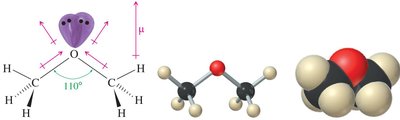
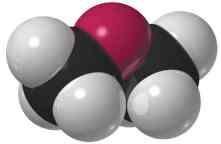
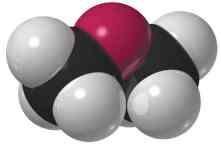
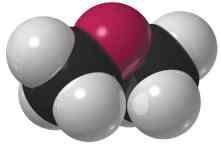
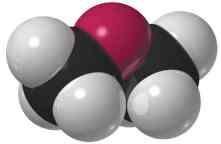
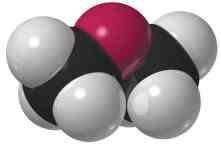
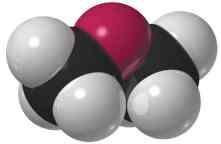
The molecular geometry of ethers is bent due to the sp3 hybridization of oxygen, resulting in a tetrahedral angle. The C–O bonds are polar, contributing to the overall dipole moment of the molecule.
Oxygen Hybridization: Oxygen in ethers is sp3 hybridized.
Bond Angles: The typical bond angle is approximately 110°.
Polarity: Ethers have polar C–O bonds, but the molecule as a whole is less polar than alcohols.
Physical Properties of Ethers
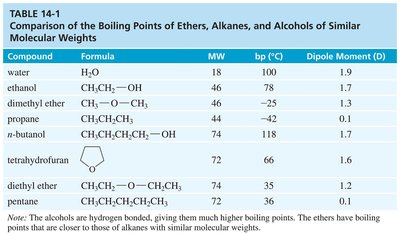
Ethers have boiling points similar to alkanes of comparable molecular weight, which are lower than those of alcohols due to the absence of hydrogen bonding between ether molecules. Ethers possess significant dipole moments, allowing them to dissolve both polar and nonpolar substances.
Boiling Points: Ethers have lower boiling points than alcohols but are similar to alkanes.
Dipole Moments: Ethers have moderate dipole moments, contributing to their solvent properties.
Compound | Formula | Molecular Weight | Boiling Point (°C) | Dipole Moment (D) |
|---|---|---|---|---|
Water | H2O | 18 | 100 | 1.9 |
Ethanol | CH3CH2OH | 46 | 78 | 1.7 |
Dimethyl ether | CH3OCH3 | 46 | -25 | 1.3 |
Propane | CH3CH2CH3 | 44 | -42 | 0.1 |
n-Butanol | CH3CH2CH2CH2OH | 74 | 118 | 1.7 |
Tetrahydrofuran | 72 | 66 | 1.6 | |
Diethyl ether | CH3CH2OCH2CH3 | 74 | 35 | 1.2 |
Pentane | CH3CH2CH2CH2CH3 | 72 | 36 | 0.1 |
Hydrogen Bonding in Ethers
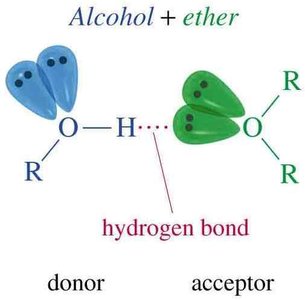
Ethers cannot form hydrogen bonds with themselves, but they can act as hydrogen bond acceptors with compounds containing O–H or N–H bonds. This property influences their boiling points and solubility.
Hydrogen Bond Acceptor: Ethers accept hydrogen bonds from donors such as alcohols and water.
Solubility: Ethers are soluble in water due to their ability to accept hydrogen bonds.
Solvent Properties of Ethers
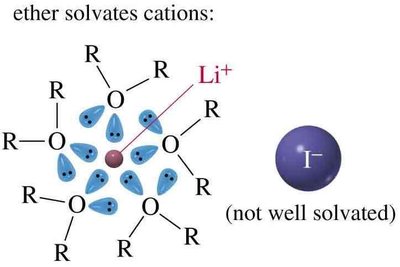
Ethers are widely used as solvents in organic chemistry because they can dissolve both polar and nonpolar substances and are generally unreactive toward strong bases. Their large dipole moments allow them to solvate cations effectively.
Solubility: Nonpolar solutes dissolve better in ethers than in alcohols.
Reactivity: Ethers are unreactive toward strong bases, making them ideal solvents for many reactions.
Cation Solvation: Ethers solvate cations, aiding in the dissolution of ionic compounds.

Ether Complexes
Ethers can form complexes with various reagents, stabilizing them in solution. For example, Grignard reagents are stabilized by ether complexation, and borane (BH3) is stabilized by the nonbonding electrons of ethers.
Grignard Reagents: Ethers stabilize Grignard reagents, keeping them in solution.
Borane Complexes: Ethers stabilize borane through electron donation.
Crown Ether Complexes
Crown ethers are cyclic polyethers that can complex metal cations in the center of the ring. The size of the crown ether determines which cation it can solvate best, allowing polar inorganic salts to dissolve in nonpolar organic solvents.
Host-Guest Relationship: Crown ethers act as hosts, binding metal cations as guests.
Solubility Enhancement: Crown ethers increase the solubility of salts in organic solvents.
Nomenclature of Ethers
Ethers are named using both common and IUPAC systems. Common names list the alkyl groups alphabetically followed by 'ether.' IUPAC names treat the more complex group as the parent alkane and the smaller group as an 'alkoxy' substituent.
Common Names: Alkyl alkyl ether (e.g., diethyl ether, methyl t-butyl ether).
IUPAC Names: Alkoxy alkanes (e.g., 2-methyl-2-methoxypropane, methoxycyclohexane).
Cyclic Ethers and Epoxides
Cyclic ethers are heterocyclic compounds with oxygen in the ring. Epoxides (oxiranes) are three-membered cyclic ethers, while oxetanes, furans, pyrans, and dioxanes are larger ring systems.
Epoxides: Three-membered rings, highly reactive due to ring strain.
Other Cyclic Ethers: Oxetanes (four-membered), furans (five-membered), pyrans (six-membered), dioxanes (six-membered with two oxygens).
Epoxide Nomenclature
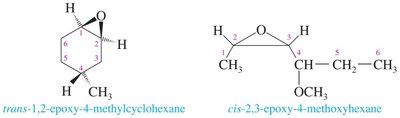
Epoxides are named by adding 'oxide' to the parent alkene or by treating the oxygen as a substituent (epoxy) and specifying its position. The oxirane ring is the parent structure, with substituents named in alphabetical order.
Parent Name: Oxirane ring (oxygen is position 1).
Substituent Naming: Use numbers to specify the position of the epoxy group.
Spectroscopy of Ethers
Ethers exhibit a characteristic C–O stretch in the IR spectrum around 1000–1200 cm–1. If the IR spectrum shows a C–O stretch but lacks C=O or OH stretches, the compound is likely an ether.
IR Spectroscopy: C–O stretch in fingerprint region (1000–1200 cm–1).
Identification: Absence of C=O or OH stretches indicates ether.
Williamson Ether Synthesis
The Williamson ether synthesis is a key method for preparing ethers. It involves an SN2 attack of an alkoxide ion on an unhindered primary alkyl halide or tosylate. Alkoxides are typically generated by reacting alcohols with sodium, potassium, or sodium hydride.
Mechanism: SN2 attack of alkoxide on alkyl halide.
Preparation of Alkoxide: Alcohol + Na, K, or NaH.
Limitations: Works best with primary halides; phenyl halides cannot be used.
Alkoxymercuration-Demercuration
This method uses mercuric acetate and an alcohol to add RO–H to a double bond, forming the Markovnikov product. The reaction is completed by reduction with sodium borohydride.
Reagents: Hg(OAc)2, alcohol, NaBH4.
Product: Markovnikov addition of ether to alkene.
Bimolecular Dehydration of Alcohols
Industrial synthesis of ethers can be achieved by bimolecular dehydration of alcohols using strong acid at elevated temperatures. If the temperature is too high, alkenes may form instead.
Conditions: Acidic, 140°C.
Products: Ethers or alkenes, depending on temperature.
Cleavage of Ethers
Ethers are generally unreactive toward bases, but protonated ethers can undergo substitution reactions with strong acids, resulting in the formation of alkyl halides and alcohols. The reactivity order is HI > HBr >> HCl.
Mechanism: Protonation, followed by SN2 attack by halide.
Products: Alkyl halides and alcohols.
Phenyl Ethers: Phenol is formed and cannot react further to become a phenyl halide.

Autoxidation of Ethers
Ethers can slowly oxidize in the presence of atmospheric oxygen to form hydroperoxides and dialkyl peroxides, which are highly explosive upon heating. Proper storage and handling are essential to prevent accidents.
Products: Hydroperoxides and dialkyl peroxides (ROOR).
Precautions: Do not distill to dryness; store in full bottles with tight caps.
Sulfides (Thioethers) and Thiols
Sulfides (thioethers) are analogs of ethers, with sulfur replacing oxygen. They are named similarly, using 'sulfide' in common names or 'alkylthio' in IUPAC names. Thiols (R–SH) have acidity comparable to phenols, and thiolates are better nucleophiles than alkoxides.
Sulfides: R–S–R', named like ethers.
Thiols: R–SH, acidic like phenols.
Thiolates: Strong nucleophiles, weaker bases than alkoxides.
Sulfide Reactions
Sulfides are easily oxidized to sulfoxides and sulfones. They react with unhindered alkyl halides to give sulfonium salts, which are used as alkylating agents due to their neutral leaving group.
Oxidation: Sulfides → sulfoxides → sulfones.
Alkylation: Formation of sulfonium salts.
Reducing Agents: Sulfides are used as mild reducing agents.
Synthesis of Epoxides
Epoxides can be synthesized by peroxyacid epoxidation or base-promoted cyclization of halohydrins. These methods are important for preparing highly reactive three-membered cyclic ethers.
Peroxyacid Epoxidation: Alkene + peroxyacid → epoxide.
Halohydrin Cyclization: Halohydrin + base → epoxide.
Ring Opening Reactions of Epoxides
Epoxides undergo ring opening reactions under acidic or basic conditions. The orientation of nucleophilic attack depends on the conditions: in base, attack occurs at the least hindered carbon; in acid, attack occurs at the most substituted carbon.
Acid-Catalyzed Opening: Nucleophile attacks the more substituted carbon.
Base-Catalyzed Opening: Nucleophile attacks the less hindered carbon.
Ring Strain: Epoxides are higher in energy due to ring strain, making ring opening thermodynamically favored.
Reactions with Grignard and Organolithium Reagents
Strong bases such as Grignard reagents and organolithium compounds open the epoxide ring by attacking the less hindered carbon, followed by protonation to yield alcohols.
Mechanism: Nucleophilic attack, ring opening, protonation.
Products: Alcohols with extended carbon chains.
Summary
Ethers, epoxides, and thioethers are important classes of organic compounds with distinct structural, physical, and chemical properties. Their reactivity, nomenclature, and synthetic methods are fundamental to organic chemistry, with applications ranging from solvents to reagents and intermediates in synthesis.
