 Indietro
Exam III Review – Organic Chemistry: SN1, Nucleophilicity, and Reaction Mechanisms
Guida di studio - Note intelligenti
 Appunti personalizzati basati sui tuoi materiali, ampliati con definizioni chiave, esempi e contesto.
Q1. Which of the following statements related to SN1 reactions is not true?
Background
Topic: SN1 Reaction Mechanism
This question tests your understanding of the characteristics and steps involved in the SN1 (unimolecular nucleophilic substitution) reaction mechanism.
Key Terms and Concepts:
SN1 Reaction: A two-step substitution reaction involving carbocation formation.
Racemic mixture: Equal amounts of two enantiomers formed when the carbocation intermediate is planar.
Carbocation: An intermediate with a positively charged carbon atom, highly electrophilic.
Polar protic solvent: Solvents that stabilize ions and favor SN1 reactions.
Rate-determining step: The slowest step in a reaction mechanism, controlling the overall rate.
Step-by-Step Guidance
Review each statement and recall the key features of the SN1 mechanism.
Consider which step is actually rate-determining in SN1 reactions (formation of the carbocation or nucleophilic attack?).
Think about the effect of solvent and the stereochemistry of the product.
Identify the statement that does not align with the established SN1 mechanism.
Try solving on your own before revealing the answer!
Final Answer: d. The attack of the nucleophile is the rate determining step
In SN1 reactions, the rate-determining step is the formation of the carbocation intermediate, not the nucleophilic attack. The nucleophile attacks after the carbocation is formed, which is a fast step.
Q2. The reaction of tert-butyl chloride, (CH3)3CCl, with water in an inert solvent gives tert-butyl alcohol, (CH3)3COH. What is the effect of decreasing in three times the concentration of alkyl halide on the rate of the reaction?
Background
Topic: SN1 Reaction Kinetics
This question tests your understanding of how the rate of an SN1 reaction depends on the concentration of the alkyl halide.
Key Terms and Formulas:
Rate Law for SN1:
k: Rate constant
[R-X]: Concentration of the alkyl halide
Step-by-Step Guidance
Recall that the SN1 rate law is first order with respect to the alkyl halide.
Consider what happens to the rate if the concentration of the alkyl halide is decreased by a factor of 3.
Set up the proportional relationship:
Compare the new rate to the original rate to determine the factor by which the rate changes.
Try solving on your own before revealing the answer!
Final Answer: a. the rate decreases by a factor of 3
Since the SN1 reaction is first order in alkyl halide, decreasing its concentration by 3 decreases the rate by 3.
Q3. What is the major organic product obtained from the following reaction?
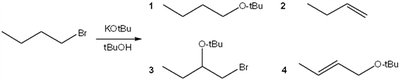
Background
Topic: E2 Elimination vs. Substitution
This question tests your ability to predict the major product when a bulky base (KOtBu) reacts with a primary alkyl halide.
Key Terms and Concepts:
E2 Elimination: A one-step elimination reaction where a base removes a proton and a leaving group departs simultaneously.
Bulky base: Large bases like KOtBu favor less substituted (Hofmann) alkenes due to steric hindrance.
Zaitsev vs. Hofmann product: Zaitsev is the more substituted alkene; Hofmann is the less substituted alkene.
Step-by-Step Guidance
Identify the substrate (1-bromopentane) and the base (KOtBu).
Recall that KOtBu is a bulky base, which tends to favor the Hofmann product (less substituted alkene).
Analyze the possible elimination products and determine which is the less substituted alkene.
Match the structure of the less substituted alkene to the answer choices provided.
Try solving on your own before revealing the answer!
Final Answer: 2
The major product is the less substituted alkene (1-pentene), due to the use of the bulky base KOtBu, which favors the Hofmann product.
Q4. What is the major organic product(s) obtained from the following reaction?
Background
Topic: Alkynes and Elimination Reactions
This question tests your understanding of elimination reactions and the formation of alkynes from dihalides.
Key Terms and Concepts:
Alkyne formation: Double elimination of dihalides can yield alkynes.
Vicinal dihalide: Two halogens on adjacent carbons.
Base-induced elimination: Strong bases can remove two equivalents of HX to form alkynes.
Step-by-Step Guidance
Identify the starting material and the type of elimination (single or double).
Determine if the reaction conditions favor the formation of an internal or terminal alkyne.
Consider the possible products based on the structure of the starting material and the base used.
Match the correct product(s) to the answer choices.
Try solving on your own before revealing the answer!
Final Answer: b. 2-hexyne
Double elimination of a vicinal dihalide with a strong base yields an internal alkyne (2-hexyne).
Q5. Which of the following anions is the most nucleophilic in polar protic solvents?
Background
Topic: Nucleophilicity in Different Solvents
This question tests your understanding of how nucleophilicity trends change in polar protic solvents.
Key Terms and Concepts:
Nucleophilicity: The ability of a species to donate a pair of electrons to an electrophile.
Polar protic solvent: Solvents that can hydrogen bond, stabilizing smaller anions more than larger ones.
Trend: In polar protic solvents, nucleophilicity increases down the group (I− > Br− > Cl− > F−).
Step-by-Step Guidance
Recall the periodic trend for nucleophilicity in polar protic solvents.
Consider how hydrogen bonding affects the nucleophilicity of each halide ion.
Identify which anion is least stabilized (and thus most nucleophilic) in this environment.
Match your reasoning to the answer choices.
Try solving on your own before revealing the answer!
Final Answer: d. I−
Iodide is the most nucleophilic in polar protic solvents because it is least solvated and most available to react.
Q6. Which of the following is the most nucleophilic?
Background
Topic: Nucleophilicity Comparison
This question tests your ability to compare the nucleophilicity of different species, including bases and acids.
Key Terms and Concepts:
Nucleophile: A species that donates an electron pair to form a new bond.
Conjugate base: The deprotonated form of an acid, usually more nucleophilic.
Acid strength: Weaker acids have stronger conjugate bases (more nucleophilic).
Step-by-Step Guidance
Identify which species are neutral and which are negatively charged.
Recall that negatively charged species are generally more nucleophilic than their neutral counterparts.
Compare the basicity and nucleophilicity of the options given.
Determine which is the strongest nucleophile among the choices.
Try solving on your own before revealing the answer!
Final Answer: a. sodium methoxide
Sodium methoxide is a strong nucleophile due to its negative charge and lack of resonance stabilization.
Q7. Which of the following is most likely to undergo rearrangement during reaction with methanol?
Background
Topic: Carbocation Rearrangement in SN1 Reactions
This question tests your understanding of carbocation stability and the likelihood of rearrangement during SN1 reactions.
Key Terms and Concepts:
Carbocation rearrangement: Migration of a hydride or alkyl group to form a more stable carbocation.
SN1 mechanism: Involves carbocation intermediates, which may rearrange for greater stability.
Stability order: Tertiary > Secondary > Primary > Methyl
Step-by-Step Guidance
Examine each structure and identify the type of carbocation that would form after the leaving group departs.
Determine if a more stable carbocation could be formed via hydride or alkyl shift.
Identify which structure is most likely to undergo such a rearrangement.
Match your reasoning to the answer choices.
Try solving on your own before revealing the answer!
Final Answer: 2
Structure 2 forms a secondary carbocation that can rearrange to a more stable tertiary carbocation, making it most likely to undergo rearrangement.
Q8. Which of the following energy diagrams represents the course of an exothermic SN1 reaction?
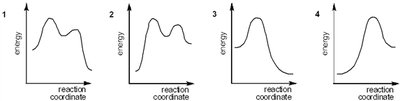
Background
Topic: Reaction Energy Diagrams
This question tests your ability to interpret reaction coordinate diagrams for SN1 reactions, specifically for exothermic processes.
Key Terms and Concepts:
Exothermic reaction: Products are lower in energy than reactants.
SN1 energy profile: Two-step process with a carbocation intermediate, showing two energy maxima (transition states).
Step-by-Step Guidance
Look for a diagram with two peaks (indicating two transition states for SN1).
Check that the final energy (products) is lower than the initial energy (reactants), indicating exothermicity.
Compare the diagrams to see which matches both criteria.
Match your reasoning to the answer choices.
Try solving on your own before revealing the answer!
Final Answer: 1
Diagram 1 shows two transition states and the products lower in energy than the reactants, consistent with an exothermic SN1 reaction.
Q9. Which of the following represents the transition state of the rate-determining step in the reaction between tert-butyl bromide and methanol?
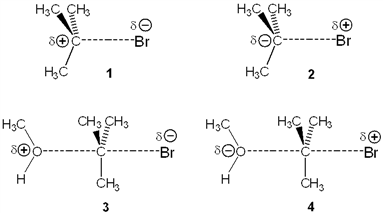
Background
Topic: Transition State Structures in SN1 Reactions
This question tests your ability to recognize the transition state for the rate-determining step (carbocation formation) in an SN1 reaction.
Key Terms and Concepts:
Transition state: The highest energy point along the reaction coordinate for a given step.
Rate-determining step: For SN1, this is the loss of the leaving group to form the carbocation.
Partial bonds: The transition state shows partial breaking of the C–Br bond and partial positive charge on carbon.
Step-by-Step Guidance
Recall that the rate-determining step in SN1 is the departure of the leaving group (Br−) to form a carbocation.
Look for a structure showing a partially broken C–Br bond and a developing positive charge on carbon.
Compare the four structures to see which best represents this transition state.
Match your reasoning to the answer choices.
Try solving on your own before revealing the answer!
Final Answer: 1
Structure 1 shows a partially broken C–Br bond and a partial positive charge on carbon, representing the transition state for carbocation formation in SN1.
Q10. What is the best choice of reagent to perform the following transformation?
Background
Topic: Reagent Selection for Organic Transformations
This question tests your ability to choose the correct reagent for a specific organic transformation, such as elimination or substitution.
Key Terms and Concepts:
Reagent: A substance used to cause a chemical reaction.
Elimination vs. substitution: The choice of reagent determines the reaction pathway.
Strong base: Promotes elimination (E2) reactions.
Step-by-Step Guidance
Analyze the starting material and the desired product.
Determine whether the transformation is an elimination or substitution.
Recall which reagents favor elimination (especially E2) and which favor substitution or addition.
Match the correct reagent to the transformation shown.
Try solving on your own before revealing the answer!
Final Answer: c. NaOCH3
NaOCH3 is a strong base that promotes elimination (E2) to form the desired product.
