 Indietro
Chem 120, Mark Merchant Exam 4 Part 7
Guida di studio - Note intelligenti
 Appunti personalizzati basati sui tuoi materiali, ampliati con definizioni chiave, esempi e contesto.
Fatty Acid Degradation: β-Oxidation
Overview of β-Oxidation
Fatty acids serve as a major stored source of energy, especially when blood glucose levels are low. The process of fatty acid degradation, known as β-oxidation, occurs in the mitochondrial matrix and is stimulated by the hormone glucagon. The pathway is named for the oxidation of the β-carbon (the second carbon from the carbonyl group) of the fatty acid.
Location: Mitochondrial matrix
Trigger: Low blood glucose, glucagon release
Key Step: Oxidation at the β-carbon
Product: Acetyl coenzyme A (AcCoA), which enters the TCA (Krebs) cycle
Example: The β-oxidation pathway is the reverse of fatty acid synthesis, cleaving two-carbon units from the fatty acid chain.
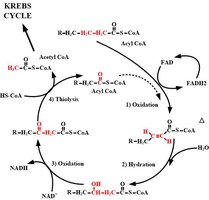
Mechanism and Steps of β-Oxidation
Each round of β-oxidation shortens the fatty acid by two carbons, producing one AcCoA, one NADH, and one FADH2. The α and β carbons are central to the chemistry, with the β-carbon being oxidized.
Step 1: Oxidation by FAD (produces FADH2)
Step 2: Hydration (adds water across the double bond)
Step 3: Oxidation by NAD+ (produces NADH)
Step 4: Thiolysis (cleavage by CoA, releases AcCoA)
This cycle repeats until the entire fatty acid is converted to AcCoA.
Energy Yield from β-Oxidation
Complete oxidation of fatty acids via β-oxidation and the TCA cycle yields significant amounts of ATP. For example, a C18 fatty acid undergoes eight rounds of β-oxidation, generating nine AcCoA molecules.
Each round of β-oxidation: 1 NADH (2.5 ATP), 1 FADH2 (1.5 ATP)
For C18 fatty acid:
8 rounds × 1 NADH × 2.5 ATP = 20 ATP
8 rounds × 1 FADH2 × 1.5 ATP = 12 ATP
Total from β-oxidation: 32 ATP
Energy Yield from the TCA Cycle
AcCoA produced from β-oxidation enters the TCA cycle, where further ATP is generated. Each AcCoA yields:
3 NADH (2.5 ATP each)
1 FADH2 (1.5 ATP)
1 ATP
For C18 fatty acid (9 AcCoA):
9 rounds × 3 NADH × 2.5 ATP = 67.5 ATP
9 rounds × 1 FADH2 × 1.5 ATP = 13.5 ATP
9 rounds × 1 ATP = 9 ATP
Total from TCA cycle: 90 ATP
Total Energy Yield Calculation
The total ATP yield from complete oxidation of a C18 fatty acid is the sum of ATP from β-oxidation and the TCA cycle:
ATP from β-oxidation: 32 ATP
ATP from TCA cycle: 90 ATP
Total ATP: 122 ATP
Formula for ATP yield:
Example: For a C18 fatty acid, total ATP = 32 + 90 = 122 ATP.
Summary Table: Energy Yield from Fatty Acid Oxidation
Process | Rounds | NADH | FADH2 | ATP | Total ATP |
|---|---|---|---|---|---|
β-Oxidation | 8 | 8 × 2.5 = 20 | 8 × 1.5 = 12 | 0 | 32 |
TCA Cycle | 9 | 9 × 3 × 2.5 = 67.5 | 9 × 1 × 1.5 = 13.5 | 9 | 90 |
Total | - | - | - | - | 122 |
Application: Students should be able to calculate energy yields for fatty acids of various lengths using the above principles.
Additional info: The β-oxidation pathway is a key metabolic process in biochemistry and is directly relevant to the organic chemistry of metabolic pathways (Chapter 33).
