 Indietro
Final Exam Review: Chemistry of Life - Key Concepts and Laboratory Techniques
Guida di studio - Note intelligenti
 Appunti personalizzati basati sui tuoi materiali, ampliati con definizioni chiave, esempi e contesto.
Laboratory Safety
General Laboratory Safety Principles
Laboratory safety is essential for preventing accidents and ensuring a safe working environment. Students must be familiar with standard safety protocols before beginning any experiment.
Personal Protective Equipment (PPE): Always wear lab coats, safety goggles, and gloves when handling chemicals.
Proper Handling of Chemicals: Read labels carefully, avoid direct contact, and never taste or smell chemicals unless instructed.
Emergency Procedures: Know the location of safety showers, eyewash stations, fire extinguishers, and exits.
Waste Disposal: Dispose of chemical waste according to laboratory guidelines.
Laboratory Techniques and Measurements
SI Units and Measurement Systems
Accurate measurement is fundamental in chemistry. The International System of Units (SI) is the standard, but metric and common laboratory units are also used.
Length: Measured in meters (m), centimeters (cm).
Mass: Measured in kilograms (kg), grams (g).
Time: Measured in seconds (s).
Temperature: Measured in Kelvin (K), Celsius (°C).
Amount of Substance: Measured in moles (mol), millimoles (mmol).
Volume: Measured in cubic meters (m3), liters (L), milliliters (mL).
Volume and Density Calculations
Volume and density are key physical properties measured in the lab. The volume of a rectangular object is calculated by multiplying its dimensions.
Volume Formula:
Density Formula: , where m is mass and v is volume.
Density Units: g/mL or g/cm3
Example: If a solid has a mass of 86.453 g and a volume of 11.5 mL, its density is g/mL.
Anions, Cations, and Ionic Reactions (Qualitative Analysis)
Cations in Flame Tests
Flame tests are used to identify metal cations based on the color they emit when heated.
Potassium: Violet/purple flame
Calcium: Orange flame
Lithium: Red flame
Sodium: Yellow flame
Copper: Green flame
Precipitation Tests
Precipitation reactions help identify ions in solution by forming insoluble compounds.
Example: Mixing solutions of silver nitrate and sodium chloride produces a white precipitate of silver chloride.
Mass Conversions to Moles and Atoms
Molar Mass Calculations
Molar mass is the mass of one mole of a substance, calculated by summing the atomic masses of its constituent elements.
Example: NaOH: Na = 22.99 g/mol, O = 15.99 g/mol, H = 1.008 g/mol. Total = 39.998 g/mol.
Mass to Moles Conversion
To convert mass to moles, divide the mass by the molar mass.
Formula:
Example: 47.60 g MgCl2 (Mg = 24.305 g/mol, Cl = 35.45 g/mol): Molar mass = 24.305 + 2(35.45) = 95.205 g/mol. Moles = mol.
Number of Atoms
The number of atoms in a sample is calculated using Avogadro's number ( atoms/mol).
Formula:
Example: 3 moles of NaOH contains Na atoms.
Titration of Acetic Acid in Vinegar
Acid-Base Titration
Titration is a technique used to determine the concentration of an unknown solution by reacting it with a solution of known concentration.
Reaction:
Indicator: Used to signal the endpoint of the titration by changing color.
Color Change: The indicator is one color in acidic medium and another in basic medium.
Example: If 20.0 mL of acetic acid is titrated with 10.0 mL of 0.100 M NaOH, the molarity of acetic acid is calculated using .
Solubility and Solubility Curve
Solubility Principles
Solubility describes how much of a substance can dissolve in a solvent. The "like dissolves like" rule states that polar substances dissolve in polar solvents, and nonpolar substances dissolve in nonpolar solvents.
Saturated Solution: A solution in which no more solute can dissolve at a given temperature.
Equilibrium and Le Chatelier’s Principle
Chemical Equilibrium
At equilibrium, the rates of the forward and reverse reactions are equal, and the concentrations of reactants and products remain constant over time.
Le Châtelier’s Principle: If a system at equilibrium is disturbed, it will shift to counteract the disturbance and restore equilibrium.
Example Reaction:
Color Change: Addition of heat shifts the equilibrium, changing the solution color from yellow to orange.
Factors Affecting Equilibrium
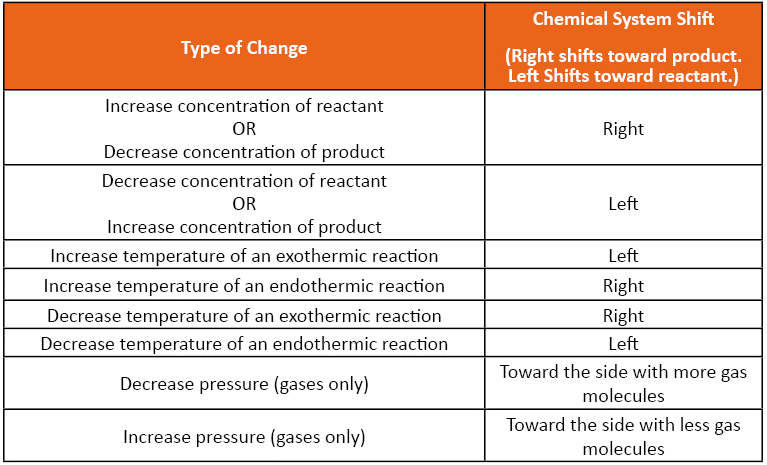
Changes in concentration, temperature, and pressure can shift the equilibrium position.
Type of Change | Chemical System Shift |
|---|---|
Increase concentration of reactant OR Decrease concentration of product | Right |
Decrease concentration of reactant OR Increase concentration of product | Left |
Increase temperature of an exothermic reaction | Left |
Increase temperature of an endothermic reaction | Right |
Decrease temperature of an exothermic reaction | Right |
Decrease temperature of an endothermic reaction | Left |
Decrease pressure (gases only) | Toward the side with more gas molecules |
Increase pressure (gases only) | Toward the side with less gas molecules |
Reaction Quotient (Q) and Equilibrium Constant (Kc)
The reaction quotient (Q) compares the current concentrations of reactants and products to the equilibrium constant (Kc).
Equilibrium Constant:
Reaction Quotient:
Direction of Reaction: If Q < Kc, the reaction proceeds toward products. If Q > Kc, the reaction proceeds toward reactants.
Example: For the reaction , calculate Q and compare to Kc to predict the direction of shift.
