 Indietro
Friedel–Crafts Acylation and Intramolecular Cyclization Mechanism
Guida di studio - Note intelligenti
 Appunti personalizzati basati sui tuoi materiali, ampliati con definizioni chiave, esempi e contesto.
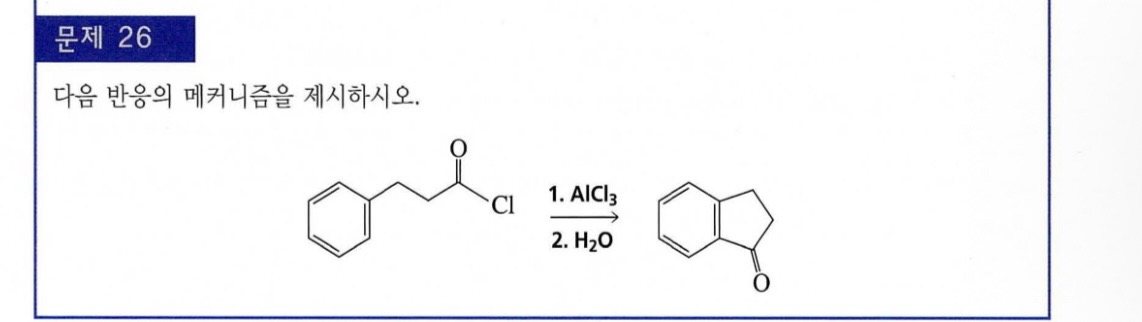
Q1. Propose the mechanism for the following reaction:
The reaction involves a compound with a benzene ring and a side chain containing a carbonyl chloride group, treated with AlCl3 followed by water, resulting in a bicyclic ketone product.
Background
Topic: Friedel–Crafts Acylation and Intramolecular Cyclization
This question tests your understanding of the Friedel–Crafts acylation reaction, specifically the intramolecular version (acylation within the same molecule), which is a key method for synthesizing polycyclic aromatic ketones such as indanones. The use of AlCl3 as a Lewis acid catalyst is crucial for generating the acylium ion intermediate.
Key Terms and Formulas
Friedel–Crafts Acylation: An electrophilic aromatic substitution where an acyl group is introduced onto an aromatic ring using an acyl chloride and a Lewis acid (e.g., AlCl3).
Intramolecular Cyclization: A reaction where two functional groups within the same molecule react to form a ring.
Acylium Ion: A resonance-stabilized cation () generated from an acyl chloride and AlCl3.
Key Mechanistic Steps:
Generation of the acylium ion () from the acyl chloride and AlCl3.
Electrophilic attack of the aromatic ring on the acylium ion (intramolecularly).
Restoration of aromaticity and hydrolysis to yield the final ketone product.
Step-by-Step Guidance
Recognize that AlCl3 acts as a Lewis acid, abstracting the chloride from the acyl chloride to generate the acylium ion ().
Identify the position on the aromatic ring that will attack the acylium ion. In this case, the ortho position relative to the side chain is favored for intramolecular cyclization.
Draw the formation of a new carbon–carbon bond between the aromatic ring and the carbonyl carbon, resulting in a cyclized carbocation intermediate.
Show the loss of a proton from the aromatic ring to restore aromaticity, forming the bicyclic ketone skeleton.
After the cyclization, water is added to hydrolyze the AlCl3 complex, yielding the final ketone product.
Try solving on your own before revealing the answer!
Final Answer:
The mechanism proceeds as follows:
AlCl3 reacts with the acyl chloride to generate the acylium ion ().
The ortho position of the benzene ring attacks the acylium ion intramolecularly, forming a five-membered ring (cyclization).
A proton is lost to restore aromaticity, resulting in a bicyclic carbocation intermediate.
Hydrolysis with water removes the AlCl3 and yields the final product: 1-indanone (a bicyclic aromatic ketone).
This is a classic example of the intramolecular Friedel–Crafts acylation (also called the Friedel–Crafts cyclization), commonly used to synthesize indanones and related structures.
