 Indietro
Fundamental Concepts in Organic Chemistry: Functional Groups, Isomerism, and Nomenclature
Guida di studio - Note intelligenti
 Appunti personalizzati basati sui tuoi materiali, ampliati con definizioni chiave, esempi e contesto.
General Chemistry Review and Hybridization
Electronic Structure and Bonding
Understanding the electronic structure and bonding in organic molecules is foundational for predicting molecular properties and reactivity. Hybridization describes the mixing of atomic orbitals to form new hybrid orbitals suitable for the pairing of electrons to form chemical bonds.
Sigma (σ) bonds are formed by the head-on overlap of orbitals (e.g., s-s, s-p, spn-spn).
Hybridization types:
sp3: Four sigma bonds, tetrahedral geometry (e.g., methane, CH4).
sp2: Three sigma bonds, one pi bond, trigonal planar geometry (e.g., ethene, C2H4).
sp: Two sigma bonds, two pi bonds, linear geometry (e.g., acetylene, C2H2).
Lone pairs on heteroatoms (e.g., O, N) occupy hybridized orbitals according to the atom's geometry.
Example: In a carbocation, the carbon is sp2 hybridized, and the empty orbital is a p orbital.
Intermolecular Forces
Types of Noncovalent Interactions
Intermolecular forces are crucial for understanding physical properties such as boiling point, melting point, and solubility.
Dispersion forces (London forces): Present in all molecules, especially significant in nonpolar compounds.
Dipole-dipole interactions: Occur between polar molecules due to permanent dipoles.
Hydrogen bonding: A strong dipole-dipole interaction involving H bonded to N, O, or F.
Example: Alcohols can hydrogen bond with water, while alkanes cannot.
Classification of Carbon Atoms and Functional Groups
Primary, Secondary, Tertiary, and Quaternary Carbons
Carbons are classified based on the number of other carbons to which they are attached:
Primary (1°): Attached to one other carbon.
Secondary (2°): Attached to two other carbons.
Tertiary (3°): Attached to three other carbons.
Quaternary (4°): Attached to four other carbons.

Classification of Amines and Alcohols
Amines and alcohols are also classified as 1°, 2°, or 3° depending on the number of carbon groups attached to the nitrogen or oxygen atom.
Functional Groups in Organic Chemistry
Common Functional Groups
Functional groups are specific groups of atoms within molecules that are responsible for the characteristic chemical reactions of those molecules. Recognizing functional groups is essential for predicting reactivity and naming compounds.
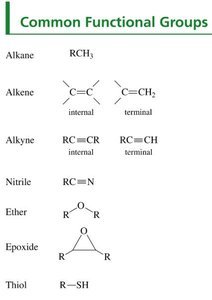
Alkane: Saturated hydrocarbon, single bonds only (RCH3).
Alkene: Contains a carbon-carbon double bond.
Alkyne: Contains a carbon-carbon triple bond.
Nitrile: Contains a carbon-nitrogen triple bond (RC≡N).
Ether: Oxygen atom connected to two alkyl or aryl groups (R–O–R).
Epoxide: Three-membered cyclic ether.
Thiol: Contains a sulfhydryl group (R–SH).
Other important functional groups include alcohols, amines, arenes, aldehydes, ketones, carboxylic acids, esters, and amides.
Special Groups and Atom Arrangements
Some atom arrangements are commonly named and frequently encountered in organic chemistry, though not always classified as functional groups.
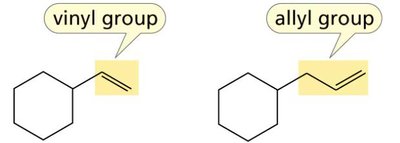
Vinyl group: –CH=CH2
Allyl group: –CH2CH=CH2
Phenyl group: Benzene ring as a substituent.
Benzyl group: –CH2 attached to a benzene ring.
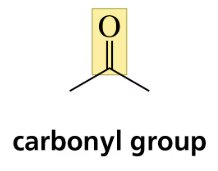
Carbonyl group: C=O, found in aldehydes, ketones, carboxylic acids, esters, and amides.
Isomerism in Organic Compounds
Structural (Constitutional) Isomers
Isomers are compounds with the same molecular formula but different structures. Structural or constitutional isomers differ in the connectivity of their atoms.
Example: C5H12 has three structural isomers: n-pentane, isopentane, and neopentane.
Nomenclature of Organic Compounds
Systematic (IUPAC) Nomenclature
Naming organic compounds systematically allows chemists to communicate structures unambiguously. The IUPAC system uses a combination of prefixes, parent names, and suffixes to indicate the structure and functional groups present.
Parent name: Indicates the number of carbons in the longest continuous chain.
Prefix: Indicates substituents attached to the parent chain.
Suffix: Indicates the main functional group.
Steps for Naming:
Identify the longest continuous carbon chain (parent chain).
Number the chain to give the highest priority functional group the lowest possible number.
Name and number substituents; list them in alphabetical order.
Assemble the name: substituent positions and names (alphabetical), parent chain, suffix for the main functional group.
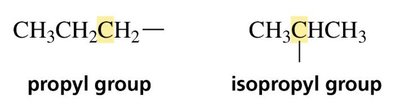
Example: 4-ethyl-3,6-dipropyloctane
Naming Rings and Functional Groups
If the largest chain is a ring, add the prefix "cyclo-" to the parent name. When multiple functional groups are present, the suffix of the highest priority group is used, and the parent chain is numbered to give it the lowest possible number.
Study Strategies for Organic Chemistry
Effective Use of Textbooks and Practice Problems
Active learning strategies, such as self-testing and spaced repetition, are more effective than passive reading. Practice problems and in-text questions help reinforce understanding and prepare for higher-order assessments.
Summarize key points after reading.
Test yourself with practice problems.
Review and correct mistakes using textbook resources.
