 Indietro
Chem 120, Mark Merchant Exam 4 Part 5
Guida di studio - Note intelligenti
 Appunti personalizzati basati sui tuoi materiali, ampliati con definizioni chiave, esempi e contesto.
Glycogen Structure and Function
Overview of Glycogen
Glycogen is a highly branched polymer of glucose, serving as a critical storage form of glucose in animals, particularly in the liver (hepatocytes). Its structure and metabolism are essential for maintaining stable serum glucose levels.
Glycogen Structure: Composed of thousands of glucose monomers linked primarily by α(1→4) glycosidic bonds, with branch points formed by α(1→6) bonds.
Function: Acts as a glucose reservoir, allowing rapid release or storage of glucose depending on metabolic needs.
Location: Synthesized and stored in the cytoplasm of hepatocytes.
Regulation: Glycogen synthesis is stimulated by insulin when serum glucose is high; degradation is stimulated by glucagon when serum glucose is low.
Physiological Roles
Glucose Storage: When serum glucose is high, glycogen synthesis removes excess glucose from the blood.
Glucose Release: When serum glucose is low, glycogen degradation releases glucose into the bloodstream.
Glycogen Synthesis
Enzymatic Steps in Glycogen Formation
Glycogen synthesis is a multi-step process involving several key enzymes and the activation of glucose.
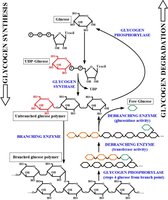
Glycogen Synthase: Catalyzes the addition of glucose monomers to form linear chains.
Branching Enzyme: Introduces α(1→6) branch points, creating a highly branched structure.
UDP-Glucose: Glucose must be activated by conjugation to uridine diphosphate (UDP) before it can be added to glycogen.
Example: The activation step can be represented as: Glycogen synthase then catalyzes: 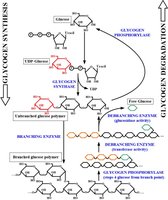
Importance of Branching
Compact Storage: Branching allows glycogen to be stored efficiently in a small volume.
Rapid Mobilization: Multiple terminal ends enable rapid addition or removal of glucose units.
Glycogen Degradation
Enzymatic Steps in Glycogen Breakdown
Glycogen degradation is essential for releasing glucose during fasting or low serum glucose conditions.
Glycogen Phosphorylase: Removes glucose monomers from linear chains by phosphorolysis.
Debranching Enzyme: Handles branch points with two activities:
Transferase Activity: Transfers three glucose units from a branch to a linear chain.
Glucosidase Activity: Removes the single glucose at the branch point.
Example: Glycogen phosphorylase reaction: 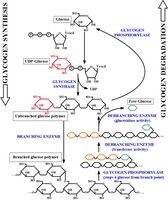
Regulation of Glycogen Metabolism
Hormonal Regulation
Glycogen metabolism is tightly regulated by hormones to maintain glucose homeostasis.
Insulin: Produced by pancreatic β-cells; activates glycogen synthase and inactivates glycogen phosphorylase, promoting glycogen synthesis when serum glucose is high.
Glucagon: Produced by pancreatic α-cells; inactivates glycogen synthase and activates glycogen phosphorylase, promoting glycogen degradation when serum glucose is low.
Example:
Hormone | Effect on Glycogen Synthase | Effect on Glycogen Phosphorylase |
|---|---|---|
Insulin | Activates | Inactivates |
Glucagon | Inactivates | Activates |
Summary Table: Glycogen Metabolism Enzymes
Enzyme | Function | Location |
|---|---|---|
Glycogen Synthase | Adds glucose to linear chains | Cytoplasm of hepatocytes |
Branching Enzyme | Creates branch points | Cytoplasm of hepatocytes |
Glycogen Phosphorylase | Removes glucose from linear chains | Cytoplasm of hepatocytes |
Debranching Enzyme | Transfers and removes branch point glucoses | Cytoplasm of hepatocytes |
Additional info:
Glycogen metabolism is a classic example of carbohydrate biochemistry, relevant to organic chemistry through the study of glycosidic bonds, enzyme mechanisms, and metabolic regulation. Understanding these pathways is foundational for advanced topics such as metabolic pathways, carbohydrate chemistry, and biochemical regulation.
