 Indietro
Chem 120, Mark Merchant Exam 4 Part 2
Guida di studio - Note intelligenti
 Appunti personalizzati basati sui tuoi materiali, ampliati con definizioni chiave, esempi e contesto.
Glycolysis: Overview and Energy Yield
Introduction to Glycolysis
Glycolysis is a central metabolic pathway that converts glucose into pyruvate, generating energy in the form of ATP and NADH. This process occurs in the cytoplasm and involves ten distinct enzyme-catalyzed steps. Glycolysis is fundamental to cellular metabolism and is tightly regulated to maintain energy homeostasis.
Glucose Entry: Glucose enters the cell via GLUT proteins.
Location: Glycolysis occurs in the cytoplasm.
End Product: Pyruvate is produced, which is further processed in the mitochondria.
Energy Yield: The pathway generates a net equivalent of 7 ATP molecules per glucose.
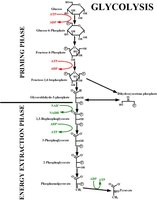
Phases of Glycolysis
Glycolysis is divided into two main phases: the priming phase and the energy extraction phase. Each phase involves specific reactions and energy changes.
Priming Phase: The first three steps consume two ATP molecules to phosphorylate glucose and its derivatives.
Cleavage: The six-carbon sugar (fructose 1,6-bisphosphate) is split into two three-carbon sugars: glyceraldehyde-3-phosphate and dihydroxyacetone phosphate.
Energy Extraction Phase: Each three-carbon sugar undergoes further reactions, generating NADH and ATP.
Energy Calculations in Glycolysis
Energy yield is calculated based on the products formed during glycolysis. After the cleavage step, all subsequent reactions are doubled due to the two three-carbon intermediates.
ATP Consumption: -1 ATP (step 1), -1 ATP (step 3)
NADH Production: 2 NADH (each yields 2.5 ATP, total 5 ATP)
ATP Production: 2 ATP (step 7), 2 ATP (step 10)
Total Net ATP: 7 ATP per glucose molecule
Equation:
Example: For one molecule of glucose, glycolysis yields 7 ATP equivalents, considering both ATP and NADH contributions.
Mitochondrial Processing of Pyruvate
Conversion to Acetyl-CoA
After glycolysis, pyruvate is transported into the mitochondria, where it is converted to acetyl-CoA by the enzyme pyruvate dehydrogenase. This reaction also produces NADH, contributing further to cellular energy.
Location: Mitochondrial matrix
Enzyme: Pyruvate dehydrogenase
NADH Production: 1 NADH per pyruvate (doubled for two pyruvates per glucose)
ATP Equivalent: Each NADH yields 2.5 ATP
Equation:
Regulation of Glycolysis
Allosteric Regulation
Glycolysis is tightly regulated to maintain constant ATP levels in the cell. Several metabolites act as allosteric inhibitors, modulating enzyme activity based on cellular energy status.
Regulatory Molecules: ATP, NADH, and citrate
Mechanism: These molecules bind to glycolytic enzymes as allosteric noncompetitive inhibitors, slowing glycolysis when energy is abundant.
Dynamic Regulation: As ATP is consumed, inhibitors dissociate, reactivating glycolysis to restore ATP levels.
Example: When ATP concentration is high, glycolysis slows; as ATP is used, glycolysis resumes to replenish energy.
Additional info: Glycolysis is a key pathway in the organic chemistry of metabolic processes, linking carbohydrate metabolism to energy production and further biochemical pathways such as the citric acid cycle.
