 Indietro
Hybridization, Lewis Structures, and Molecular Geometry in Organic Chemistry
Guida di studio - Note intelligenti
 Appunti personalizzati basati sui tuoi materiali, ampliati con definizioni chiave, esempi e contesto.
Hybridization of Atomic Orbitals
Definition and Importance
Hybridization is the process by which atomic orbitals mix to form new, equivalent hybrid orbitals that are used to form chemical bonds in molecules. This concept is essential for understanding the geometry and bonding properties of organic molecules, especially those containing carbon.
Hybrid Orbitals: Result from the combination of s and p atomic orbitals.
Types of Hybridization: sp, sp2, and sp3 are the most common for carbon.
Geometric Implications: The type of hybridization determines the molecular geometry and bond angles around the atom.
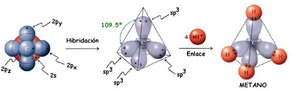
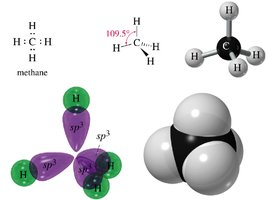
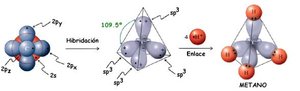
sp3 Hybridization
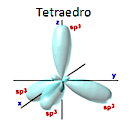
Occurs when one s and three p orbitals mix to form four equivalent sp3 hybrid orbitals, as seen in methane (CH4).
Geometry: Tetrahedral
Bond Angle: 109.5°
Example: Methane (CH4)
Bonding: Four sigma (σ) bonds are formed with hydrogen atoms.
sp2 and sp Hybridization
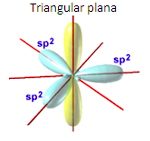
sp2 Hybridization: Mixing of one s and two p orbitals forms three sp2 hybrid orbitals (trigonal planar geometry, 120° bond angles). Example: Ethene (C2H4).
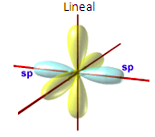
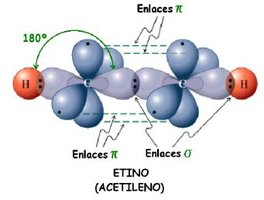
sp Hybridization: Mixing of one s and one p orbital forms two sp hybrid orbitals (linear geometry, 180° bond angles). Example: Acetylene (C2H2).
Lewis Structures and Formal Charges
Steps for Drawing Lewis Structures
Count the total number of valence electrons (e-V) in the molecule or ion. For ions, add one electron for each negative charge and subtract one for each positive charge.
Calculate the total number of electrons needed for each atom to satisfy the octet rule (e-O; hydrogen only needs two electrons).
Determine the total number of bonds (E) using:
Calculate the number of non-bonding electrons (e-NE):
Draw the connectivity of atoms, usually based on experimental data or chemical intuition (H forms one bond, C four, N three, O two).
Assign bonds and lone pairs to complete the octet for each atom, forming double or triple bonds as needed.
Calculate the formal charge (CF) for each atom:
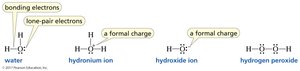
Isomerism in Organic Compounds
Organic molecules can have different atom connectivities, leading to structural (constitutional) isomers. For example, C2H6O can be ethanol or dimethyl ether.
Common Bonding Patterns
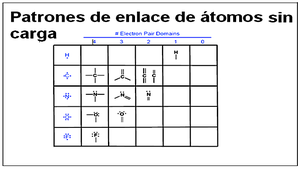
Recognizing typical bonding patterns for main group elements helps in drawing correct Lewis structures and predicting charges:
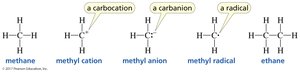
Carbon: Four bonds (neutral), otherwise charged or radical.
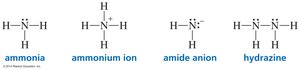
Nitrogen: Three bonds (neutral), otherwise charged.
Oxygen: Two bonds (neutral), otherwise charged.
Predicting Hybridization and Molecular Geometry
Determining Hybridization
Draw the Lewis structure, focusing on the atom of interest.
Count the number of sigma bonds and lone pairs (hybrid orbitals, O.H.).
Correlate the number of hybrid orbitals with the type of hybridization:
Hybridization | # Hybrid Orbitals | Geometry | Bond Angle |
|---|---|---|---|
sp3 | 4 | Tetrahedral | 109.5° |
sp2 | 3 | Trigonal planar | 120° |
sp | 2 | Linear | 180° |
Examples of Hybridization
Methane (CH4): sp3 hybridization, tetrahedral geometry, 109.5° bond angles.
Ethene (C2H4): sp2 hybridization, trigonal planar geometry, 120° bond angles.
Acetylene (C2H2): sp hybridization, linear geometry, 180° bond angles.
Predicting Molecular Polarity
Steps to Determine Polarity
Draw the Lewis structure of the molecule.
Identify the hybridization of each central atom (except hydrogen).
Draw the geometry of electron pairs and deduce the molecular geometry.
Draw vectors for each covalent bond, pointing toward the more electronegative atom.
Sum the vectors; if there is a resultant vector, the molecule is polar.
If the atom has lone pairs, include them in the geometry to deduce the molecular shape.
Examples:
sp (linear): usually nonpolar
sp2 (trigonal planar): usually nonpolar
sp3 (tetrahedral): can be polar or nonpolar depending on substituents
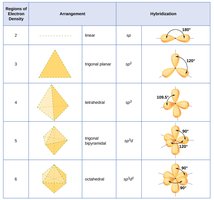
Summary Table: Hybridization, Geometry, and Bond Angles
Regions of Electron Density | Arrangement | Hybridization | Bond Angle |
|---|---|---|---|
2 | Linear | sp | 180° |
3 | Trigonal planar | sp2 | 120° |
4 | Tetrahedral | sp3 | 109.5° |
5 | Trigonal bipyramidal | sp3d | 120°, 90° |
6 | Octahedral | sp3d2 | 90° |
Practice Problems
Practice drawing Lewis structures, assigning hybridization, and predicting geometry and polarity for various organic molecules. Use the steps and tables above as guides.
