 Indietro
Introduction to Organic Chemistry: Atomic Structure, Bonding, and Molecular Structure
Guida di studio - Note intelligenti
 Appunti personalizzati basati sui tuoi materiali, ampliati con definizioni chiave, esempi e contesto.
Introduction to Organic Chemistry
What is Organic Chemistry?
Organic chemistry is the study of the structure, properties, composition, reactions, and synthesis of carbon-containing compounds. It is foundational for understanding biological processes, pharmaceuticals, and materials science.
Organic compounds are primarily composed of carbon and hydrogen, often with oxygen, nitrogen, sulfur, phosphorus, and halogens.
Carbon's ability to form four covalent bonds leads to a vast diversity of molecular structures.
Atomic Structure and the Periodic Table
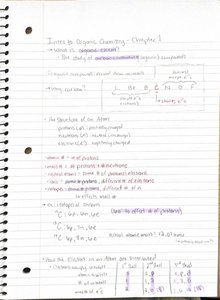
The Structure of the Atom
Atoms consist of a nucleus (protons and neutrons) surrounded by electrons in defined energy levels or shells.
Protons (p+): Positively charged particles in the nucleus.
Neutrons (n0): Neutral particles in the nucleus.
Electrons (e-): Negatively charged particles in orbitals around the nucleus.
Atomic number (Z): Number of protons in the nucleus; defines the element.
Mass number (A): Total number of protons and neutrons.
Isotopes: Atoms of the same element with different numbers of neutrons.
Electron configuration describes the arrangement of electrons in an atom's orbitals, following the Aufbau principle, Pauli exclusion principle, and Hund's rule.
Orbitals and Electron Arrangement
Electrons occupy atomic orbitals (s, p, d, f) with specific shapes and energies.
s orbital: Spherical, holds up to 2 electrons.
p orbital: Dumbbell-shaped, three orientations, holds up to 6 electrons.
Electron shells: Principal energy levels (n = 1, 2, 3, ...).
Valence electrons: Electrons in the outermost shell, crucial for bonding and chemical reactivity.
Bonding: How Atoms Form Bonds
Ionic and Covalent Bonds
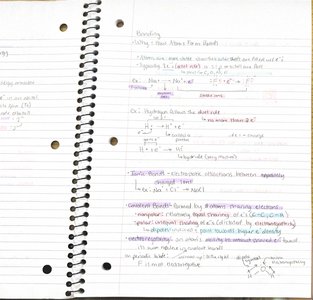
Atoms form bonds to achieve stable electron configurations, often resembling noble gases.
Ionic bonds: Formed by transfer of electrons from one atom to another, resulting in oppositely charged ions (e.g., NaCl).
Covalent bonds: Formed by sharing electrons between atoms (e.g., H2, CH4).
Bond polarity arises from differences in electronegativity between bonded atoms.
Electronegativity and Bond Polarity
Electronegativity is the tendency of an atom to attract electrons in a bond. The greater the difference, the more polar the bond.
Nonpolar covalent: Electrons shared equally (e.g., H2).
Polar covalent: Electrons shared unequally (e.g., H2O).
Ionic: Electrons transferred (e.g., NaCl).
Lewis Structures and Molecular Representation
Drawing Lewis Structures
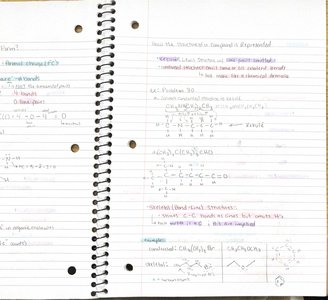
Lewis structures depict the arrangement of valence electrons among atoms in a molecule.
Count total valence electrons.
Arrange atoms and connect with single bonds.
Distribute remaining electrons to satisfy the octet rule (or duet for H).
Use double or triple bonds if necessary to complete octets.
Resonance Structures
Some molecules are best represented by two or more Lewis structures, called resonance structures. The actual molecule is a resonance hybrid.
Resonance stabilizes molecules by delocalizing electrons.
Curved arrows show movement of electrons between resonance forms.
Molecular Geometry and Hybridization
VSEPR Theory and Molecular Shapes
The Valence Shell Electron Pair Repulsion (VSEPR) theory predicts molecular shapes based on electron pair repulsion.
Tetrahedral: 109.5°, e.g., CH4
Trigonal planar: 120°, e.g., BF3
Linear: 180°, e.g., CO2
Hybridization
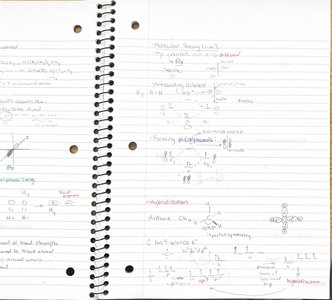
Atomic orbitals mix to form hybrid orbitals for bonding:
sp3: Tetrahedral, 4 sigma bonds (e.g., CH4).
sp2: Trigonal planar, 3 sigma bonds + 1 pi bond (e.g., C2H4).
sp: Linear, 2 sigma bonds + 2 pi bonds (e.g., C2H2).
Bond Strength, Length, and Dipole Moments
Bond Length and Strength
Bond length is the distance between nuclei of bonded atoms; bond strength is the energy required to break a bond.
Triple bonds are shorter and stronger than double bonds, which are shorter and stronger than single bonds.
Bond dissociation energy increases with bond order.
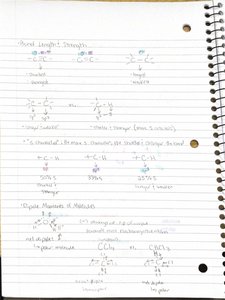
Dipole Moments
A dipole moment arises in molecules with polar bonds and an asymmetric shape, resulting in a separation of charge.
Measured in Debye units (D).
Nonpolar molecules (e.g., CCl4) have zero dipole moment due to symmetry.
Polar molecules (e.g., CHCl3) have a net dipole moment.
Summary Table: Bond Types and Properties
Bond Type | Bond Order | Bond Length | Bond Strength |
|---|---|---|---|
Single (C–C) | 1 | Longest | Weakest |
Double (C=C) | 2 | Intermediate | Intermediate |
Triple (C≡C) | 3 | Shortest | Strongest |
Additional info: This guide covers foundational concepts from "A Review of General Chemistry" and "Molecular Representations," including atomic structure, bonding, Lewis structures, resonance, hybridization, and molecular geometry, as typically presented in the first chapter of an Organic Chemistry textbook.
