 Indietro
Isomerism and Chirality in Organic Chemistry: Structured Study Notes
Guida di studio - Note intelligenti
 Appunti personalizzati basati sui tuoi materiali, ampliati con definizioni chiave, esempi e contesto.
Isomerism in Organic Chemistry
Types of Isomers
Isomers are compounds that have the same molecular formula but differ in the arrangement of atoms. Understanding the classification of isomers is fundamental in organic chemistry.
Structural (Constitutional) Isomers: Compounds with different connectivity of atoms.
Stereoisomers: Compounds with the same connectivity but different spatial arrangements.
Stereoisomer Classification
Conformational Isomers: Interconvertible by rotation about single bonds.
Configurational Isomers: Cannot be interconverted by rotation about single bonds. Includes geometrical isomers (cis/trans, E/Z) and isomers with asymmetric centers (enantiomers, diastereomers).
Geometric Isomerism: Cis/Trans and E/Z Nomenclature
Geometric isomers arise due to restricted rotation, typically at double bonds or in rings. The spatial arrangement of substituents leads to distinct compounds with different properties.
Cis Isomer: Substituents are on the same side of the double bond or ring.
Trans Isomer: Substituents are on opposite sides.
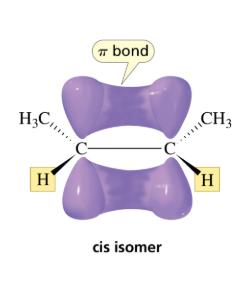
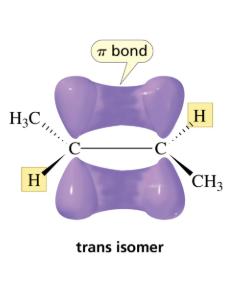
When more than two different substituents are present, E/Z nomenclature is used, based on the Cahn-Ingold-Prelog priority rules:
Z (zusammen): High-priority groups are on the same side of the double bond.
E (entgegen): High-priority groups are on opposite sides.
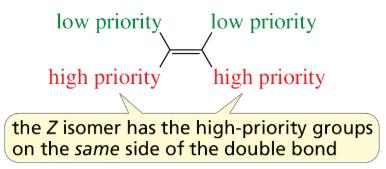
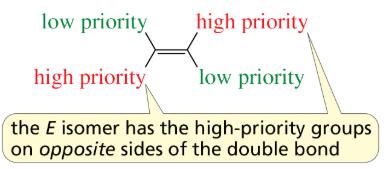
Cahn-Ingold-Prelog Rules for E/Z Assignment
Assign priority based on atomic number to atoms directly attached to the double bond.
If the first atoms are identical, move outward until a difference is found.
Multiple bonds are treated as equivalent to the same number of single bonds.
Chirality and Asymmetric Centers
Chirality is a property of a molecule that makes it non-superimposable on its mirror image. This is a key concept in stereochemistry and has significant biological implications.
Chiral Objects: Cannot be superimposed on their mirror images (e.g., left and right hands).
Achiral Objects: Can be superimposed on their mirror images (e.g., a flask).
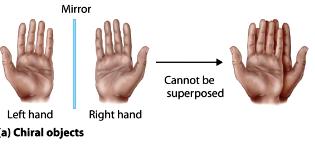
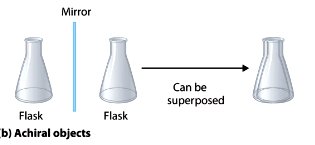
An asymmetric center (stereocenter) is a carbon atom bonded to four different groups. The presence of asymmetric centers leads to the existence of enantiomers and diastereomers.
Enantiomers: Stereoisomers that are nonsuperimposable mirror images.
Diastereomers: Stereoisomers that are not mirror images.
Chirality in Pharmaceuticals
Many pharmaceuticals are chiral, and often only one enantiomer is biologically active. The other enantiomer may be inactive or even harmful.
(S)-ibuprofen: Active form.
(R)-ibuprofen: Inactive form.
(S)-naproxen: Anti-inflammatory.
(R)-naproxen: Liver toxin.
(S)-thalidomide: Teratogen (causes birth defects).
(R)-thalidomide: Sedative.
Determining Chirality and Stereoisomer Relationships
To determine if a molecule is chiral, check for asymmetric centers and test for superimposability with its mirror image. The number of possible stereoisomers depends on the number of stereogenic elements (asymmetric centers, E/Z double bonds, cis/trans isomerism).
Assigning R/S Configuration
Rank the four groups attached to the asymmetric center using Cahn-Ingold-Prelog rules.
Orient the molecule so the lowest priority group is in the back.
Trace a path from priority 1 to 2 to 3.
Clockwise = R; Counterclockwise = S.
The enantiomer will have the opposite configuration.
Practice and Application
Students should practice identifying isomer types, assigning E/Z and R/S configurations, and determining the number of stereoisomers for given molecules. Understanding these concepts is essential for predicting molecular properties and biological activity.
Summary Table: Types of Isomers
Type | Definition | Example |
|---|---|---|
Structural Isomers | Different connectivity | Butane vs. isobutane |
Stereoisomers | Same connectivity, different spatial arrangement | Cis/trans alkenes |
Conformational Isomers | Interconvertible by rotation | Staggered vs. eclipsed ethane |
Configurational Isomers | Cannot interconvert by rotation | Enantiomers, diastereomers |
Geometric Isomers | Different arrangement at double bond/ring | Cis/trans, E/Z alkenes |
Enantiomers | Mirror images, nonsuperimposable | (R)- and (S)-lactic acid |
Diastereomers | Not mirror images | Threo and erythro forms |
Example: Determining Stereoisomers
For a molecule with n asymmetric centers, the maximum number of stereoisomers is . However, symmetry and other stereogenic elements may reduce this number.
Key Formula:
where n = number of asymmetric centers.
Additional info: If E/Z double bonds or cis/trans rings are present, include these in the count of stereogenic elements.
