Indietro
Ketones and Aldehydes: Structure, Reactivity, and Nucleophilic Addition Reactions
Guida di studio - Note intelligenti
 Appunti personalizzati basati sui tuoi materiali, ampliati con definizioni chiave, esempi e contesto.
Ketones and Aldehydes: Structure and Nomenclature
Introduction to Ketones and Aldehydes
Ketones and aldehydes are two important classes of carbonyl compounds in organic chemistry. Both contain a carbonyl group (C=O), but differ in their substituents: aldehydes have at least one hydrogen attached to the carbonyl carbon, while ketones have two carbon groups attached. Their reactivity and nomenclature are central to understanding organic synthesis and mechanisms.
Aldehyde: Contains a terminal carbonyl group (R-CHO).
Ketone: Contains an internal carbonyl group (R-CO-R').
Nomenclature: Aldehydes are named with the suffix -al, ketones with -one.
Reactivity of Ketones and Aldehydes
Relative Reactivity and Steric Effects
Aldehydes are generally more reactive toward nucleophilic addition than ketones. This is due to two main factors: steric hindrance and electronic effects. Ketones, with two alkyl groups, are more hindered and less electrophilic than aldehydes, which have only one alkyl group and one hydrogen.
Steric Hindrance: Ketones are less reactive due to bulkier substituents.
Electronic Effects: Alkyl groups donate electrons, reducing the partial positive charge on the carbonyl carbon in ketones.
Nucleophilic Addition to Carbonyl Compounds
Mechanism of Nucleophilic Addition
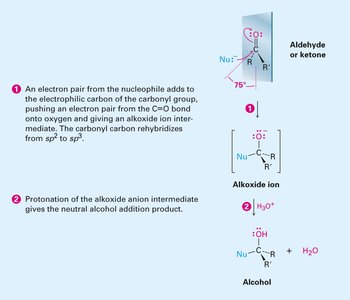
Nucleophilic addition is the primary reaction mechanism for aldehydes and ketones, as they lack a leaving group. The nucleophile attacks the electrophilic carbonyl carbon, forming a tetrahedral intermediate, which is then protonated to yield an alcohol.
Step 1: Nucleophile adds to the carbonyl carbon, breaking the π bond and forming an alkoxide ion.
Step 2: Alkoxide ion is protonated to form the alcohol product.
Common Negatively Charged Nucleophiles
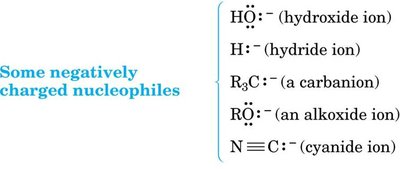
Several negatively charged nucleophiles participate in addition reactions with carbonyl compounds. Their strength and reactivity influence the outcome and stereochemistry of the products.
Nucleophile | Structure | Example |
|---|---|---|
Hydroxide ion | HO- | Base-catalyzed addition |
Hydride ion | H- | NaBH4, LiAlH4 |
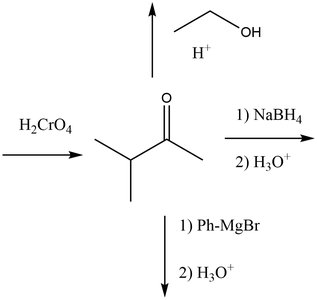
Carbanion | R3C- | Grignard reagent |
Alkoxide ion | RO- | Alcohol addition |
Cyanide ion | N≡C- | Cyanohydrin formation |
Stereochemistry of Nucleophilic Addition
Formation of Stereocenters
Nucleophilic addition to an asymmetric carbonyl carbon can create new stereocenters, leading to the formation of enantiomers. The configuration depends on the direction of nucleophilic attack and the priorities of substituents.
Enantiomers: Two products with opposite configurations (R and S).
Dash and Wedge Notation: Used to indicate stereochemistry in product structures.
Nucleophilic Addition-Elimination: Formation of Imines
Reaction with Amines
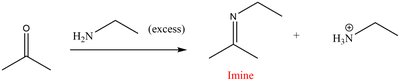
Amines, which are moderately nucleophilic, react with aldehydes and ketones to form imines via nucleophilic addition-elimination. This reaction does not require acid/base catalysis if the amine is sufficiently nucleophilic.
Step 1: Amine attacks the carbonyl carbon, forming a tetrahedral intermediate.
Step 2: Elimination of water yields the imine product.
Excess amine: Drives the reaction to completion.
Reduction of Carbonyl Compounds
Hydride Reduction
Strong nucleophilic hydride sources such as sodium borohydride (NaBH4) and lithium aluminum hydride (LiAlH4) reduce aldehydes and ketones to alcohols. The mechanism involves nucleophilic addition of hydride to the carbonyl carbon, followed by protonation.
NaBH4: Milder, used for aldehydes and ketones.
LiAlH4: Stronger, can reduce esters and carboxylic acids.
Product: Alcohol corresponding to the original carbonyl compound.
Reactions with Alcohols: Acetal and Hemiacetal Formation
Acetal Formation Mechanism
Acetals are formed by the acid-catalyzed reaction of aldehydes or ketones with alcohols. The process is reversible and involves the formation of a hemiacetal intermediate, which contains both a hydroxyl and an ether group. Further reaction yields the acetal, which has two ether groups attached to the same carbon.
Hemiacetal: Carbon with one -OH and one -OR group.
Acetal: Carbon with two -OR groups, no -OH group.
Acid Catalyst: Required for acetal formation.
Hemiacetals and Carbohydrates
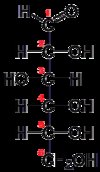
Glucose: Aldose and Pyranose Forms
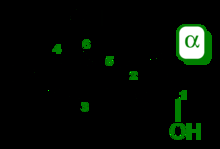
Carbohydrates such as glucose can form hemiacetals intramolecularly, resulting in cyclic structures. The most common forms are five-membered (furanose) and six-membered (pyranose) rings. In aqueous solution, both open-chain and cyclic forms exist, leading to diastereomers (α and β anomers).
α-D-Glucose: Aldose form with specific stereochemistry.
α-D-Glucopyranose: Six-membered ring form.
Ring Preference: Five- and six-membered rings are favored due to minimal angle strain.
Summary of Carbonyl Reactions
Predicting Products and Mechanisms
Carbonyl compounds undergo a variety of reactions depending on the nucleophile and conditions. Strong nucleophiles favor nucleophilic addition, while weak nucleophiles may require acid catalysis and can lead to addition-elimination mechanisms. The stereochemistry and number of products depend on the symmetry of the starting material and the nature of the nucleophile.
Strong nucleophiles: Direct addition, possible formation of enantiomers.
Weak nucleophiles: Addition-elimination, formation of imines or acetals.
Reduction: Hydride sources convert carbonyls to alcohols.
Grignard reagents: Add to carbonyls to form alcohols after protonation.