 Indietro
Major Organic Reactions and Synthetic Methodologies in Drug Synthesis
Guida di studio - Note intelligenti
 Appunti personalizzati basati sui tuoi materiali, ampliati con definizioni chiave, esempi e contesto.
Introduction to Drug Synthesis and Organic Chemistry
Organic chemistry is fundamental to the synthesis of pharmaceuticals, enabling the construction of complex molecules from simpler building blocks. The design and synthesis of drug molecules require a deep understanding of functional groups, reaction mechanisms, and selectivity principles to achieve efficient and targeted transformations.
Role of Organic Synthesis in Drug Development
Stages of Drug Development
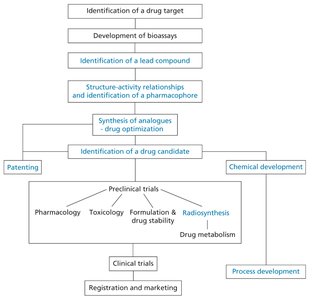
Drug synthesis is integral at multiple stages of pharmaceutical development, from the identification of a biological target to the large-scale production of optimized drug candidates.
Lead Compound Identification: Screening chemical libraries to find compounds with desirable biological activity.
Structure-Activity Relationships (SAR): Systematic modification of lead compounds to optimize activity and properties.
Process Development: Scaling up synthesis for clinical and commercial use.
Chirality and Asymmetric Synthesis
Importance of Chirality in Drugs
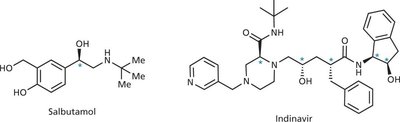
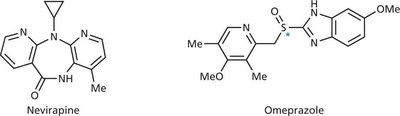
Many drugs are chiral, meaning they exist as non-superimposable mirror images (enantiomers). Biological targets such as proteins are also chiral, so different enantiomers of a drug can have distinct biological activities and side effect profiles.
Enantiomers: Molecules that are mirror images but not superimposable.
Racemic Mixture: A 1:1 mixture of two enantiomers.
Example: Thalidomide—one enantiomer is a sedative, the other is teratogenic.
Functional Groups and Reactivity
Influence of Functional Groups
Functional groups determine the chemical reactivity of organic molecules by affecting bond polarity and generating electrophilic or nucleophilic centers. This underpins the selectivity and efficiency of synthetic transformations.
Electron-Withdrawing Groups (EWGs): Increase electrophilicity by creating partial positive charges.
Electron-Donating Groups (EDGs): Increase nucleophilicity by donating electron density.
Selectivity in Organic Synthesis
Chemoselectivity
Chemoselectivity refers to the preferential reaction of one functional group in the presence of others. This is crucial when synthesizing complex molecules with multiple reactive sites.
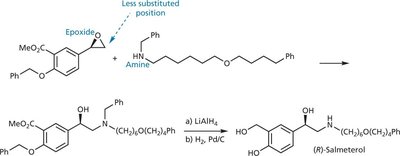
Example: Amine reacts with epoxide rather than methyl ester in Salmeterol synthesis.
Regioselectivity
Regioselectivity describes the preference for reaction at one position over another within a functional group, such as on an aromatic ring or epoxide.
Example: Amine attacks the less substituted carbon of an epoxide in the synthesis of (R)-Salmeterol.
Coupling Reactions in Drug Synthesis
Formation of Amides (N–C Bonds)
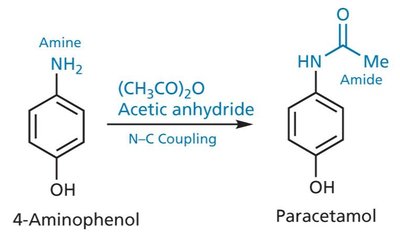
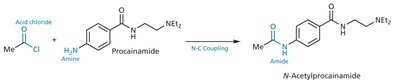
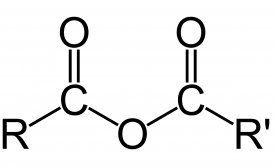
Amide bonds are formed by coupling an amine with a carboxylic acid derivative (acid chloride, anhydride, or ester). This is a key transformation in peptide and drug synthesis.
Example: Synthesis of paracetamol from 4-aminophenol and acetic anhydride.
Mechanism: Nucleophilic attack of amine on activated carboxylic acid derivative.
Activation of Carboxylic Acids
Carboxylic acids are often unreactive toward amines. Activation with agents like diisopropylcarbodiimide (DIC) or ethyl chloroformate forms more reactive intermediates (e.g., mixed anhydrides) that readily couple with amines.
Formation of Amines (N–C Bonds)
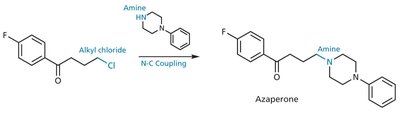
Amines can be formed by coupling an amine with an alkyl halide. This reaction is chemoselective when other functional groups are present.
Example: Synthesis of azaperone by reacting an amine with an alkyl chloride.
Formation of Esters and Ethers (O–C Bonds)
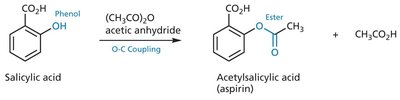
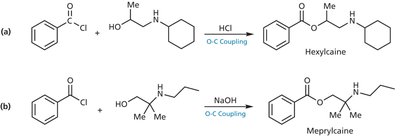
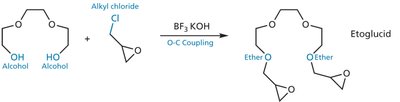
Esters are formed by coupling an alcohol or phenol with a carboxylic acid or its derivatives. Ethers are formed by reacting an alcohol with an alkyl halide.
Example (Ester): Synthesis of aspirin (acetylsalicylic acid) from salicylic acid and acetic anhydride.
Example (Ether): Synthesis of etoglucid by reacting a diol with alkyl chloride.
Making the Carbon Framework: Electrophiles and Nucleophiles
Electrophiles in Synthesis
Electrophiles are electron-deficient species that accept electron pairs from nucleophiles. Common electrophiles in organic synthesis include alkyl halides, epoxides, and carbonyl compounds.
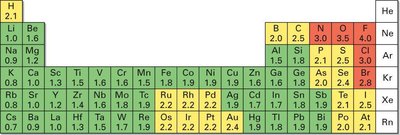
Bond Polarization: Electrophilicity is enhanced by electron-withdrawing groups, creating partial positive charges on carbon atoms.
Carbon Nucleophiles
Carbon nucleophiles react with electrophiles to form new C–C bonds, a fundamental process in building complex organic molecules.
Organometallics: Compounds with carbon-metal bonds (e.g., Grignard reagents, organolithium reagents).
Stabilized Carbanions: Carbanions stabilized by adjacent electron-withdrawing groups.
Neutral Nucleophiles: Activated π-systems (e.g., enolates).
Grignard Reagents (Organomagnesium Compounds)
Grignard reagents (RMgX) are powerful carbon nucleophiles used to form C–C bonds by addition to carbonyl compounds and epoxides.
Preparation: Reaction of alkyl or aryl halide with magnesium metal in dry ether.
Reactivity Order: RI > RBr > RCl.
Applications: Synthesis of alcohols, carboxylic acids, and complex frameworks (e.g., Tamoxifen).
Organolithium Reagents
Organolithium reagents (RLi) are even more reactive than Grignard reagents and are used for nucleophilic addition to carbonyl compounds and other electrophiles.
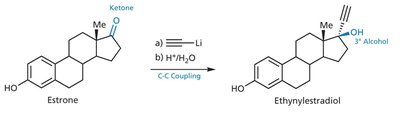
Example: C–C Coupling in Steroid Synthesis
Organolithium reagents can be used to couple alkynes with ketones, as in the synthesis of ethinylestradiol from estrone.
Summary Table: Key Bond-Forming Reactions in Drug Synthesis
Bond Type | Typical Reaction | Example |
|---|---|---|
C–N (Amide) | Amine + Acid chloride/anhydride | Paracetamol, N-acetylprocainamide |
C–N (Amine) | Amine + Alkyl halide | Azaperone |
C–O (Ester) | Alcohol/Phenol + Acid chloride/anhydride | Aspirin, Hexylcaine |
C–O (Ether) | Alcohol + Alkyl halide | Etoglucid |
C–C | Organometallic + Carbonyl/Epoxide | Tamoxifen, Ethinylestradiol |
Conclusion
Organic synthesis is essential for the construction of drug molecules, requiring mastery of functional group reactivity, selectivity principles, and coupling methodologies. The ability to form C–C, C–N, and C–O bonds efficiently underpins the development of new pharmaceuticals and the optimization of existing drugs.
