 Indietro
Mechanisms and Radical Reactions in Organic Chemistry: Arrow Pushing, Thermodynamics, and Halogenation
Guida di studio - Note intelligenti
 Appunti personalizzati basati sui tuoi materiali, ampliati con definizioni chiave, esempi e contesto.
Arrow Pushing and Reaction Mechanisms
Introduction to Arrow Pushing
Arrow pushing is a fundamental technique in organic chemistry used to illustrate the movement of electrons during chemical reactions. It helps describe reaction mechanisms, predict products, and identify reactive sites within molecules.
Curved arrows indicate the flow of electrons, either in bond formation or bond breaking.
Arrows start from electron-rich sites (nucleophiles) and point toward electron-poor sites (electrophiles).
Mechanisms are not literal depictions but are useful for understanding and predicting chemical behavior.
Polar Reactions and Curved Arrows
Polar reactions involve uneven splitting of electrons, typically between nucleophiles and electrophiles. Curved arrows are used to show:
Bond formation: Arrow goes from the nucleophile (electron-rich) to the electrophile (electron-poor).
Bond breaking: The more electronegative atom receives the electrons.
Example: Acid/Base Mechanism
In acid/base reactions, a base donates electrons to a proton (H) on an acid, forming a conjugate acid and conjugate base.
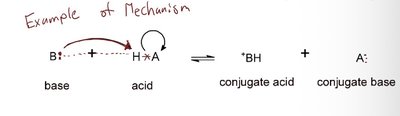
Base (B:) donates electrons to H of HA (acid).
Result: Formation of BH (conjugate acid) and A: (conjugate base).
Thermodynamics and Kinetics
Thermodynamic Parameters
Thermodynamics describes the energy changes and equilibrium in chemical reactions. Key parameters include:
Enthalpy (ΔH): Heat change during reaction.
Entropy (ΔS): Change in disorder or randomness.
Gibbs Free Energy (ΔG): Energy available to do work, determines spontaneity.
The relationship between equilibrium constant (Keq) and ΔG is given by:
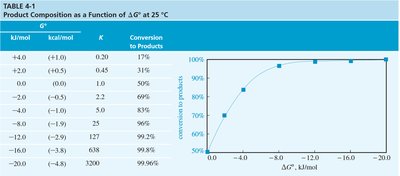
Product Composition as a Function of ΔG
As ΔG becomes more negative, the conversion to products increases.
ΔG° (kJ/mol) | K | Conversion to Products (%) |
|---|---|---|
+4.0 | 0.30 | 17% |
+2.0 | 0.45 | 31% |
0.0 | 1.0 | 50% |
-2.0 | 5.0 | 83% |
-4.0 | 127 | 99% |
-8.0 | 3200 | 99.9% |
Kinetics and Energy Diagrams
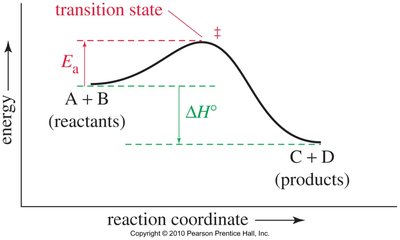
Kinetics describes how fast a reaction occurs, determined by the activation energy (Ea). Energy diagrams illustrate the energy changes during a reaction:
Transition state: Highest energy point, not isolable.
Activation energy (Ea): Energy required to reach the transition state.
Exothermic reaction: Products are lower in energy than reactants.
Effect of Temperature on Reaction Rate
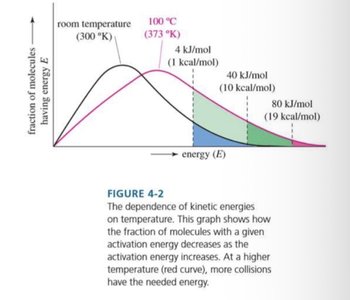
Increasing temperature raises the fraction of molecules with enough energy to overcome Ea, thus increasing reaction rate.
Radical Reactions and Halogenation
Homolytic vs. Heterolytic Cleavage
Reactions can be classified based on electron movement:
Heterolytic (polar) reactions: Electrons split unevenly, forming ions.
Homolytic (radical) reactions: Electrons split evenly, forming radicals.
Free-Radical Chain Reaction Mechanism
Halogenation of alkanes (e.g., methane) proceeds via a chain mechanism:
Initiation: Formation of radicals (e.g., Cl2 → 2 Cl•).
Propagation: Radicals react with stable molecules to form new radicals and products.
Termination: Radicals combine to form stable products, ending the chain.
Propagation Steps in Methane Chlorination
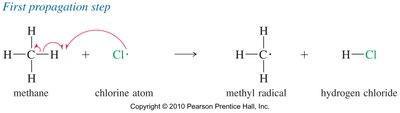
First propagation step: Cl• abstracts H from methane, forming methyl radical and HCl.
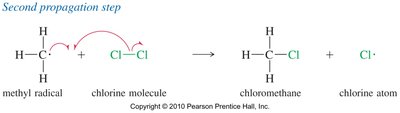
Second propagation step: Methyl radical reacts with Cl2, forming chloromethane and regenerating Cl•.
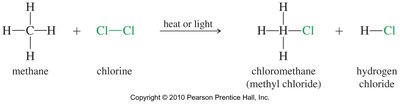
Overall Reaction
The overall halogenation reaction is:
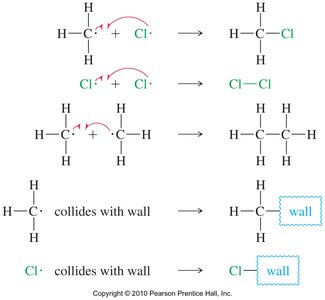
Termination Steps
Termination occurs when two radicals combine or react with contaminants/walls, removing radicals from the system.
Regioselectivity in Halogenation
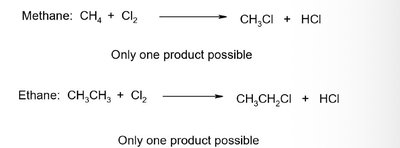
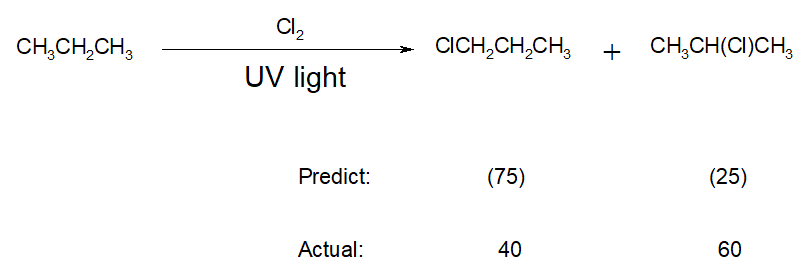
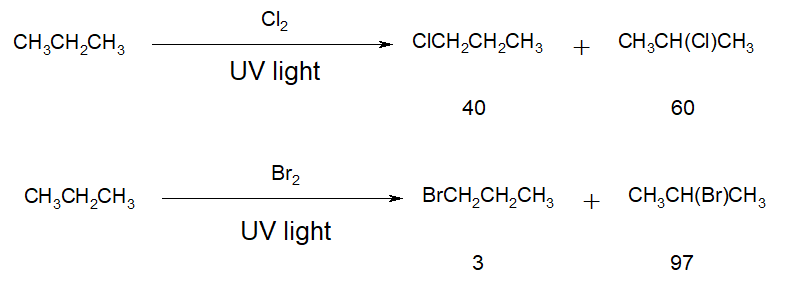
Halogenation of higher alkanes (e.g., propane) can yield multiple products, depending on which hydrogen is abstracted.
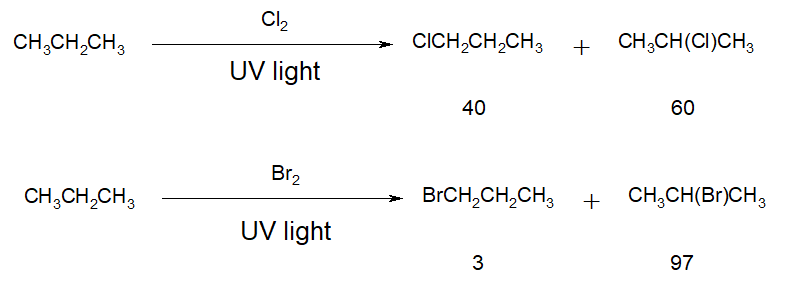
Chlorination: Less selective, more products.
Bromination: More selective, favors more stable radicals.
Product Distribution Example
For propane halogenation:
Predicted ratio: (75:25), Actual ratio: (40:60)
Bromination vs. Chlorination
Bromination is more selective, favoring the formation of the most stable radical intermediate.
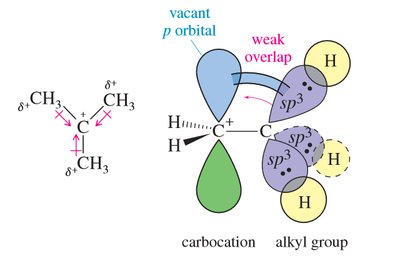
Stability of Radical Intermediates
Radical stability increases with substitution and resonance:
Order: Benzylic > Allylic > Tertiary > Secondary > Primary > Methyl
Stabilized by inductive effects and hyperconjugation.
Energy Diagrams: Bromination vs. Chlorination
Energy diagrams show differences in activation energy and selectivity for bromination and chlorination.
Practice and Applications
Predicting Products and Regioselectivity
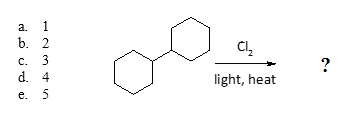
For halogenation reactions, predict the number and type of products based on the structure and the selectivity of the halogen used.
Allylic and Benzylic Halogenation
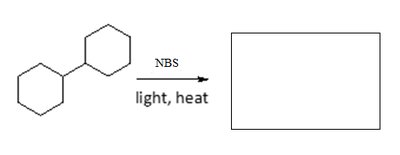
Allylic and benzylic positions are especially reactive due to resonance stabilization. N-bromosuccinimide (NBS) is used for selective bromination at these positions.
Summary Table: Bond Dissociation Energies
Bond dissociation energies are important for calculating reaction enthalpies and predicting which bonds are most likely to break during radical reactions.
Compound | Bond Dissociation Energy (kcal/mol) |
|---|---|
CH3CH2-H | 101 |
CH3CH2-Br | 70 |
H-Br | 87 |
Br2 | 46 |
Key Concepts and Equations
Arrow pushing is essential for understanding mechanisms.
Radical reactions proceed via initiation, propagation, and termination.
Thermodynamics and kinetics determine product distribution and reaction rate.
Bond dissociation energies help predict reaction feasibility.
Regioselectivity is influenced by radical stability and halogen type.
Additional info: Academic context was added to clarify the role of resonance, hyperconjugation, and selectivity in radical reactions, as well as to expand on the thermodynamic and kinetic principles underlying product formation.
