 Indietro
Module 9: Alcohols, Ethers, Epoxides, Amines, Thiols, and Sulfides – Properties, Nomenclature, Synthesis, and Reactivity
Guida di studio - Note intelligenti
 Appunti personalizzati basati sui tuoi materiali, ampliati con definizioni chiave, esempi e contesto.
Alcohols, Ethers, Epoxides, Thiols, and Sulfides: Structures and Functional Groups
Overview of Functional Groups
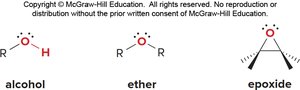
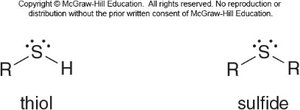
Organic compounds containing oxygen and sulfur exhibit diverse chemical and physical properties. The main functional groups discussed in this module are alcohols, ethers, epoxides, thiols, and sulfides. Each group is defined by its characteristic bonding and reactivity.
Alcohols: Contain a hydroxyl group (–OH) bonded to a carbon atom.
Ethers: Have an oxygen atom bonded to two carbon atoms (R–O–R).
Epoxides: Cyclic ethers with a three-membered ring containing an oxygen atom.
Thiols: Contain a sulfhydryl group (–SH) bonded to a carbon atom.
Sulfides: Have a sulfur atom bonded to two carbon atoms (R–S–R).
Alcohols: Types and Hybridization
Enols, Phenols, and Alcohols
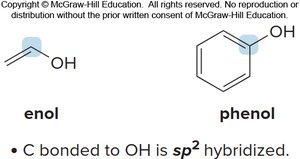
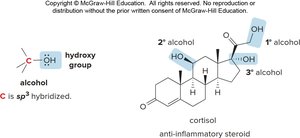
Alcohols can be classified based on the hybridization of the carbon atom to which the hydroxyl group is attached. Enols and phenols feature an –OH group attached to an sp2 hybridized carbon, while typical alcohols have the –OH group attached to an sp3 hybridized carbon.
Enol: Alcohol with –OH on a carbon-carbon double bond (sp2 hybridized).
Phenol: Alcohol with –OH on an aromatic ring (sp2 hybridized).
Alcohols are further classified as primary (1°), secondary (2°), or tertiary (3°) based on the number of carbon atoms attached to the carbon bearing the –OH group.
Physical Properties of Alcohols, Ethers, and Epoxides
Boiling Point, Melting Point, and Solubility
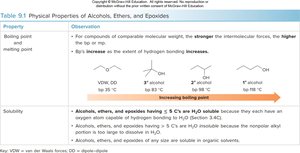
The physical properties of these compounds are largely determined by their ability to participate in hydrogen bonding and their molecular structure.
Boiling and Melting Points: Increase with the strength of intermolecular forces. Alcohols have higher boiling points than ethers and epoxides due to hydrogen bonding.
Solubility: Alcohols, ethers, and epoxides with ≤5 C atoms are soluble in water; larger molecules are soluble in organic solvents.
Property | Observation |
|---|---|
Boiling Point | Alcohols > Ethers > Epoxides (due to hydrogen bonding) |
Solubility | Small alcohols, ethers, epoxides are water-soluble; larger ones are organic-soluble |
Nomenclature of Alcohols, Ethers, Epoxides, Amines, Thiols, and Sulfides
Alcohols
Alcohols are named by identifying the longest carbon chain containing the –OH group, replacing the terminal –e with –ol, and numbering the chain to give the –OH group the lowest possible number.
Example: 2-methoxy-3-methylheptan-5-ol
Ethers
Ethers are named by listing the alkyl groups attached to oxygen in alphabetical order, followed by "ether" (common names), or by naming the oxygen-bearing substituent as an alkoxy group in IUPAC nomenclature.
Epoxides
Epoxides are named as oxiranes or as epoxy-substituted alkanes, depending on the structure.
Amines
Amines are named by replacing the terminal –e of the parent alkane with –amine, or by using N- prefixes for substituents on nitrogen.
Example: N,N-diethylethanamine
Thiols and Sulfides
Thiols are named by adding the suffix –thiol to the parent hydrocarbon. Sulfides are named similarly to ethers, but with "sulfide" as the ending.
Preparation and Synthesis of Alcohols, Ethers, Epoxides, Thiols, Sulfides, and Amines
Alcohols and Ethers
Alcohols and ethers can be synthesized via nucleophilic substitution reactions. The Williamson Ether Synthesis is a key method for preparing ethers, favoring the use of less hindered alkyl halides for optimal yields.
Williamson Ether Synthesis:
Preparation of Alkoxides: Alkoxides are generated from alcohols using strong bases.
Epoxides
Epoxides are prepared via intramolecular Williamson ether synthesis from halohydrins, using strong bases.
Thiols and Sulfides
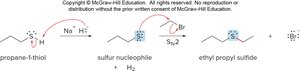
Thiols are synthesized from alkyl halides and HS–; sulfides are synthesized from alkyl halides and RS–.

Amines
Amines can be synthesized by reduction of N-containing functional groups, nucleophilic substitution, Gabriel synthesis, and reductive amination.
Reactivity: Substitution and Elimination in Alcohols and Ethers
Alcohols as Leaving Groups
Alcohols are poor leaving groups due to the basicity of hydroxide. Their leaving group ability can be improved by protonation (forming water), or by converting to alkyl tosylates, or by reaction with phosphorus and sulfur reagents.
Protonation: (water leaves easily)
Formation of Alkyl Tosylates: Alcohol reacts with tosyl chloride to form a tosylate, a good leaving group.
Phosphorus/Sulfur Reagents: Alcohols react with SOCl2 or PBr3 to form alkyl halides.
Dehydration of Alcohols
Alcohols can undergo elimination reactions to form alkenes. The mechanism and outcome depend on the structure of the alcohol, with possible carbocation rearrangements for greater stability.
Dehydration:
Carbocation Rearrangement: Alkyl groups may shift to stabilize the carbocation intermediate.
Epoxide Reactivity and Ring Opening
Acid-Catalyzed vs. Nucleophilic Ring Opening
Epoxides are more reactive than ethers due to ring strain. Under acidic conditions, nucleophiles attack the more substituted carbon after protonation. Under basic conditions, nucleophiles attack the less substituted carbon, with protonation following nucleophilic attack.
Acidic Ring Opening:
Basic Ring Opening:
Thiols and Sulfides: Properties and Reactions
Oxidation and Reduction of Thiols
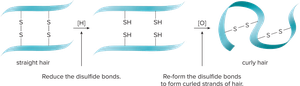
Thiols are easily oxidized to disulfides (RSSR), and disulfides can be reduced back to thiols. This chemistry is important in biological systems, such as the formation of curly hair from straight hair by manipulating disulfide bonds.
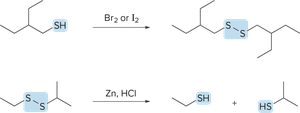
Oxidation:
Reduction:
Amines: Acid-Base Properties and Basicity
Acid/Base Chemistry of Amines
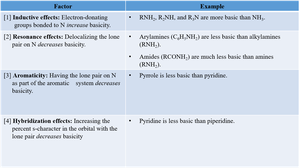
Amines act as both acids and bases, but are generally more basic than ammonia. The basicity of amines is influenced by several structural factors.
Inductive Effects: Electron-donating groups increase basicity.
Resonance Effects: Delocalization of the lone pair decreases basicity.
Aromaticity: Lone pair on N as part of aromatic system decreases basicity.
Hybridization Effects: Greater s-character in N orbital decreases basicity.
Factor | Example |
|---|---|
Inductive effects | RNH2, R2NH, R3N more basic than NH3 |
Resonance effects | Arylamines less basic than alkylamines; amides much less basic than amines |
Aromaticity | Pyrrole less basic than pyridine |
Hybridization effects | Pyridine less basic than piperidine |
pKa Values of Amines
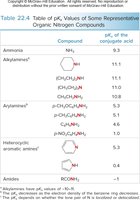
The pKa values of amines and related compounds reflect their basicity and are important for predicting their behavior in acid-base reactions.
Compound | pKa of conjugate acid |
|---|---|
Ammonia | 9.3 |
Alkylamines | 10.6–11.0 |
Arylamines | 4.6–5.1 |
Heterocyclic amines | 5.2–6.1 |
Amides | 0.1 |
Summary Table: Functional Groups and Key Properties
Functional Group | Structure | Key Properties |
|---|---|---|
Alcohol | R–OH | Hydrogen bonding, high boiling point, water solubility |
Ether | R–O–R | Lower boiling point, less reactive |
Epoxide | Three-membered ring with O | Ring strain, reactive |
Thiol | R–SH | Odorous, easily oxidized |
Sulfide | R–S–R | Less polar, important in biochemistry |
Amine | R–NH2 | Basic, nucleophilic |
Practice and Application
Reaction and Mechanism Practice
Students should practice drawing structures, naming compounds, and writing mechanisms for the synthesis and reactions of alcohols, ethers, epoxides, thiols, sulfides, and amines. Understanding the factors affecting reactivity and basicity is essential for predicting outcomes in organic synthesis.
