 Indietro
Exam 1 (PART 2)
Guida di studio - Note intelligenti
 Appunti personalizzati basati sui tuoi materiali, ampliati con definizioni chiave, esempi e contesto.
Molecular Representations
Units of Unsaturation
Units of unsaturation, also known as double bond equivalents, are used to determ
ine the degree of unsaturation in a molecule, which helps in deducing possible structures from a molecular formula.
Definition: 1 unit of unsaturation corresponds to either one ring or one π-bond (double or triple bond).
Formula: where C = number of carbons, H = number of hydrogens, N = number of nitrogens, X = number of halides (F, Cl, Br, I).
Fully saturated molecule: Contains only single bonds and no rings.
Functional Groups
Importance of Functional Groups
Functional groups are specific groups of atoms within molecules that are responsible for the characteristic chemical reactions of those molecules. Small changes in functional groups can lead to significant differences in biological activity and chemical properties.
Example: Adrenaline and dopamine differ by only a few functional groups but have very different physiological effects.
Classification and Identification of Functional Groups
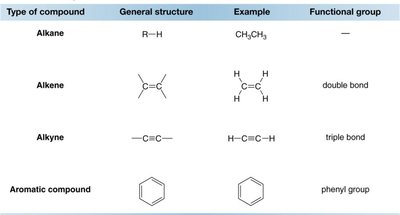
Functional groups are classified based on the atoms and bonds present. Below is a summary of common functional groups:
Type of compound | General structure | Example | Functional group |
|---|---|---|---|
Alkane | R–H | CH3CH3 | — |
Alkene | C=C | H2C=CH2 | double bond |
Alkyne | C≡C | HC≡CH | triple bond |
Aromatic compound |
| Benzene | phenyl group |
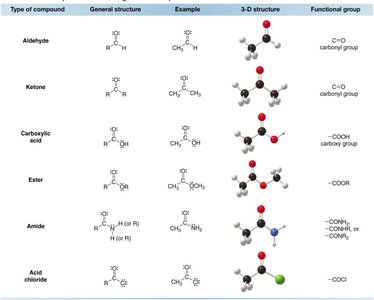
Type of compound | General structure | Example | Functional group |
|---|---|---|---|
Aldehyde | R–CHO | CH3CHO | –C=O (carbonyl group) |
Ketone | R–CO–R' | CH3COCH3 | –C=O (carbonyl group) |
Carboxylic acid | R–COOH | CH3COOH | –COOH (carboxy group) |
Ester | R–COOR' | CH3COOCH3 | –COOR |
Amide | R–CONH2 | CH3CONH2 | –CONH2, –CONHR, or –CONR2 |
Acid chloride | R–COCl | CH3COCl | –COCl |
Alcohols: Contain an –OH group attached to a saturated carbon atom.
Ethers: Contain an oxygen atom connected to two alkyl or aryl groups (R–O–R').
Epoxides: Three-membered cyclic ethers.
Amines: Nitrogen atom attached to one or more alkyl or aryl groups (classified as 1°, 2°, or 3° based on the number of carbon groups attached).
Nitriles: Contain a –C≡N group.
Alkyl halides: Carbon atom bonded to a halogen (F, Cl, Br, I).
Resonance Structures
Curved Arrow Notation
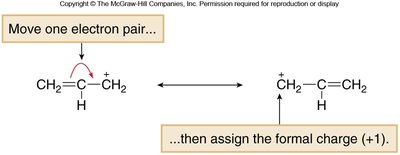
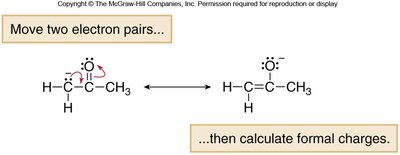
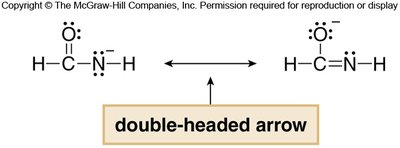
Curved arrows are used to show the movement of electrons in resonance structures. The tail of the arrow starts at the electron source (lone pair or bond), and the head points to the electron destination.
Full arrow: Movement of two electrons.
Fishhook (half) arrow: Movement of one electron (used in radical chemistry).
Principles of Resonance
Resonance involves the delocalization of π electrons and lone pairs across two or more atoms. It does not involve movement of σ-bond electrons or changes in atom connectivity.
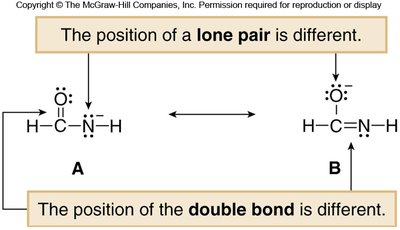
Resonance structures are alternative Lewis structures for the same molecule, differing only in the arrangement of electrons.
Resonance is not a reaction; it is a way to represent electron delocalization.
The true structure is a resonance hybrid, which is a weighted average of all valid resonance forms.
Rules for Drawing Resonance Structures
Only π electrons and lone pairs can be moved; σ bonds remain unchanged.
All resonance structures must be valid Lewis structures (no atom exceeds its octet, especially for second-row elements).
Resonance structures must have the same number of unpaired electrons.

Types of Resonance Interactions
Lone pair adjacent to a π bond (C=C or C=O).
π bond adjacent to a positive charge (carbocation).
Lone pair adjacent to a positive charge.
π bonds separated by one σ bond (conjugation).



Resonance in Conjugated Systems
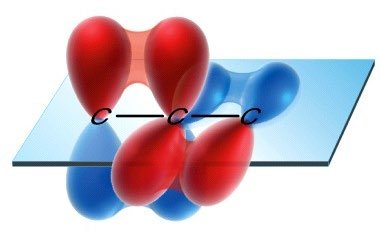
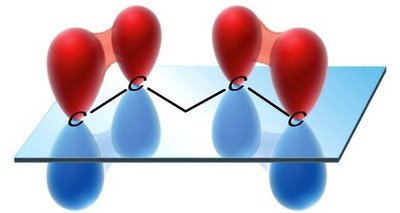
Conjugated systems have alternating single and multiple bonds, allowing for delocalization of π electrons across several atoms. This delocalization increases molecular stability.
Cumulated: Multiple bonds are adjacent (no resonance).
Conjugated: Alternating single and multiple bonds (resonance possible).
Isolated: Multiple bonds separated by more than one single bond (no resonance between them).

Resonance Hybrid
The resonance hybrid is a composite structure that represents the delocalization of electrons. It is more stable than any individual resonance form, and the best resonance contributor (major contributor) resembles the hybrid most closely.
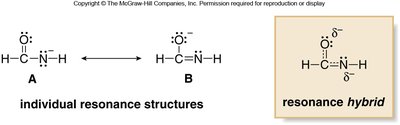
Example: For formamide anion, both oxygen and nitrogen bear partial negative charges in the resonance hybrid.
Summary Table: Functional Groups and Resonance
Functional Group | Key Atoms/Bonds | Example |
|---|---|---|
Alcohol | O–H | Ethanol |
Carboxylic Acid | COOH | Acetic acid |
Ester | COOR | Methyl acetate |
Ketone | CO | Acetone |
Aldehyde | CHO | Benzaldehyde |
Amide | CONH2 | Acetamide |
Alkene | C=C | Ethene |
Alkyne | C≡C | Acetylene |
Aromatic | Benzene ring | Benzene |
Additional info: The above notes integrate textbook-style explanations, tables, and relevant images to reinforce the concepts of molecular representations, functional groups, and resonance theory in organic chemistry.
