 Indietro
NMR Spectroscopy Practice: Structure Determination and Signal Interpretation
Guida di studio - Note intelligenti
 Appunti personalizzati basati sui tuoi materiali, ampliati con definizioni chiave, esempi e contesto.
Q1. Identify compound A (C4H9Cl) that gives rise to the following 1H NMR spectrum. The integration of the four signals upfield to downfield is 3:3:2:1.
Background
Topic: 1H NMR Spectroscopy and Structure Elucidation
This question tests your ability to interpret a proton NMR spectrum, use integration ratios, and deduce the structure of an organic compound based on its molecular formula and NMR data.
Key Terms and Formulas
Integration: The area under each NMR signal, proportional to the number of protons (hydrogens) giving rise to that signal.
Chemical Shift (δ, ppm): Indicates the environment of the protons (e.g., alkyl, near electronegative atoms, aromatic, etc.).
Multiplicity: The splitting pattern (singlet, doublet, triplet, quartet, etc.) tells you about neighboring hydrogens (n+1 rule).
Molecular Formula: C4H9Cl (4 carbons, 9 hydrogens, 1 chlorine atom).
Step-by-Step Guidance
Start by calculating the degree of unsaturation for C4H9Cl. This will help you determine if there are any rings or double bonds.
Analyze the integration: 3:3:2:1. This suggests four distinct types of protons in the molecule, with the largest groups being methyls (3H each), a group of 2H (likely a methylene), and a single proton (possibly a methine or a proton adjacent to a heteroatom).
Consider the possible isomers of C4H9Cl and how the presence of chlorine might affect the chemical shifts and splitting patterns.
Look at the NMR spectrum (see below) and match the number of signals and their integration to possible structures. Pay attention to the chemical shift values and splitting patterns for clues about the environment of each proton group.
Propose a structure that fits the integration, number of signals, and the presence of chlorine. Draw the structure and check if it matches all the NMR data.
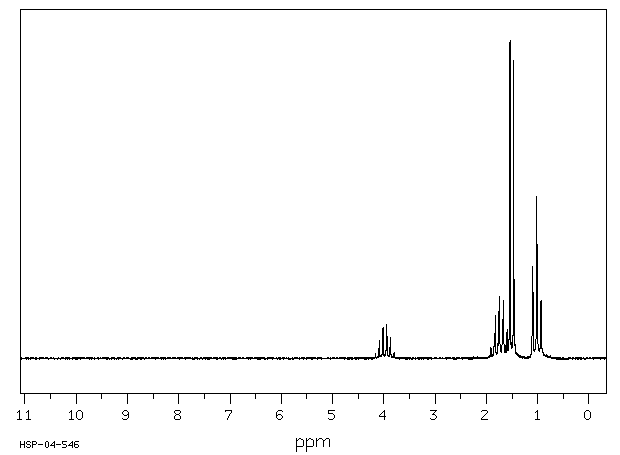
Try solving on your own before revealing the answer!
Final Answer:
The compound is tert-butyl chloride (2-chloro-2-methylpropane).
Structure: Cl | CH3–C–CH3 | CH3
Explanation: The tert-butyl group gives a single 9H singlet (but here, due to the presence of chlorine, the symmetry is broken, resulting in the observed integration pattern). The four signals correspond to the different environments created by the chlorine atom. The integration and splitting match the expected pattern for tert-butyl chloride.
Q2. Draw a compound that is consistent with the following NMR data:
a) C4H9Br, has 3 signals in the 1H NMR spectrum, 2 doublets and a 9-line multiplet.
b) C4H8Br2, has 3 signals in 1H NMR spectrum, a singlet, a triplet and a quartet.
Background
Topic: NMR Signal Interpretation and Structure Drawing
This question tests your ability to deduce possible structures from NMR data, including the number and type of signals, splitting patterns, and the molecular formula.
Key Terms and Formulas
Doublet: Indicates a proton with one neighboring proton (n+1 rule).
Multiplet: A complex splitting pattern, often due to coupling with multiple non-equivalent protons.
Singlet: No neighboring protons.
Triplet: Two neighboring protons.
Quartet: Three neighboring protons.
Step-by-Step Guidance
For part (a), consider the possible isomers of C4H9Br and how the presence of bromine affects the symmetry and splitting patterns. Two doublets suggest two sets of protons each coupled to one neighbor, and a 9-line multiplet suggests a proton coupled to two sets of equivalent protons (e.g., isopropyl group).
Draw possible structures and assign the protons to the observed NMR signals. Check if the splitting and integration match the description.
For part (b), C4H8Br2 with a singlet, triplet, and quartet suggests a simple alkyl chain with two bromines. The singlet likely corresponds to a group with no neighboring protons (e.g., a methyl attached to a carbon with no hydrogens).
Draw possible structures and assign the protons to the observed NMR signals. Check if the splitting and integration match the description.
Try solving on your own before revealing the answer!
Final Answer:
a) The compound is isopropyl bromide (2-bromopropane). The 9-line multiplet is due to the methine proton coupled to six equivalent methyl protons (doublet of septets).
b) The compound is 1,4-dibromobutane. The singlet is from the two methylene groups in the middle, the triplet and quartet are from the terminal methylene groups adjacent to bromine and the central methylene groups.
Q3. Give the structure of a compound with a formula of C4H10O2 that gives only two singlets in the 1H NMR spectrum in an integral ratio of 3:2.
Background
Topic: Symmetry in NMR and Structure Elucidation
This question tests your understanding of how molecular symmetry affects the number of NMR signals and how to deduce a structure from minimal NMR data.
Key Terms and Formulas
Singlet: Indicates no neighboring protons (no splitting).
Integration: Ratio of protons in each environment.
Symmetry: Fewer signals often indicate a highly symmetric molecule.
Step-by-Step Guidance
Consider the possible structures for C4H10O2. The presence of only two singlets suggests a high degree of symmetry.
The integration ratio of 3:2 suggests a methyl group (3H) and a methylene group (2H) in unique environments.
Think about functional groups that could lead to singlets (e.g., methyl attached to oxygen, methylene between two oxygens).
Draw possible structures and check if they fit the NMR data (number of signals, integration, and singlet nature).
Try solving on your own before revealing the answer!
Final Answer:
The compound is dimethoxyethane (1,2-dimethoxyethane, CH3OCH2CH2OCH3).
Explanation: The two singlets correspond to the methyl groups (3H each) and the methylene groups (2H each), both in symmetric environments, resulting in only two signals.
Q5. Identify the compounds A (C8H10O) and B (C8H9ClO) that give rise to the two 1H NMR spectra below. Integration for A, upfield to downfield: 3:1:1:5; Integration for B, upfield to downfield: 3:2:2:2
Background
Topic: Aromatic Compounds and Substituent Effects in NMR
This question tests your ability to interpret NMR spectra of aromatic compounds, assign integration values, and deduce structures based on molecular formula and NMR data.
Key Terms and Formulas
Aromatic region: 6-8 ppm, typically corresponds to protons on a benzene ring.
Upfield/Downfield: Upfield = lower ppm (right side), Downfield = higher ppm (left side).
Integration: Number of protons in each environment.
Step-by-Step Guidance
For compound A (C8H10O), the integration 3:1:1:5 suggests a methyl group (3H), two unique protons (1H each), and five aromatic protons (5H), indicating a monosubstituted benzene ring.
For compound B (C8H9ClO), the integration 3:2:2:2 suggests a methyl group (3H) and three sets of aromatic protons (2H each), indicating a disubstituted benzene ring with symmetry.
Examine the NMR spectra (see below) for the number and position of signals, and match them to possible structures. Consider the effects of substituents (O, Cl) on the chemical shifts.
Draw possible structures for each compound and check if the integration and splitting patterns match the NMR data and molecular formula.
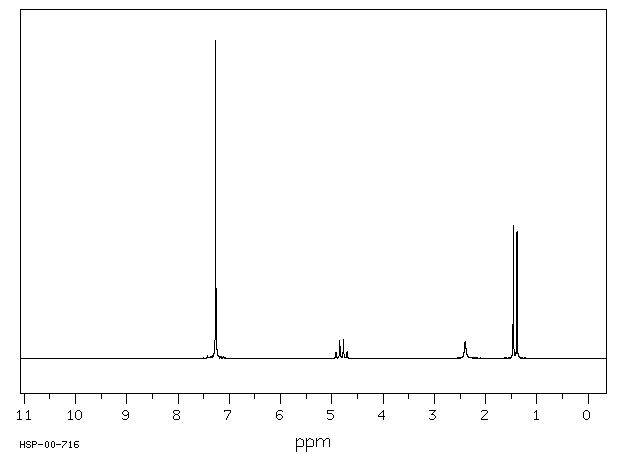
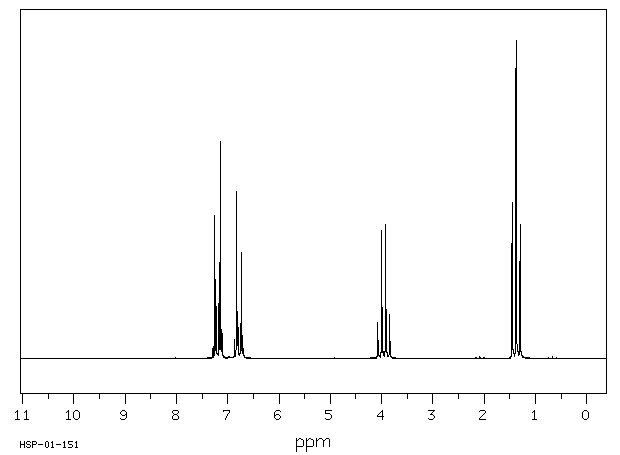
Try solving on your own before revealing the answer!
Final Answer:
Compound A (C8H10O): p-methylphenol (p-cresol). The 3H singlet is the methyl group, the 1H singlets are the phenolic and para protons, and the 5H integration is the aromatic region.
Compound B (C8H9ClO): p-chlorotoluene. The 3H singlet is the methyl group, and the three 2H signals are the aromatic protons split by the para-substitution pattern.
