 Indietro
Nucleophilic Substitution and β-Elimination: Mechanisms, Factors, and Competition
Guida di studio - Note intelligenti
 Appunti personalizzati basati sui tuoi materiali, ampliati con definizioni chiave, esempi e contesto.
Nucleophilic Substitution and β-Elimination
Introduction to Nucleophilic Substitution and β-Elimination
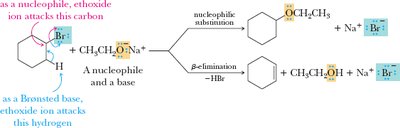
Nucleophilic substitution and β-elimination are fundamental reactions in organic chemistry, particularly involving haloalkanes. In nucleophilic substitution, a nucleophile replaces a leaving group, while β-elimination involves the removal of a hydrogen and a leaving group from adjacent carbons, forming an alkene. These reactions often compete under similar conditions.
Nucleophile: Electron-rich species (Lewis base) that donates a pair of electrons.
Electrophile: Electron-deficient species (Lewis acid) that accepts a pair of electrons.
Leaving Group: The group displaced in substitution or lost in elimination, ideally forming a stable anion.
β-Elimination: Removal of a hydrogen (β to the leaving group) and the leaving group, forming a double bond.

Types of Nucleophilic Substitution Reactions
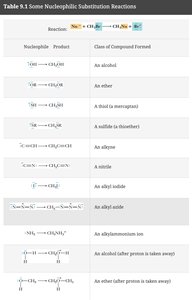
Nucleophilic substitution reactions can be classified based on the nucleophile and the product formed. The nature of the nucleophile determines the class of compound produced.
Nucleophile | Product | Class of Compound Formed |
|---|---|---|
OH- | CH3OH | An alcohol |
CH3O- | CH3OCH3 | An ether |
SH- | CH3SH | A thiol (a mercaptan) |
CH3S- | CH3SCH3 | A sulfide (a thioether) |
CN- | CH3CN | A nitrile |
I- | CH3I | An alkyl iodide |
N3- | CH3N3 | An alkyl azide |
CH3CO2- | CH3CO2CH3 | An alkylammonium ion |
NH3 | CH3NH3+ | An alkylammonium ion (other proton is taken away) |
Mechanisms of Nucleophilic Aliphatic Substitution
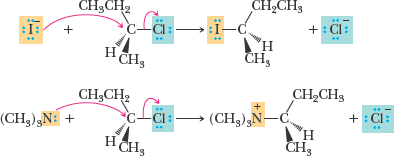
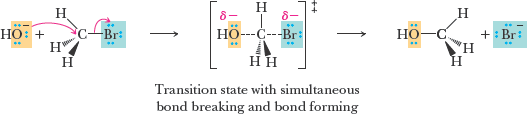
Nucleophilic substitution occurs via two main mechanisms: SN2 (bimolecular) and SN1 (unimolecular). The mechanism depends on the structure of the substrate, the nucleophile, and the reaction conditions.
SN2 Mechanism: One-step, concerted reaction where the nucleophile attacks the substrate as the leaving group departs. Involves a transition state with simultaneous bond breaking and forming.
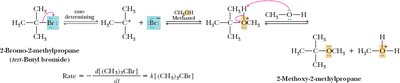
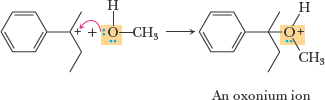
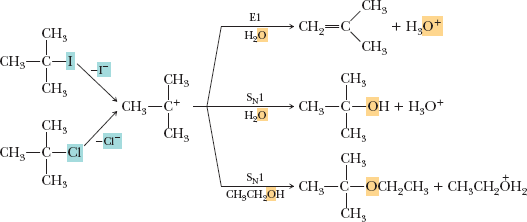
SN1 Mechanism: Two-step reaction. First, the leaving group departs, forming a carbocation intermediate. Second, the nucleophile attacks the carbocation.
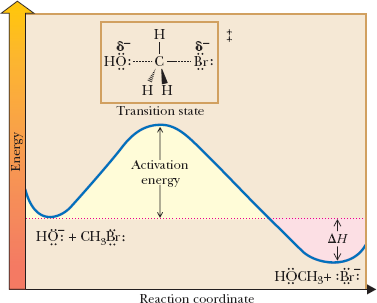
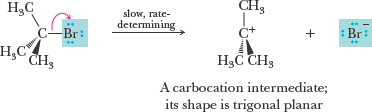
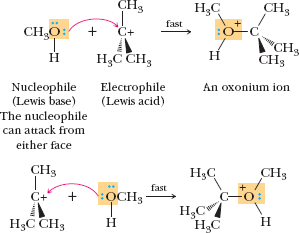
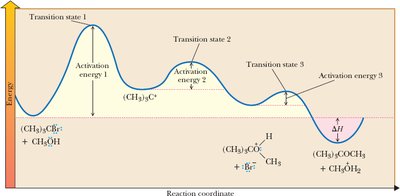
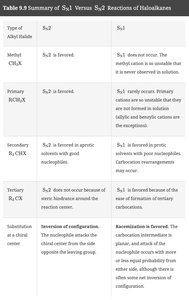
Key Mechanism Differences: SN1 vs SN2
The SN2 mechanism is characterized by a single transition state and inversion of configuration, while SN1 involves carbocation intermediates and can lead to racemization.
SN2: Concerted, single-step, inversion of configuration.
SN1: Stepwise, carbocation intermediate, racemization or partial racemization.
Experimental Evidence for SN1 and SN2 Mechanisms
Experimental approaches to distinguish SN1 and SN2 include kinetic analysis and stereochemical outcomes. SN1 reactions are first-order in substrate, while SN2 reactions are second-order (first-order in both substrate and nucleophile).
Stereochemistry of SN1 and SN2 Reactions
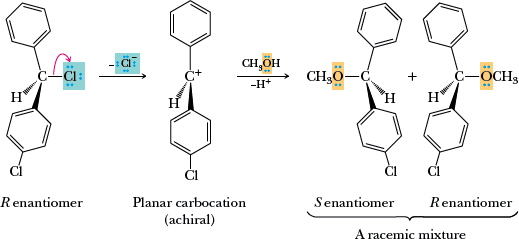
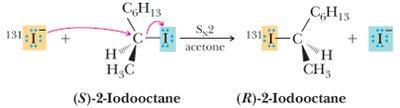
Stereochemical outcomes are crucial for identifying the mechanism. SN2 reactions always proceed with inversion of configuration due to backside attack, while SN1 reactions can lead to racemization due to planar carbocation intermediates.
SN2: Complete inversion of configuration.
SN1: Partial or complete racemization, depending on ion pair formation.
Structure of the Alkyl Portion of the Haloalkane
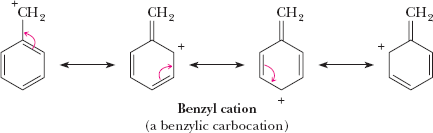
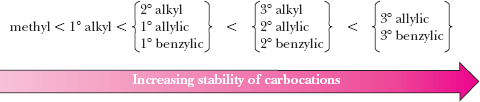
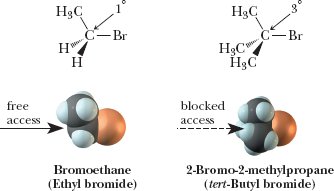
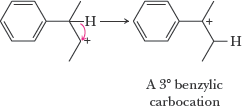
The structure of the haloalkane affects the mechanism. SN1 is favored by substrates that can form stable carbocations (tertiary, allylic, benzylic), while SN2 is favored by less hindered substrates (primary, methyl).
SN1: Favored by tertiary, allylic, and benzylic carbocations due to stability from hyperconjugation and resonance.
SN2: Favored by primary and methyl haloalkanes due to minimal steric hindrance.
The Leaving Group
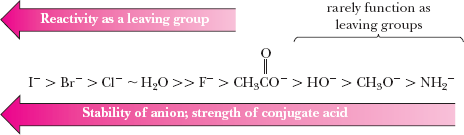
The quality of the leaving group is critical for both SN1 and SN2 reactions. Good leaving groups are weak bases and form stable anions.
Good leaving groups: I-, Br-, Cl-, H2O
Poor leaving groups: HO-, CH3O-, NH2-
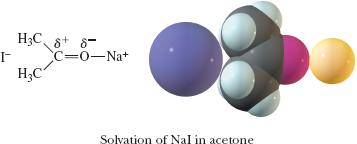
The Solvent
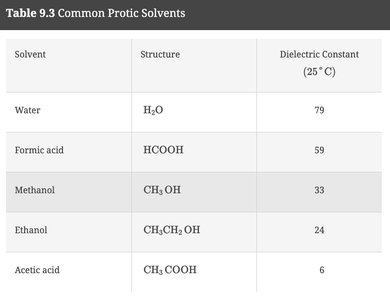
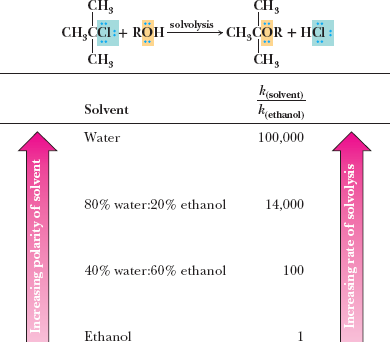
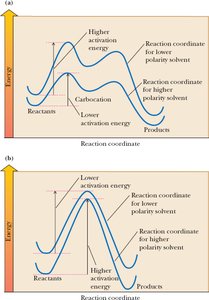
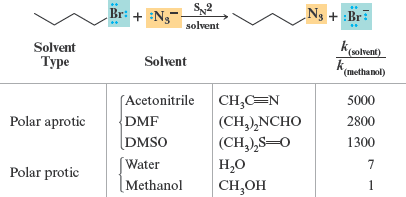
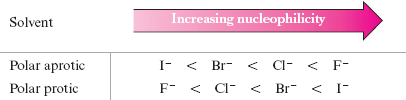
Solvents influence the rate and mechanism of nucleophilic substitution. Solvents are classified as protic (hydrogen-donating) or aprotic, and as polar or nonpolar based on dielectric constant.
Polar protic solvents: Stabilize carbocations and anions, favor SN1.
Polar aprotic solvents: Favor SN2 by solvating cations but not anions.
Structure of the Nucleophile
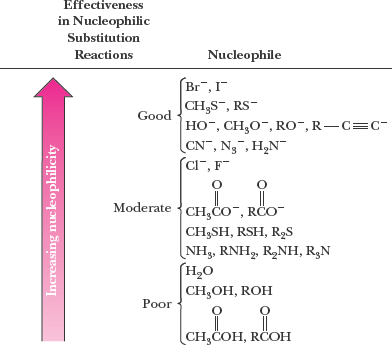
Nucleophilicity is a kinetic property, while basicity is an equilibrium property. Strong, sterically unhindered bases are good nucleophiles. Nucleophilicity is affected by solvent and the nature of the nucleophile.
Good nucleophiles: Br-, I-, HO-, CH3O-, CN-, N3-, NH2-
Moderate nucleophiles: CH3CO-, RCO-, NH3, RNH2
Poor nucleophiles: H2O, CH3OH, CH3COOH
Skeletal Rearrangement
Skeletal rearrangement is typical of SN1 reactions due to carbocation intermediates, which can rearrange to more stable forms. SN2 reactions do not involve rearrangement.

Analysis of Nucleophilic Substitution Reactions
Predicting the outcome of nucleophilic substitution requires consideration of the substrate, nucleophile, leaving group, and solvent. SN1 is favored in polar protic solvents with weak nucleophiles, while SN2 is favored with strong nucleophiles in polar aprotic solvents.
β-Elimination Mechanisms
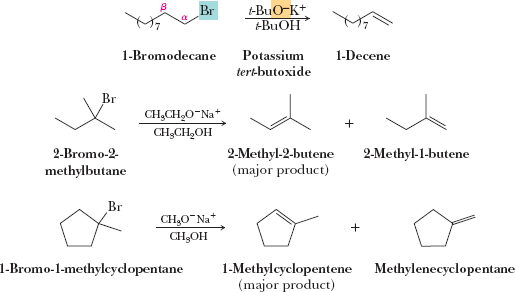
β-Elimination is a competing process to substitution, often promoted by strong bases. The major product is typically the most substituted alkene, following Zaitsev's rule.
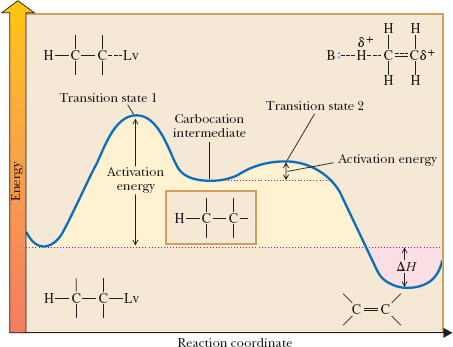
E1 Mechanism: Two-step, formation of carbocation intermediate, then loss of proton.
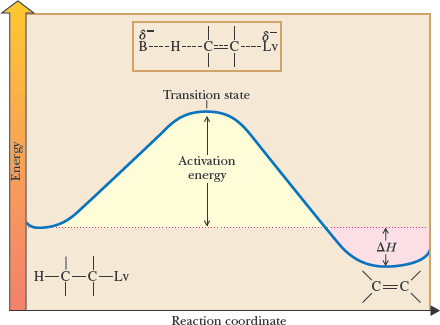
E2 Mechanism: One-step, concerted removal of proton and leaving group.

Substitution versus Elimination: Competition and Prediction
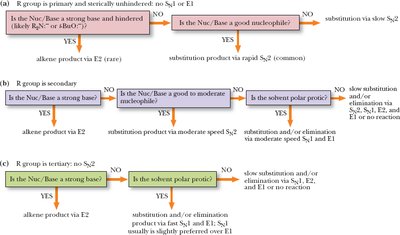
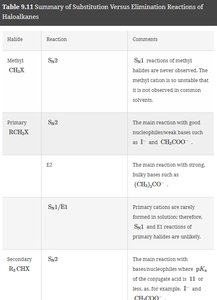
The competition between substitution and elimination depends on substrate structure, nucleophile/base strength, solvent, and temperature. Flow charts and tables help predict the dominant pathway.
SN1 vs E1: Tertiary haloalkanes in polar protic solvents give mixtures; SN1 predominates with weak bases.
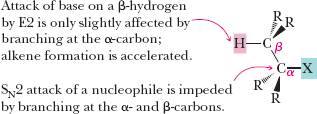
SN2 vs E2: Branching increases E2, strong bases favor E2, strong nucleophiles favor SN2.
Temperature: Higher temperatures favor elimination.
Conclusion
Nucleophilic substitution and β-elimination are central to organic chemistry, with their mechanisms and outcomes determined by substrate structure, nucleophile/base strength, leaving group, solvent, and temperature. Understanding these factors allows for prediction and control of reaction pathways.
