 Indietro
Nucleophilic Substitution and β-Elimination: Mechanisms, Factors, and Applications
Guida di studio - Note intelligenti
 Appunti personalizzati basati sui tuoi materiali, ampliati con definizioni chiave, esempi e contesto.
Chapter 9: Nucleophilic Substitution and β-Elimination
Introduction to Nucleophilic Substitution and β-Elimination
Nucleophilic substitution and β-elimination are fundamental reaction types in organic chemistry, particularly for haloalkanes. In nucleophilic substitution, a nucleophile replaces a leaving group, while in β-elimination, a base removes a proton from the β-carbon, resulting in the formation of an alkene. These reactions often compete under similar conditions, and understanding their mechanisms is crucial for predicting reaction outcomes.
Nucleophilic Substitution: Concepts and Mechanisms
Key Definitions
Nucleophile: An electron-rich species (Lewis base) that donates an electron pair to an electrophile.
Electrophile: An electron-deficient species (Lewis acid) that accepts an electron pair from a nucleophile.
Leaving Group: The atom or group that is displaced in a substitution or elimination reaction, typically forming a stable anion.
In nucleophilic substitution, new bonds are formed between the nucleophile and the electrophile, while bonds to the leaving group are broken. The stability of the leaving group and the nature of the nucleophile are critical factors.

Types of Nucleophilic Substitution Mechanisms
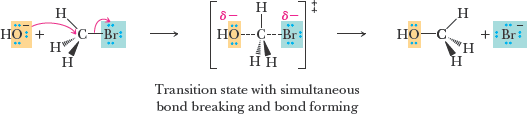
SN2 Mechanism (Bimolecular Nucleophilic Substitution):
Occurs in a single concerted step with simultaneous bond formation and bond breaking.
Both the nucleophile and the substrate are involved in the rate-determining step.
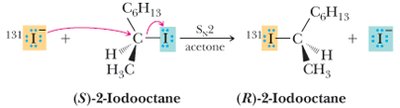
Proceeds via a backside attack, leading to inversion of configuration at the reaction center.
SN1 Mechanism (Unimolecular Nucleophilic Substitution):
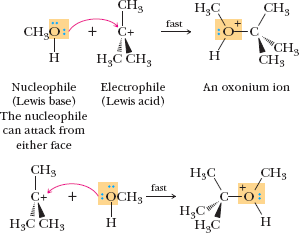
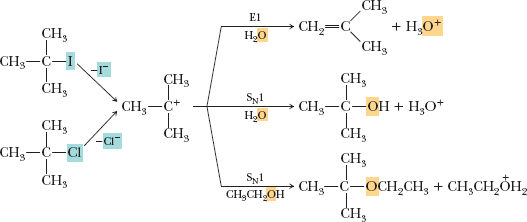
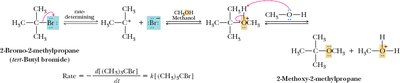
Occurs in two steps: first, the leaving group departs, forming a carbocation intermediate; second, the nucleophile attacks the carbocation.
Only the substrate is involved in the rate-determining step (first-order kinetics).
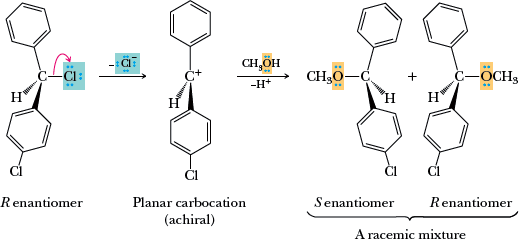
Can lead to racemization due to planar carbocation intermediate.
Examples of Nucleophilic Substitution Reactions
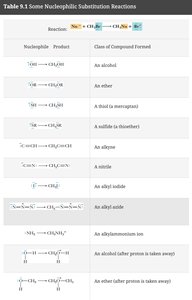
Mechanistic Details and Reaction Coordinates
SN2 Mechanism: The nucleophile attacks from the side opposite the leaving group, resulting in a transition state with partial bonds to both the nucleophile and leaving group.
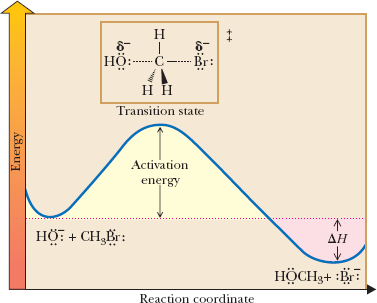
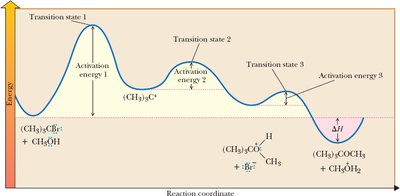
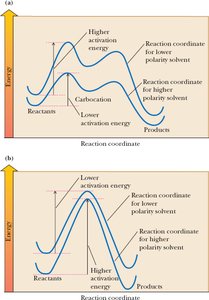
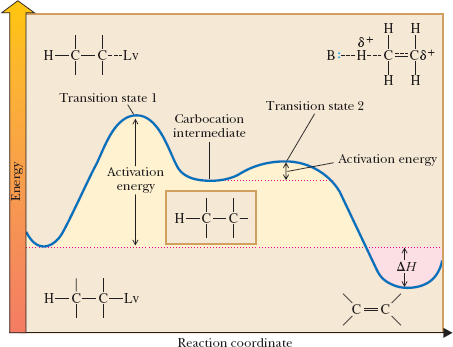
SN1 Mechanism: The leaving group departs first, forming a carbocation, which is then attacked by the nucleophile. The reaction coordinate diagram shows two energy barriers (for carbocation formation and nucleophilic attack).
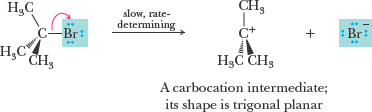
Kinetics of SN1 and SN2 Reactions
SN1: Rate depends only on the concentration of the substrate (first-order kinetics):
SN2: Rate depends on both the substrate and nucleophile (second-order kinetics):
Stereochemistry of SN1 and SN2 Reactions
SN2: Always results in inversion of configuration at the reaction center due to backside attack.
SN1: Can lead to racemization, but often partial racemization due to ion-pair effects.
Factors Affecting Nucleophilic Substitution
Structure of the Alkyl Halide
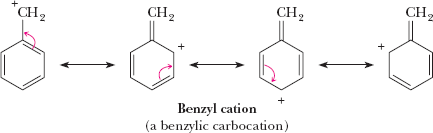
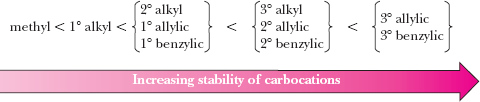
SN1: Favored by substrates that can form stable carbocations (tertiary, allylic, benzylic).
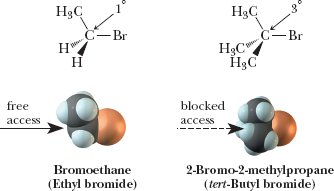
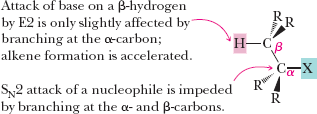
SN2: Favored by less hindered substrates (methyl, primary); steric hindrance slows the reaction.
Leaving Group Ability
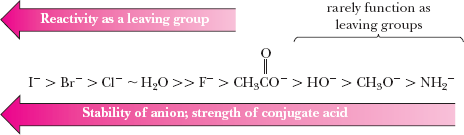
Good leaving groups are weak bases and can stabilize the negative charge after departure.
Order of leaving group ability: I- > Br- > Cl- > H2O >> F- > CH3COO- > HO- > CH3O- > NH2-
Solvent Effects
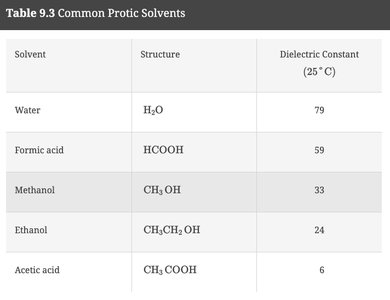
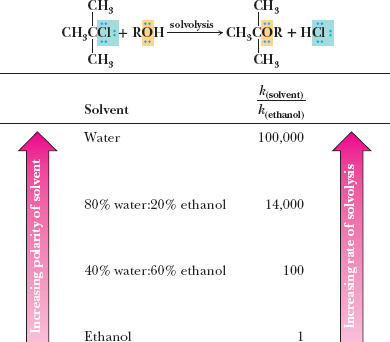
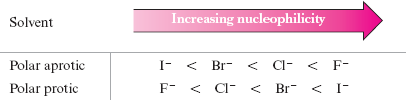
Protic solvents (e.g., water, alcohols) stabilize ions via hydrogen bonding and favor SN1 reactions by stabilizing carbocations and leaving groups.
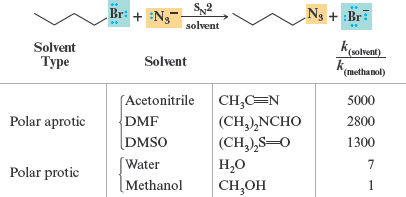
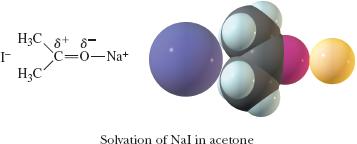
Aprotic solvents (e.g., DMSO, acetone) do not hydrogen bond to anions, increasing nucleophilicity and favoring SN2 reactions.
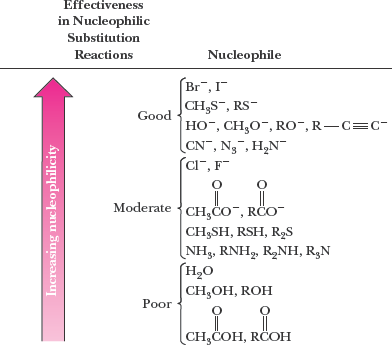
Nucleophile Structure and Strength
Nucleophilicity is a kinetic property describing how readily a species attacks an electrophile.
Strong bases are often strong nucleophiles, but steric hindrance can reduce nucleophilicity.
Polar aprotic solvents enhance nucleophilicity of anions; polar protic solvents decrease it due to solvation.
Skeletal Rearrangement in SN1 Reactions
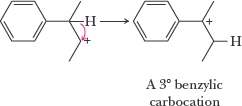
Skeletal rearrangements can occur in SN1 reactions due to the formation of carbocation intermediates, which may rearrange to more stable carbocations via hydride or alkyl shifts. SN2 reactions do not involve carbocation intermediates and thus do not undergo rearrangement.

β-Elimination Reactions
Mechanism and Products
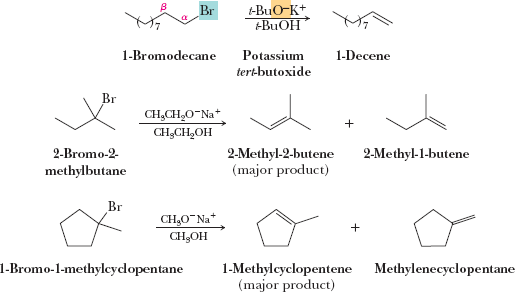
β-Elimination involves the removal of a proton from the β-carbon and a leaving group from the α-carbon, resulting in the formation of an alkene.
Strong bases (e.g., OH-, OR-, NH2-) promote β-elimination.
The major product is typically the most substituted alkene (Zaitsev's rule).

E1 and E2 Mechanisms
E1 Mechanism: Two-step process involving carbocation formation followed by deprotonation by a base.
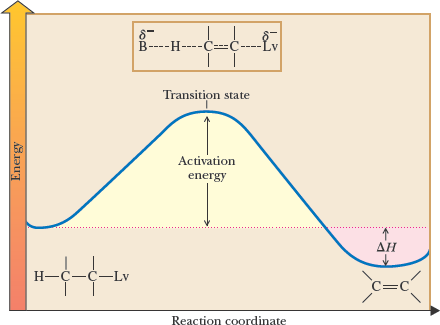
E2 Mechanism: One-step process where the base removes a proton as the leaving group departs, forming the alkene in a concerted manner.
Competition Between Substitution and Elimination
Factors Influencing the Outcome
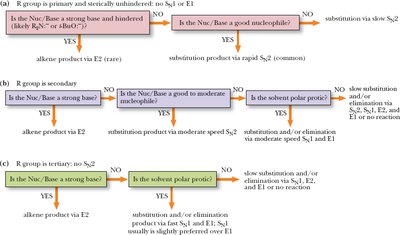
Structure of the substrate (primary, secondary, tertiary)
Strength and steric bulk of the base/nucleophile
Solvent type (protic vs. aprotic)
Temperature (higher temperatures favor elimination)
Summary Tables
Summary of SN1 vs SN2 Reactions
Summary of Substitution vs Elimination Reactions
Key Takeaways
SN1 and SN2 are the two main mechanisms for nucleophilic substitution; E1 and E2 are the main mechanisms for β-elimination.
The outcome of a reaction depends on substrate structure, nucleophile/base strength, leaving group ability, solvent, and temperature.
Understanding these factors allows for prediction and control of organic reaction pathways.
