 Indietro
Nucleophilic Substitution: Mechanisms, Reactivity, and Stereochemistry
Guida di studio - Note intelligenti
 Appunti personalizzati basati sui tuoi materiali, ampliati con definizioni chiave, esempi e contesto.
Chapter 6: Nucleophilic Substitution
Section 6.1: Functional-Group Transformation by Nucleophilic Substitution
Nucleophilic substitution is a fundamental reaction in organic chemistry, enabling the transformation of functional groups by replacing a leaving group with a nucleophile. This process is central to the synthesis of alkyl halides from alcohols and other related transformations.
Nucleophilic Substitution: Involves the replacement of a leaving group (LG) on an electrophilic carbon by a nucleophile (Nu).
General Reaction:
Key Participants:
Nucleophile: Electron-rich species (often an anion) that donates a pair of electrons.
Electrophile: Carbon atom bonded to a leaving group, typically polarized to facilitate nucleophilic attack.
Leaving Group: Atom or group that departs with a pair of electrons, often a halide or pseudohalide.
Example: Formation of alkyl halides from alcohols via substitution.
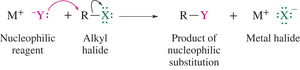
The Nucleophile
Nucleophiles are typically simple metal salts, where the nucleophilic anion can be organic or inorganic. Their strength and structure influence the rate and outcome of substitution reactions.
Common Nucleophiles:
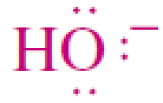
Metal hydroxides ()
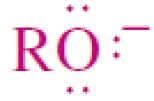
Metal alkoxides ()
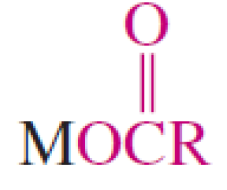
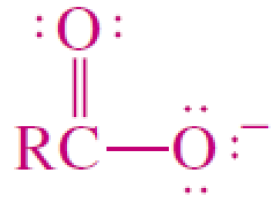
Metal carboxylates (, )
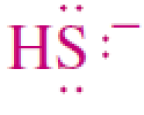
Metal hydrogen sulfides ()
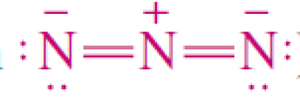
Metal azides ()
Key Point: The nucleophile must possess a lone pair of electrons and often a negative charge.
The Electrophile
The electrophilic carbon must be sp3-hybridized and bonded to a leaving group. Alkyl halides and sulfonates are common electrophiles in nucleophilic substitution.
Electrophilic Carbon: Partial positive charge due to bond polarization toward the leaving group.
Requirement: Must be sp3-hybridized for SN2 reactions.
Section 6.2: Relative Reactivity of Halide Leaving Groups
Leaving Group Ability
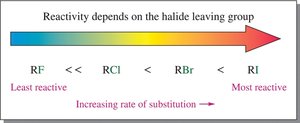
The efficiency of nucleophilic substitution depends greatly on the leaving group. Good leaving groups are associated with strong acids and weaker C–X bonds.
Trend: Reactivity increases as the leaving group becomes more stable after departure.
Order of Reactivity:
Good Leaving Groups: Halides (Cl-, Br-, I-), sulfonates.
Section 6.3: The SN2 Mechanism of Nucleophilic Substitution
Kinetics of SN2
SN2 reactions are bimolecular, involving simultaneous interaction between the nucleophile and the electrophile. The rate depends on both reactants.
Rate Law:
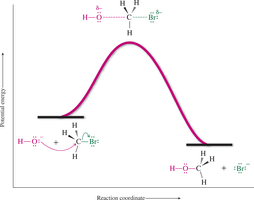
Example: Substitution of methyl bromide with hydroxide ion.

Reaction Coordinate Diagram
The SN2 mechanism proceeds through a single transition state, with the nucleophile attacking the electrophilic carbon as the leaving group departs.
Transition State: Both nucleophile and leaving group are partially bonded to the carbon.
Energy Profile: One peak corresponding to the transition state.
Stereochemistry of SN2
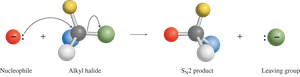
SN2 reactions are stereospecific, resulting in inversion of configuration at the electrophilic carbon. This is known as the "Walden inversion."
Inversion of Configuration: The nucleophile attacks from the opposite side of the leaving group.
100% Stereospecific: The product's stereochemistry is always inverted relative to the starting material.

Electrostatic and Stereoelectronic Explanation
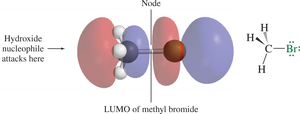
Electrostatic potential maps and molecular orbital theory explain why SN2 reactions occur with inversion. The nucleophile attacks the electrophilic carbon from the backside, where the LUMO is most accessible.
Backside Attack: Nucleophile overlaps with the LUMO of the electrophile.
Valence Bond Theory: Transition state is planar, with nucleophile and leaving group aligned oppositely.


Section 6.4: Steric Effects and SN2 Reaction Rates
Steric Hindrance in the Electrophile
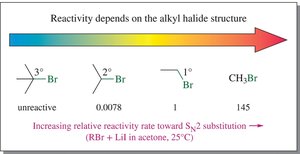
Steric hindrance from alkyl groups attached to the electrophilic carbon significantly affects the rate of SN2 reactions. The more crowded the carbon, the slower the reaction.
Order of Reactivity: Methyl > Primary > Secondary > Tertiary alkyl halides
Reason: Bulky groups impede the nucleophile's access to the electrophilic carbon.
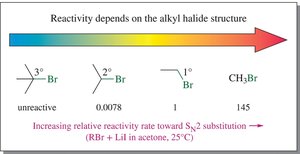
The Neopentyl Effect: Adjacent Alkyl Groups
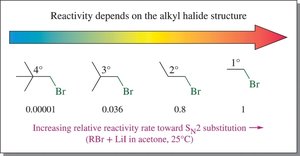
Even alkyl groups adjacent to the electrophilic carbon (not directly attached) can slow SN2 reactions by steric hindrance, though not as severely as direct substitution.
Order of Reactivity: Quaternary < Tertiary < Secondary < Primary
Example: Neopentyl bromide reacts much slower than primary bromide due to adjacent branching.
Summary Table: Reactivity of Alkyl Halides in SN2
Alkyl Halide | Structure | Relative Rate |
|---|---|---|
Methyl | CH3Br | 145 |
Primary | CH3CH2Br | 1 |
Secondary | (CH3)2CHBr | 0.0078 |
Tertiary | (CH3)3CBr | Unreactive |
Key Equations
General SN2 Reaction:
Rate Law:
Conclusion
Nucleophilic substitution, particularly the SN2 mechanism, is a cornerstone of organic synthesis. Understanding the roles of nucleophile, electrophile, leaving group, and steric effects is essential for predicting and controlling these reactions.
