 Indietro
Organic Chemistry Exam 1 - Set 2 Study Guidance
Guida di studio - Note intelligenti
 Appunti personalizzati basati sui tuoi materiali, ampliati con definizioni chiave, esempi e contesto.
Q1. What happens to the beta hydrogen during the conversion of two sigma bonds into a pi bond in an elimination reaction?
Background
Topic: Elimination Reactions (E2/E1 Mechanism)
This question tests your understanding of the role of the beta hydrogen in elimination reactions, specifically how a pi bond is formed from sigma bonds.
Key Terms:
Beta hydrogen: The hydrogen atom on the carbon adjacent to the carbon bearing the leaving group.
Elimination reaction: A reaction where atoms are removed from a molecule, resulting in the formation of a double bond (pi bond).
Pi bond: A bond formed by the sideways overlap of p orbitals, typically in alkenes.
Step-by-Step Guidance
Identify the beta hydrogen in the molecule undergoing elimination.
Recall that elimination reactions (E2/E1) involve the removal of a leaving group and a hydrogen from adjacent carbons.
Understand that the base abstracts the beta hydrogen, which is removed as a proton (H+).
Recognize that the electrons from the C-H bond help form the new pi bond between the alpha and beta carbons.
Try solving on your own before revealing the answer!
Final Answer: a. It is removed as a proton, allowing the formation of the pi bond.
In elimination reactions, the beta hydrogen is abstracted by a base, and its removal as a proton enables the formation of a double bond (pi bond) between the alpha and beta carbons.
Q2. Give the identity of products obtained in each elimination reaction shown below. Determine which is the major product if more than one type of product can be obtained in the reactions. Also provide a brief explanation for your answers by comparing the degree of substitution of each double bond in the products.
Background
Topic: Elimination Reactions & Zaitsev's Rule
This question tests your ability to predict the products of elimination reactions and identify the major product based on the degree of substitution of the resulting alkenes.
Key Terms and Formulas:
Zaitsev's Rule: The most substituted alkene is usually the major product in elimination reactions.
Degree of substitution: Refers to the number of alkyl groups attached to the carbons of the double bond.
Elimination reaction: Removal of a leaving group and a hydrogen to form a double bond.
Step-by-Step Guidance
Write the starting structure for each reaction and identify the leaving group and possible beta hydrogens.
Draw all possible alkenes formed by elimination of the leaving group and a beta hydrogen.
Compare the degree of substitution for each possible alkene product.
Apply Zaitsev's Rule to determine which product is the most substituted and thus the major product.
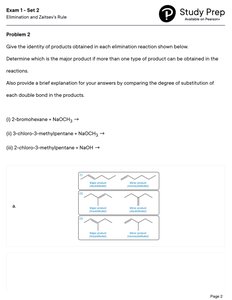
Try solving on your own before revealing the answer!
Final Answer:
For each reaction, the major product is the most substituted alkene, as predicted by Zaitsev's Rule. The degree of substitution determines the stability and predominance of the product.
Q3. Draw the product(s) obtained in the following reaction of the stereoisomer of 2-bromo-1,3,5-trimethylcyclohexane with CH3O-.
Background
Topic: SN1/SN2/E1/E2 Mechanisms & Stereochemistry
This question tests your ability to predict the product(s) of a nucleophilic substitution or elimination reaction, considering the stereochemistry of the starting material.
Key Terms:
Stereoisomer: Molecules with the same connectivity but different spatial arrangement.
CH3O-: A strong nucleophile and base, favoring E2 or SN2 mechanisms.
Product: The molecule formed after the reaction.
Step-by-Step Guidance
Examine the stereochemistry of the starting cyclohexane and identify the position of the bromine and methyl groups.
Determine whether the reaction will proceed via E2 or SN2, based on the base/nucleophile and substrate structure.
Draw the product(s) considering the possible elimination or substitution, and account for stereochemical outcomes.
Check for possible regio- and stereoisomers among the products.
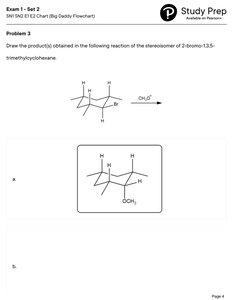
Try solving on your own before revealing the answer!
Final Answer:
The product(s) will depend on the stereochemistry and whether elimination or substitution occurs. The most likely product is the one where the nucleophile attacks or the base abstracts a hydrogen anti to the leaving group, resulting in a specific stereoisomer.
Q7. Explain the reason why stronger bases such as sodium hydride (NaH) lead to a faster E2 elimination compared to sodium methoxide (CH3ONa) by using the reaction's coordinate diagram.
Background
Topic: E2 Mechanism & Reaction Kinetics
This question tests your understanding of how base strength affects the rate of E2 elimination reactions, using energy diagrams.
Key Terms:
E2 elimination: A concerted mechanism where a base removes a proton and a leaving group departs simultaneously.
Transition state: The highest energy point along the reaction coordinate.
Activation energy (): The energy barrier that must be overcome for the reaction to proceed.
Step-by-Step Guidance
Compare the strength of NaH and CH3ONa as bases.
Recall that stronger bases can abstract protons more efficiently, lowering the activation energy ().
Analyze the reaction coordinate diagram: a lower means a faster reaction.
Relate the stability of the transition state to the base strength.
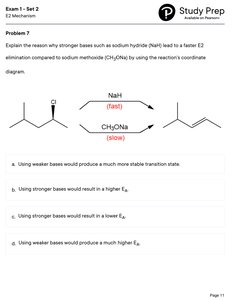
Try solving on your own before revealing the answer!
Final Answer: c. Using stronger bases would result in a lower .
Stronger bases facilitate proton abstraction, lowering the activation energy and speeding up the E2 elimination.
Q8. Identify the better SN2 substrate from the following pairs of compounds.
Background
Topic: SN2 Mechanism & Substrate Structure
This question tests your ability to compare different substrates and determine which is more reactive in SN2 reactions.
Key Terms:
SN2 reaction: A bimolecular nucleophilic substitution, favored by less hindered substrates.
Substrate: The molecule undergoing substitution.
Steric hindrance: The crowding around the reactive center, which slows SN2 reactions.
Step-by-Step Guidance
Compare the degree of substitution at the carbon bearing the leaving group for each pair.
Recall that primary substrates are better for SN2 than secondary or tertiary.
Consider the effect of branching and the nature of the leaving group.
Identify the substrate with the least steric hindrance in each pair.
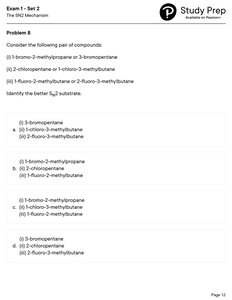
Try solving on your own before revealing the answer!
Final Answer:
The better SN2 substrate is the one with the least steric hindrance and a good leaving group, typically the primary halide.
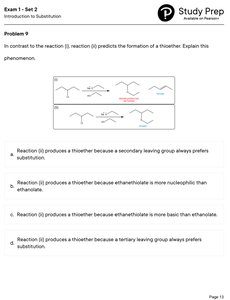
Q9. In contrast to the reaction (i), reaction (ii) predicts the formation of a thioether. Explain this phenomenon.
Background
Topic: Substitution Reactions & Nucleophile Strength
This question tests your understanding of why certain nucleophiles favor substitution over elimination, leading to thioether formation.
Key Terms:
Thioether: An organic compound containing a sulfur atom bonded to two carbon atoms.
Nucleophile: A species that donates an electron pair to form a bond.
Leaving group: The atom or group that departs during substitution or elimination.
Step-by-Step Guidance
Compare the nucleophilicity and basicity of ethanethiolate and ethanoate.
Recall that stronger nucleophiles favor substitution, while stronger bases favor elimination.
Analyze the leaving group and substrate structure in both reactions.
Determine why reaction (ii) leads to thioether formation.
Try solving on your own before revealing the answer!
Final Answer: b. Reaction (ii) produces a thioether because ethanethiolate is more nucleophilic than ethanoate.
Ethanethiolate is a stronger nucleophile, favoring substitution and thioether formation.
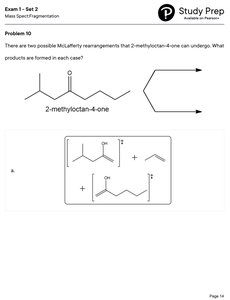
Q10. There are two possible McLafferty rearrangements that 2-methyloctan-4-one can undergo. What products are formed in each case?
Background
Topic: Mass Spectrometry & McLafferty Rearrangement
This question tests your understanding of the McLafferty rearrangement, a fragmentation process in mass spectrometry involving transfer of a hydrogen atom and cleavage of a bond.
Key Terms:
McLafferty rearrangement: A specific fragmentation in mass spectrometry involving a six-membered transition state.
Fragmentation: The breaking of bonds in a molecule to form ions.
Product: The ion formed after rearrangement.
Step-by-Step Guidance
Identify the possible sites for McLafferty rearrangement in 2-methyloctan-4-one.
Draw the six-membered transition state for each rearrangement.
Show the cleavage of the bond and transfer of the hydrogen atom.
Write the structure of the resulting fragment ions.
Try solving on your own before revealing the answer!
Final Answer:
Each McLafferty rearrangement produces a specific fragment ion, depending on which side of the ketone the rearrangement occurs. The products are the ions shown in the diagram.
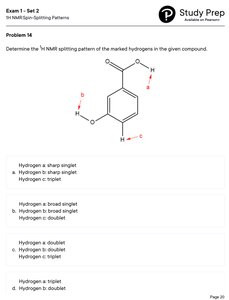
Q14. Determine the 1H NMR splitting pattern of the marked hydrogens in the given compound.
Background
Topic: 1H NMR Spin-Splitting Patterns
This question tests your ability to predict the splitting pattern (multiplicity) of protons in a molecule based on their neighboring hydrogens.
Key Terms:
Spin-splitting: The splitting of NMR signals due to coupling with neighboring protons.
Multiplicity: The number of peaks in an NMR signal (singlet, doublet, triplet, etc.).
Coupling: Interaction between nuclear spins of adjacent protons.
Step-by-Step Guidance
Identify the number of neighboring hydrogens for each marked proton (a, b, c).
Apply the n+1 rule: the multiplicity is one more than the number of neighboring hydrogens.
Determine the expected splitting pattern for each marked hydrogen.
Compare the options to match the predicted patterns.
Try solving on your own before revealing the answer!
Final Answer: d. Hydrogen a: triplet, Hydrogen b: doublet, Hydrogen c: doublet.
The splitting pattern is determined by the number of adjacent hydrogens for each marked proton.
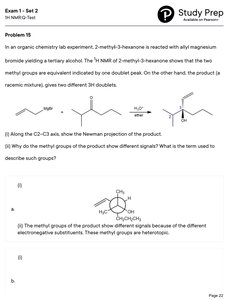
Q15. In an organic chemistry lab experiment, 2-methyl-3-hexanone is reacted with allyl magnesium bromide yielding a tertiary alcohol. The 1H NMR of 2-methyl-3-hexanone shows that the two methyl groups are equivalent indicated by one doublet peak. On the other hand, the product (in racemic mixture) gives two different 3H doublets. (i) Along the C2–C3 axis, show the Newman projection of the product. (ii) Why do the methyl groups of the product show different signals? What is the term used to describe such groups?
Background
Topic: 1H NMR & Stereochemistry
This question tests your understanding of chemical equivalence and stereochemistry in NMR, specifically the concept of diastereotopic and enantiotopic groups.
Key Terms:
Newman projection: A way to visualize the spatial arrangement of atoms along a bond axis.
Diastereotopic: Non-equivalent groups in a chiral environment.
Enantiotopic: Groups that are equivalent in achiral environments but not in chiral ones.
Step-by-Step Guidance
Draw the Newman projection along the C2–C3 axis for the product.
Identify the spatial arrangement of the methyl groups.
Analyze why the methyl groups are no longer equivalent in the product.
Determine the term used to describe such groups (diastereotopic, enantiotopic, homotopic).
Try solving on your own before revealing the answer!
Final Answer: d. The methyl groups of the product show different signals because of the creation of a new chiral center affecting nearby protons. These methyl groups are diastereotopic.
The formation of a chiral center makes the methyl groups non-equivalent, resulting in two distinct NMR signals.
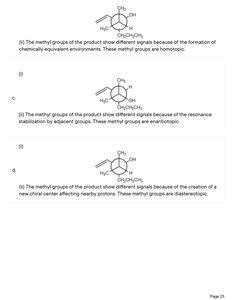
Q17. For the given compound, draw an estimated 1H NMR spectrum, and show the multiplicity, integration, and chemical shift of each signal. Mark the signals according to the sets of equivalent hydrogens.
Background
Topic: NMR Practice
This question tests your ability to interpret and draw a 1H NMR spectrum, including multiplicity, integration, and chemical shift for a given compound.
Key Terms:
Multiplicity: The splitting pattern of each signal.
Integration: The area under each signal, proportional to the number of hydrogens.
Chemical shift: The position of the signal on the NMR spectrum (in ppm).
Step-by-Step Guidance
Identify the sets of equivalent hydrogens in the compound.
Assign the expected chemical shift for each set based on their environment.
Determine the multiplicity for each set using the n+1 rule.
Draw the estimated spectrum, marking integration and chemical shift.
Try solving on your own before revealing the answer!
Final Answer:
The estimated NMR spectrum shows three signals, each corresponding to a set of equivalent hydrogens, with their respective multiplicity, integration, and chemical shift.
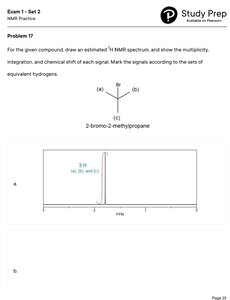
Q18. Write down how many signals are there and indicate their multiplicity in the 1H NMR spectra of the given molecule.
Background
Topic: 1H NMR Spin-Splitting (N+1 Rule)
This question tests your ability to count the number of NMR signals and determine their multiplicity for a given molecule.
Key Terms:
N+1 rule: The multiplicity of a signal is one more than the number of neighboring hydrogens.
Signal: Each unique set of equivalent hydrogens produces a signal in the NMR spectrum.
Step-by-Step Guidance
Identify all sets of equivalent hydrogens in the molecule.
Count the number of unique signals.
Determine the multiplicity for each signal using the n+1 rule.
Label each signal with its expected multiplicity (singlet, doublet, triplet, quartet).
Try solving on your own before revealing the answer!
Final Answer:
There are four signals in the NMR spectrum, each with its respective multiplicity as shown in the diagram.
Q19. What are the expected chemical shifts (ppm) for each of the protons present in the structures given below?
Background
Topic: 1H NMR Table
This question tests your ability to assign chemical shifts to protons in different environments based on their structure.
Key Terms:
Chemical shift: The position of a proton's signal in the NMR spectrum, measured in ppm.
Proton environment: The chemical surroundings of each proton, affecting its shift.
Step-by-Step Guidance
Identify the environment of each proton in the given structures.
Use typical chemical shift values for protons in those environments (alkyl, aromatic, etc.).
Assign the expected chemical shift (ppm) for each proton.
Compare the options to match the expected values.
Try solving on your own before revealing the answer!
Final Answer: a. (a) Protons 'a' = δ 1.5, protons 'b' = δ 3.5; (b) Protons 'a' = δ 2.5, protons 'b' = δ 5.1.
The chemical shifts are assigned based on the typical environments of the protons in the given structures.
