 Indietro
Organic Chemistry Exam 1 Study Guidance
Guida di studio - Note intelligenti
 Appunti personalizzati basati sui tuoi materiali, ampliati con definizioni chiave, esempi e contesto.
Q15. Which of the following shows curved arrows that correctly accounts for the differences between the two structures?
Background
Topic: Resonance Structures and Electron-Pushing Arrows
This question tests your understanding of how to use curved arrows to represent the movement of electrons in resonance structures. Recognizing correct electron flow is essential for drawing valid resonance forms in organic molecules.
Key Terms and Concepts:
Resonance Structures: Different Lewis structures for the same molecule that show the delocalization of electrons.
Curved Arrows: Used to indicate the movement of electron pairs (either lone pairs or pi bonds) from one atom or bond to another.
Rules for Curved Arrows: Arrows start at an electron source (lone pair or bond) and point to where the electrons are moving (an atom or bond).
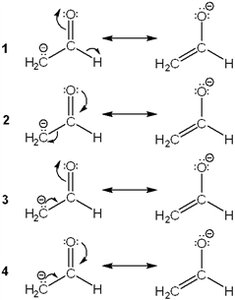
Step-by-Step Guidance
Examine each set of resonance structures and the curved arrows shown. Identify the starting and ending points of each arrow.
Recall that a valid resonance arrow must start at a lone pair or a pi bond and end at a position where a new bond or lone pair will be formed.
Check that the total number of electrons and the overall charge are conserved in each resonance structure.
Look for any violations of the octet rule or incorrect movement of electrons (e.g., moving atoms instead of electrons).
Compare each option to see which one correctly shows the electron flow that leads from one resonance structure to the other, following all the rules above.
Try solving on your own before revealing the answer!
Final Answer: Option 3
Option 3 correctly shows the curved arrows that account for the differences between the two resonance structures. The arrows start at a lone pair or a pi bond and end at the appropriate atom or bond, conserving charge and following the octet rule.
Q20. Which of the following Newman projections does not represent 2-methylhexane?
Background
Topic: Newman Projections and Alkane Structure
This question tests your ability to interpret Newman projections and recognize the correct structure of a given alkane. Newman projections are a way to visualize the spatial arrangement of atoms around a carbon-carbon single bond.
Key Terms and Concepts:
Newman Projection: A way to view a molecule by looking straight down a particular bond, showing the relative positions of substituents.
2-Methylhexane: An alkane with a methyl group on the second carbon of a six-carbon chain.
Substituent Positioning: Correctly identifying which groups are attached to which carbons is crucial for matching the projection to the correct molecule.
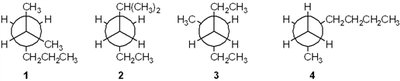
Step-by-Step Guidance
Recall the structure of 2-methylhexane and draw its carbon skeleton, labeling each carbon and its substituents.
For each Newman projection, identify the front and back carbons and the groups attached to each.
Check if the arrangement of groups in each projection matches what is possible for 2-methylhexane.
Look for any projection where the substituents do not correspond to the correct connectivity of 2-methylhexane.
Try solving on your own before revealing the answer!
Final Answer: Option 3
Option 3 does not represent a possible Newman projection for 2-methylhexane, as the arrangement of substituents does not match the structure of this molecule.
Q21. Which of the following structures represents trans-1,3-dimethylcyclohexane?
Background
Topic: Cyclohexane Conformations and Stereochemistry
This question tests your understanding of cis/trans isomerism in cyclohexane rings, specifically how to identify the trans isomer based on the positions of substituents.
Key Terms and Concepts:
Cyclohexane Chair Conformation: The most stable 3D shape of cyclohexane, with alternating axial and equatorial positions.
Trans Isomer: Substituents are on opposite sides of the ring (one up, one down).
1,3-Dimethylcyclohexane: Methyl groups attached to carbons 1 and 3 of the cyclohexane ring.

Step-by-Step Guidance
Identify the positions of carbons 1 and 3 on the cyclohexane ring in each structure.
Check the orientation (axial/equatorial and up/down) of the methyl groups at these positions.
Recall that in the trans isomer, the two methyl groups must be on opposite sides of the ring (one up, one down).
Compare each structure to see which one fits this description.
Try solving on your own before revealing the answer!
Final Answer: Option 2
Option 2 shows the two methyl groups on opposite sides of the cyclohexane ring, which is characteristic of the trans isomer.
Q26. The following pairs of Newman projections represent the same compound but in differing conformations. True or False?
Background
Topic: Conformational Isomerism in Alkanes
This question tests your ability to recognize whether two Newman projections represent the same molecule in different conformations (rotamers) or different molecules entirely.
Key Terms and Concepts:
Newman Projection: A way to visualize the spatial arrangement of groups around a carbon-carbon bond.
Conformational Isomers (Rotamers): Different spatial arrangements of a molecule that can be interconverted by rotation around single bonds.
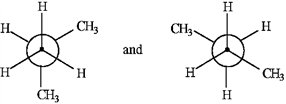
Step-by-Step Guidance
Identify the groups attached to the front and back carbons in each Newman projection.
Determine if the connectivity and identity of the groups are the same in both projections.
Check if one projection can be rotated to match the other, indicating they are conformers of the same molecule.
Try solving on your own before revealing the answer!
Final Answer: False
The two Newman projections do not represent the same compound in different conformations; they have different connectivity or arrangement of groups.
Q29. In the following structure the positions labeled a and d are equatorial positions. True or False?
Background
Topic: Cyclohexane Chair Conformation and Axial/Equatorial Positions
This question tests your ability to identify axial and equatorial positions in the chair conformation of cyclohexane, which is important for understanding the stability of substituted cyclohexanes.
Key Terms and Concepts:
Chair Conformation: The most stable conformation of cyclohexane, with alternating axial (vertical) and equatorial (slanted) positions.
Axial Position: Points straight up or down, parallel to the ring's axis.
Equatorial Position: Points outward, away from the ring, roughly in the plane of the ring.
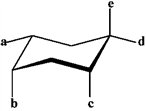
Step-by-Step Guidance
Identify the labeled positions (a and d) on the cyclohexane chair structure.
Recall the pattern of axial and equatorial positions around the ring (they alternate at each carbon).
Determine whether positions a and d are pointing outward (equatorial) or straight up/down (axial).
Try solving on your own before revealing the answer!
Final Answer: True
Positions a and d are both equatorial in the given chair conformation, as they point outward from the ring.
Q37. Match the Newman projection for the conformation of 2-methylbutane to the indicated position on the potential energy diagram. Conformation A is represented by Roman numeral ____.
Background
Topic: Conformational Analysis and Potential Energy Diagrams
This question tests your ability to relate Newman projections of a molecule to positions on a potential energy diagram, which represent different conformations and their relative stabilities.
Key Terms and Concepts:
Newman Projection: A way to visualize the conformation of a molecule by looking down a bond.
Potential Energy Diagram: Shows the energy changes as a molecule rotates around a bond, with minima representing stable conformations and maxima representing less stable ones.
Staggered and Eclipsed Conformations: Staggered conformations are lower in energy, while eclipsed are higher.
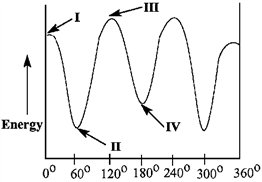
Step-by-Step Guidance
Identify the conformation shown in Newman projection A (e.g., staggered, eclipsed, anti, gauche).
Recall which Roman numeral on the energy diagram corresponds to the energy of that conformation (minima for staggered, maxima for eclipsed).
Match the conformation to the correct position on the diagram based on its stability.
Try solving on your own before revealing the answer!
Final Answer: II
Conformation A corresponds to Roman numeral II on the potential energy diagram, representing a staggered (and thus more stable) conformation.
