 Indietro
Organic Chemistry Exam 1 Study Guidance: Mechanisms, Spectroscopy, and NMR
Guida di studio - Note intelligenti
 Appunti personalizzati basati sui tuoi materiali, ampliati con definizioni chiave, esempi e contesto.
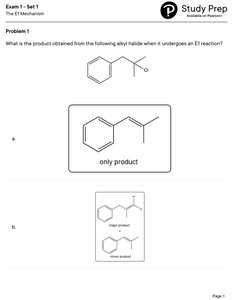
Q1. What is the product obtained from the following alkyl halide when it undergoes an E1 reaction?
Background
Topic: E1 Elimination Mechanism
This question tests your understanding of the E1 mechanism, which involves the formation of a carbocation intermediate and subsequent elimination to form an alkene.
Key Terms and Formulas:
E1 Mechanism: Unimolecular elimination, two-step process (carbocation formation, then elimination).
Zaitsev's Rule: The most substituted alkene is usually the major product.
Carbocation stability: More substituted carbocations are more stable.
Step-by-Step Guidance
Identify the leaving group and the possible carbocation formed after its departure.
Consider carbocation rearrangement for increased stability (if possible).
Determine which beta hydrogens are available for elimination.
Apply Zaitsev's rule to predict the most substituted alkene product.
Try solving on your own before revealing the answer!
Final Answer:
The only product is the more substituted alkene, as shown in option a. The E1 mechanism favors the formation of the most stable (most substituted) alkene according to Zaitsev's rule.
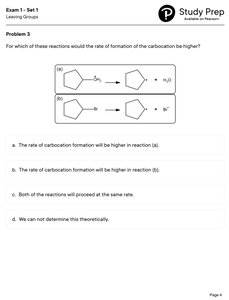
Q2. For which of these reactions would the rate of formation of the carbocation be higher?
Background
Topic: Leaving Groups and Carbocation Formation
This question tests your understanding of how the nature of the leaving group affects the rate of carbocation formation in substitution/elimination reactions.
Key Terms and Formulas:
Leaving Group: The atom or group that departs with a pair of electrons.
Carbocation Formation: The rate depends on the ability of the leaving group to depart.
Step-by-Step Guidance
Compare the leaving groups in both reactions (H2O vs Br-).
Recall that a better leaving group increases the rate of carbocation formation.
Consider the relative leaving group abilities: water (neutral) vs bromide (anionic).
Try solving on your own before revealing the answer!
Final Answer:
The rate of carbocation formation will be higher in reaction (a), where water is the leaving group. Water is a better leaving group than bromide, so the carbocation forms faster.
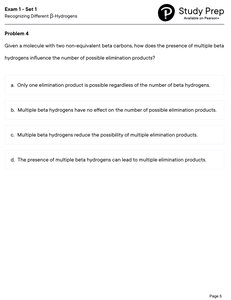
Q3. Given a molecule with two non-equivalent beta carbons, how does the presence of multiple beta hydrogens influence the number of possible elimination products?
Background
Topic: Beta Hydrogens in Elimination Reactions
This question tests your understanding of how the number and position of beta hydrogens affect the diversity of elimination products.
Key Terms and Formulas:
Beta Hydrogen: Hydrogen atom attached to a carbon adjacent to the carbon bearing the leaving group.
Elimination Product: Alkene formed by removal of a beta hydrogen.
Step-by-Step Guidance
Identify the beta carbons and count the beta hydrogens.
Consider how elimination from different beta hydrogens leads to different alkene products.
Think about the possibility of forming multiple elimination products.
Try solving on your own before revealing the answer!
Final Answer:
The presence of multiple beta hydrogens can lead to multiple elimination products, as elimination can occur at different positions.
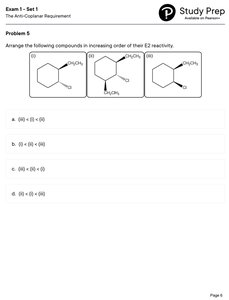
Q4. Arrange the following compounds in increasing order of their E2 reactivity.
Background
Topic: E2 Elimination and Anti-Coplanar Requirement
This question tests your understanding of the structural requirements for E2 elimination, specifically the need for anti-coplanar geometry between the leaving group and the beta hydrogen.
Key Terms and Formulas:
E2 Mechanism: Bimolecular elimination, requires anti-coplanar arrangement.
Anti-Coplanar: The leaving group and the beta hydrogen must be on opposite sides (180° apart).
Step-by-Step Guidance
Examine the orientation of the leaving group and beta hydrogen in each compound.
Identify which compounds have the required anti-coplanar geometry.
Rank the compounds based on how easily they can undergo E2 elimination.
Try solving on your own before revealing the answer!
Final Answer:
The correct order is (I) < (III) < (II). Compound II has the best anti-coplanar arrangement, making it most reactive in E2 elimination.
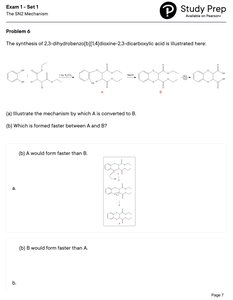
Q5. The synthesis of 2,3-dihydrobenzo[b][1,4]dioxine-2,3-dicarboxylic acid is illustrated here. (a) Illustrate the mechanism by which A is converted to B. (b) Which is formed faster between A and B?
Background
Topic: SN2 Mechanism and Reaction Rate
This question tests your ability to illustrate a nucleophilic substitution mechanism and compare the rates of formation for two compounds.
Key Terms and Formulas:
SN2 Mechanism: Bimolecular nucleophilic substitution, involves a backside attack.
Reaction Rate: Depends on steric hindrance and nucleophile strength.
Step-by-Step Guidance
Draw the mechanism for the conversion of A to B, showing the nucleophile attacking the electrophile.
Compare the steric environments of A and B to determine which would react faster.
Consider the accessibility of the electrophilic center in each compound.
Try solving on your own before revealing the answer!
Final Answer:
B would form faster than A due to less steric hindrance, making the SN2 reaction more efficient.
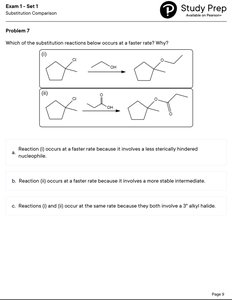
Q6. Which of the substitution reactions below occurs at a faster rate? Why?
Background
Topic: Substitution Mechanisms and Nucleophile Strength
This question tests your understanding of how nucleophile strength and steric hindrance affect the rate of substitution reactions.
Key Terms and Formulas:
Nucleophile: Species that donates an electron pair to form a bond.
Steric Hindrance: Bulky groups can slow down reactions.
Step-by-Step Guidance
Compare the nucleophiles in both reactions for steric hindrance.
Consider the stability of the intermediate formed in each reaction.
Determine which reaction would proceed faster based on these factors.
Try solving on your own before revealing the answer!
Final Answer:
Reaction (i) occurs at a faster rate because it involves a less sterically hindered nucleophile, allowing for easier attack.
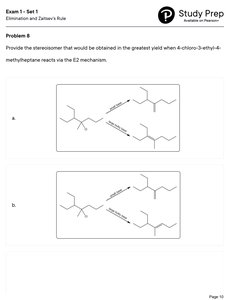
Q7. Provide the stereoisomer that would be obtained in the greatest yield when 4-chloro-3-ethyl-4-methylheptane reacts via the E2 mechanism.
Background
Topic: E2 Elimination and Zaitsev's Rule
This question tests your understanding of stereochemistry in E2 eliminations and the application of Zaitsev's rule to predict the major product.
Key Terms and Formulas:
E2 Mechanism: Requires anti-coplanar geometry.
Zaitsev's Rule: The most substituted alkene is favored.
Stereoisomer: Different spatial arrangement of atoms.
Step-by-Step Guidance
Identify the possible beta hydrogens for elimination.
Determine which elimination leads to the most substituted alkene.
Draw the stereoisomer with the greatest yield based on anti-coplanar requirement.
Try solving on your own before revealing the answer!
Final Answer:
The stereoisomer with the most substituted double bond (Zaitsev product) is obtained in greatest yield via the E2 mechanism.
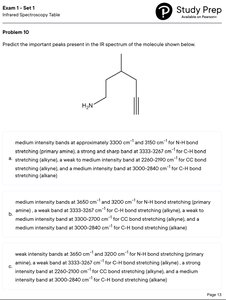
Q8. Predict the important peaks present in the IR spectrum of the molecule shown below.
Background
Topic: Infrared Spectroscopy
This question tests your ability to predict IR absorption bands based on functional groups present in a molecule.
Key Terms and Formulas:
IR Spectroscopy: Identifies functional groups by their characteristic absorption frequencies.
NH Stretch: Appears around 3300–3500 cm-1.
C=C Stretch: Appears around 1600–1680 cm-1.
Step-by-Step Guidance
Identify the functional groups in the molecule (amine, alkene).
Recall the characteristic IR absorption frequencies for each group.
Match the predicted peaks to the options provided.
Try solving on your own before revealing the answer!
Final Answer:
Medium intensity bands at approximately 3300 cm-1 and 3150 cm-1 for NH bond stretching, and medium intensity band at 3000–2840 cm-1 for C-H bond stretching (alkene).
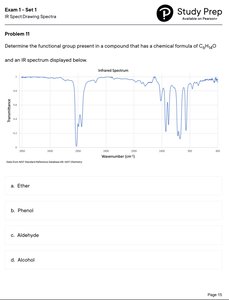
Q9. Determine the functional group present in a compound that has a chemical formula of C7H8O and an IR spectrum displayed below.
Background
Topic: IR Spectroscopy and Functional Group Identification
This question tests your ability to interpret IR spectra and deduce the functional group present in a compound.
Key Terms and Formulas:
Functional Group: Specific group of atoms responsible for characteristic reactions.
IR Spectrum: Shows absorption bands for different functional groups.
Step-by-Step Guidance
Analyze the IR spectrum for characteristic peaks (broad, sharp, etc.).
Compare the spectrum to known functional group absorption patterns.
Use the molecular formula to narrow down the possibilities.
Try solving on your own before revealing the answer!
Final Answer:
The functional group present is phenol, based on the IR spectrum and molecular formula.
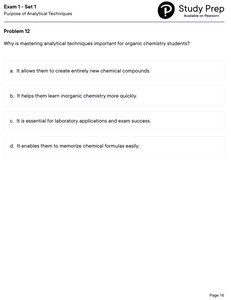
Q10. Why is mastering analytical techniques important for organic chemistry students?
Background
Topic: Analytical Techniques in Organic Chemistry
This question tests your understanding of the role of analytical techniques in organic chemistry education and practice.
Key Terms and Formulas:
Analytical Techniques: Methods used to identify, quantify, and characterize chemical compounds.
Laboratory Applications: Essential for experimental work and research.
Step-by-Step Guidance
Consider how analytical techniques are used in organic chemistry labs.
Think about their importance for understanding chemical structures and reactions.
Reflect on their role in exam success and research.
Try solving on your own before revealing the answer!
Final Answer:
It is essential for laboratory applications and exam success, as analytical techniques are fundamental to organic chemistry.
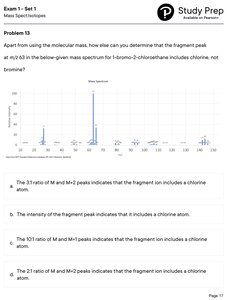
Q11. Apart from using the molecular mass, how else can you determine that the fragment peak at m/z 63 in the mass spectrum for 1-bromo-2-chlorooctane includes chlorine, not bromine?
Background
Topic: Mass Spectrometry and Isotopic Patterns
This question tests your understanding of how isotopic patterns in mass spectrometry can indicate the presence of chlorine or bromine atoms.
Key Terms and Formulas:
Mass Spectrum: Shows peaks corresponding to fragment ions.
Isotopic Pattern: Chlorine and bromine have characteristic M and M+2 peak ratios.
Step-by-Step Guidance
Examine the M and M+2 peak intensities in the mass spectrum.
Recall the characteristic ratios for chlorine (3:1) and bromine (1:1).
Determine which ratio matches the observed peaks.
Try solving on your own before revealing the answer!
Final Answer:
The 3:1 ratio of M and M+2 peaks indicates that the fragment ion includes a chlorine atom.
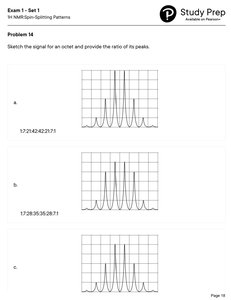
Q12. Sketch the signal for an octet and provide the ratio of its peaks.
Background
Topic: NMR Spin-Splitting Patterns
This question tests your understanding of NMR multiplicity and the peak ratios for an octet.
Key Terms and Formulas:
Octet: Splitting pattern for a proton coupled to seven equivalent protons.
Peak Ratio: Follows Pascal's triangle for n+1 peaks.
Step-by-Step Guidance
Recall that an octet has 8 peaks (n+1 rule).
Use Pascal's triangle to determine the ratio of peaks for an octet.
Sketch the pattern and label the peak ratios.
Try solving on your own before revealing the answer!
Final Answer:
The ratio of peaks for an octet is 1:7:21:35:35:21:7:1, as shown in option a.
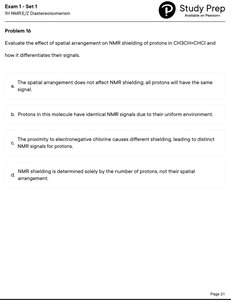
Q13. Evaluate the effect of spatial arrangement on NMR shielding of protons in ClCH2CHCl and how it differentiates their signals.
Background
Topic: NMR Shielding and Diastereotopic Protons
This question tests your understanding of how spatial arrangement and proximity to electronegative atoms affect NMR signals.
Key Terms and Formulas:
NMR Shielding: Protons near electronegative atoms are less shielded and appear downfield.
Diastereotopic Protons: Protons in different environments give distinct signals.
Step-by-Step Guidance
Identify the protons in ClCH2CHCl and their environments.
Consider how proximity to chlorine affects shielding.
Determine if the protons are diastereotopic and how their signals differ.
Try solving on your own before revealing the answer!
Final Answer:
The proximity to electronegative chlorine causes different shielding, leading to distinct NMR signals for protons.
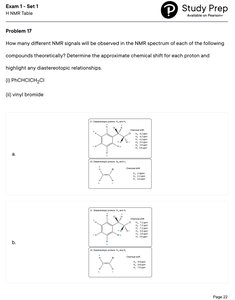
Q14. How many different NMR signals will be observed in the NMR spectrum of each of the following compounds theoretically? Determine the approximate chemical shift for each proton and highlight any diastereotopic relationships.
Background
Topic: NMR Signal Counting and Chemical Shift Assignment
This question tests your ability to count unique NMR signals and assign chemical shifts based on proton environments.
Key Terms and Formulas:
Chemical Shift: Position of NMR signal, depends on proton environment.
Diastereotopic Protons: Protons in different environments give separate signals.
Step-by-Step Guidance
Identify all unique proton environments in each compound.
Assign approximate chemical shifts based on proximity to functional groups.
Highlight any diastereotopic relationships.
Try solving on your own before revealing the answer!
Final Answer:
Each compound will show a specific number of NMR signals based on unique proton environments and diastereotopic relationships, as illustrated in the provided diagrams.
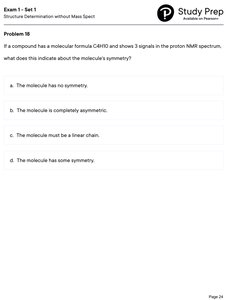
Q15. If a compound has a molecular formula C4H10 and shows 3 signals in the proton NMR spectrum, what does this indicate about the molecule's symmetry?
Background
Topic: NMR and Molecular Symmetry
This question tests your understanding of how symmetry affects the number of NMR signals observed.
Key Terms and Formulas:
Molecular Symmetry: Equivalent protons give the same NMR signal.
NMR Signal: Number of signals reflects symmetry and unique environments.
Step-by-Step Guidance
Consider the possible structures for C4H10 (butane, isobutane).
Count the number of unique proton environments in each structure.
Relate the number of NMR signals to molecular symmetry.
Try solving on your own before revealing the answer!
Final Answer:
The molecule has some symmetry, as indicated by the presence of 3 NMR signals for C4H10.
