 Indietro
Organic Chemistry Exam III Review – SN1, Nucleophilicity, Reaction Mechanisms, and Energy Diagrams
Guida di studio - Note intelligenti
 Appunti personalizzati basati sui tuoi materiali, ampliati con definizioni chiave, esempi e contesto.
Q1. Which of the following statements related to SN1 reactions is not true?
Background
Topic: SN1 Reaction Mechanism
This question tests your understanding of the characteristics and steps involved in SN1 reactions, including stereochemistry, carbocation formation, solvent effects, and rate-determining steps.
Key Terms:
SN1 Reaction: Substitution Nucleophilic Unimolecular
Carbocation: Positively charged carbon intermediate
Polar protic solvent: Solvent with hydrogen bonding capability
Racemic mixture: Equal amounts of enantiomers
Rate-determining step: Slowest step in a reaction mechanism
Step-by-Step Guidance
Review the mechanism of SN1 reactions, focusing on the formation of a carbocation intermediate.
Recall that SN1 reactions typically occur in polar protic solvents, which stabilize the carbocation.
Consider the stereochemical outcome: SN1 reactions often produce racemic mixtures due to nucleophilic attack from either side.
Identify which step is rate-determining in SN1 reactions (hint: it's related to carbocation formation).
Compare each statement to your knowledge of SN1 mechanisms and identify the one that does not fit.
Try solving on your own before revealing the answer!
Final Answer: d. The attack of the nucleophile is the rate determining step
In SN1 reactions, the rate-determining step is the formation of the carbocation, not the nucleophilic attack. The nucleophile attacks after the carbocation is formed, which is a fast step.
Q2. The reaction of tert-butyl chloride, (CH3)3CCl, with water in an inert solvent gives tert-butyl alcohol, (CH3)3COH. What is the effect of decreasing in three times the concentration of alkyl halide on the rate of the reaction?
Background
Topic: Reaction Kinetics of SN1 Mechanism
This question tests your understanding of how the rate of an SN1 reaction depends on the concentration of the alkyl halide.
Key Terms and Formula:
Rate Law for SN1:
k: Rate constant
Alkyl halide: Organic compound with a halogen attached
Step-by-Step Guidance
Recall the rate law for SN1 reactions: the rate depends only on the concentration of the alkyl halide.
Consider what happens to the rate if the concentration of alkyl halide is decreased by a factor of 3.
Set up the proportional relationship: .
Compare the new rate to the original rate to determine the effect.
Try solving on your own before revealing the answer!
Final Answer: a. the rate decreases by a factor of 3
Since the rate is directly proportional to the concentration of alkyl halide, decreasing it by a factor of 3 decreases the rate by the same factor.
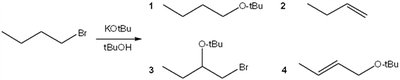
Q3. What is the major organic product obtained from the following reaction?
Background
Topic: Nucleophilic Substitution vs. Elimination (E2) Mechanism
This question tests your ability to predict the major product when a primary alkyl bromide reacts with KOtBu (potassium tert-butoxide) in tert-butanol.
Key Terms:
KOtBu: Strong, bulky base
E2 Elimination: Bimolecular elimination mechanism
Substitution: Replacement of a leaving group by a nucleophile
Regioselectivity: Preference for formation of one constitutional isomer over another
Step-by-Step Guidance
Examine the structure of the starting material: a primary alkyl bromide.
Consider the effect of KOtBu, a bulky base, which favors elimination (E2) over substitution.
Predict the most likely elimination product, considering the base's preference for less substituted (Hofmann) alkenes.
Compare the possible products to the answer choices and identify which matches the expected outcome.
Try solving on your own before revealing the answer!
Final Answer: 2
The major product is the less substituted alkene (Hofmann product) due to the bulky base KOtBu favoring elimination at the least hindered position.
Q4. What is the major organic product(s) obtained from the following reaction?
Background
Topic: Alkyne Chemistry and Reaction Mechanisms
This question tests your ability to predict the products of a reaction involving an alkyne and the conditions provided.
Key Terms:
Alkyne: Hydrocarbon with a triple bond
Regioselectivity: Preference for formation of one isomer
Reaction conditions: Influence product outcome
Step-by-Step Guidance
Identify the starting material and the reagents used in the reaction.
Recall the typical products formed under these conditions (e.g., elimination, addition, or fragmentation).
Analyze the possible products based on the structure and reaction mechanism.
Compare the answer choices to your predicted products.
Try solving on your own before revealing the answer!
Final Answer: c. propene + propyne
The reaction conditions favor fragmentation, resulting in propene and propyne as the major products.
Q5. Which of the following anions is the most nucleophilic in polar protic solvents?
Background
Topic: Nucleophilicity in Different Solvents
This question tests your understanding of how nucleophilicity changes in polar protic solvents due to solvation effects.
Key Terms:
Nucleophile: Species that donates an electron pair
Polar protic solvent: Solvent with hydrogen bonding
Solvation: Interaction of solvent with ions
Step-by-Step Guidance
Recall that polar protic solvents strongly solvate small, highly charged anions.
Consider the trend: larger anions are less solvated and thus more nucleophilic in these solvents.
Compare the nucleophilicity of F−, Cl−, Br−, and I− in polar protic solvents.
Identify which anion is least hindered by solvation and thus most nucleophilic.
Try solving on your own before revealing the answer!
Final Answer: d. I−
Iodide is the largest anion and is least solvated in polar protic solvents, making it the most nucleophilic under these conditions.
Q6. Which of the following is the most nucleophilic?
Background
Topic: Nucleophilicity Comparison
This question tests your ability to compare the nucleophilicity of different species based on their structure and charge.
Key Terms:
Nucleophile: Electron pair donor
Acid/base properties: Affect nucleophilicity
Charge: Negatively charged species are generally more nucleophilic
Step-by-Step Guidance
Identify which species are negatively charged and which are neutral.
Recall that negatively charged species are typically more nucleophilic than neutral ones.
Compare the nucleophilicity of sodium methoxide, acetic acid, propanoic acid, and water.
Consider the effect of resonance and structure on nucleophilicity.
Try solving on your own before revealing the answer!
Final Answer: a. sodium methoxide
Sodium methoxide is a strong, negatively charged nucleophile, making it the most nucleophilic among the choices.
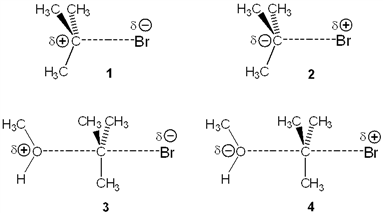
Q7. Which of the following is most likely to undergo rearrangement during reaction with methanol?
Background
Topic: Carbocation Rearrangement in SN1 Reactions
This question tests your ability to identify which substrate is most likely to undergo carbocation rearrangement during an SN1 reaction with methanol.
Key Terms:
Carbocation rearrangement: Migration of hydride or alkyl group to stabilize carbocation
SN1 mechanism: Involves carbocation intermediate
Stability: Tertiary carbocations are more stable than secondary or primary
Step-by-Step Guidance
Examine the structures and identify the type of carbocation each would form upon leaving group departure.
Determine which carbocation is least stable and most likely to rearrange to a more stable form.
Consider possible hydride or alkyl shifts for each structure.
Compare the likelihood of rearrangement for each option.
Try solving on your own before revealing the answer!
Final Answer: 3
Structure 3 forms a secondary carbocation that can rearrange to a more stable tertiary carbocation, making it most likely to undergo rearrangement.
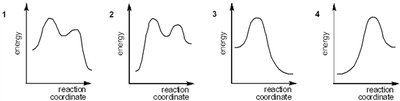
Q8. Which of the following energy diagrams represents the course of an exothermic SN1 reaction?
Background
Topic: Reaction Energy Diagrams
This question tests your ability to interpret energy diagrams and identify the one that corresponds to an exothermic SN1 reaction.
Key Terms:
Exothermic reaction: Releases energy, products lower in energy than reactants
SN1 mechanism: Two-step process with carbocation intermediate
Energy diagram: Graph of energy vs. reaction coordinate
Step-by-Step Guidance
Recall that SN1 reactions have two transition states and a carbocation intermediate.
Identify which diagram shows two peaks (transition states) and an intermediate valley (carbocation).
Look for a diagram where the products are lower in energy than the reactants (exothermic).
Compare the diagrams to these criteria.
Try solving on your own before revealing the answer!
Final Answer: 3
Diagram 3 shows two transition states and the products are lower in energy than the reactants, indicating an exothermic SN1 reaction.
Q9. Which of the following represents the transition state of the rate-determining step in the reaction between tert-butyl bromide and methanol?
Background
Topic: Transition State in SN1 Mechanism
This question tests your ability to identify the transition state for the rate-determining step (carbocation formation) in an SN1 reaction.
Key Terms:
Transition state: High-energy, unstable state during a reaction
Rate-determining step: Slowest step, usually carbocation formation in SN1
SN1 mechanism: Involves leaving group departure and carbocation formation
Step-by-Step Guidance
Recall that the rate-determining step in SN1 is the departure of the leaving group to form a carbocation.
Identify the structure that shows partial bonds and charges, representing the transition state.
Compare the options to find the one that best illustrates the transition state for carbocation formation.
Try solving on your own before revealing the answer!
Final Answer: 1
Structure 1 shows the partial positive and negative charges and the bond breaking, representing the transition state for carbocation formation in SN1.
Q10. What is the best choice of reagent to perform the following transformation?
Background
Topic: Reagent Selection for Organic Transformations
This question tests your ability to select the appropriate reagent for a specific organic transformation based on the reactant and desired product.
Key Terms:
Reagent: Substance used to cause a chemical reaction
Transformation: Conversion of one functional group to another
Mechanism: Pathway by which the reaction occurs
Step-by-Step Guidance
Analyze the starting material and the desired product.
Consider the functional group change and which reagent is best suited for this transformation.
Compare the answer choices and recall the typical reactions each reagent performs.
Identify the reagent that will achieve the desired transformation efficiently.
Try solving on your own before revealing the answer!
Final Answer: c. NaOCH3
NaOCH3 is a strong nucleophile and base, suitable for the transformation shown in the question.
