 Indietro
Organic Chemistry Exam Study Guidance: Mechanisms, Reactions, and Concepts
Guida di studio - Note intelligenti
 Appunti personalizzati basati sui tuoi materiali, ampliati con definizioni chiave, esempi e contesto.
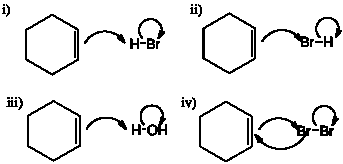
Q4. Which Mechanism step/steps do not happen in the reactions of alkenes that have been described in this class?
Background
Topic: Alkene Reaction Mechanisms
This question tests your understanding of the typical steps involved in the mechanisms of alkene reactions, such as electrophilic addition, hydration, and halogenation. You need to identify which steps (from the provided options) are not part of the mechanisms covered in your course.
Key Terms:
Electrophilic addition: A common mechanism for alkene reactions where an electrophile attacks the double bond.
Carbocation intermediate: Often formed during alkene reactions, especially with HX addition.
Anti addition vs. syn addition: Refers to the stereochemistry of the addition process.
Step-by-Step Guidance
Review the four mechanism steps shown in the image and identify what each step represents (e.g., addition of HBr, Br2, H2O, etc.).
Recall which mechanisms are commonly taught for alkene reactions: electrophilic addition, hydration, halogenation, and hydroboration.
Compare each step to the mechanisms you have learned. Ask yourself: Does this step occur in any of the standard alkene reactions?
Eliminate steps that are not part of the typical mechanisms (e.g., steps involving unusual reagents or electron flow not matching the standard process).
Try solving on your own before revealing the answer!
Final Answer: Steps ii and iv do not happen in the reactions of alkenes described in this class.
Step ii shows the addition of Br-H, which is not a standard alkene reaction. Step iv shows the addition of Br-Br, which is not a typical mechanism step for alkenes. The standard mechanisms involve HBr, H2O, or Br2, but not Br-H or Br-Br as shown.
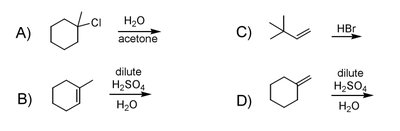
Q7. Which of the reactions below is MOST likely to involve a rearrangement?
Background
Topic: Carbocation Rearrangement in Organic Reactions
This question tests your ability to recognize which reaction conditions are likely to produce carbocation intermediates, which can then rearrange to form more stable carbocations.
Key Terms:
Carbocation rearrangement: A process where a carbocation shifts to a more stable position (e.g., hydride or methyl shift).
Reaction conditions: Acidic conditions (e.g., H2SO4) often lead to carbocation intermediates.
Step-by-Step Guidance
Examine each reaction and identify if a carbocation intermediate is likely to form.
Recall that reactions involving strong acids (like H2SO4) and water often proceed via carbocation intermediates.
Determine which reaction is most likely to allow for rearrangement (look for tertiary carbocation formation or possibility of hydride/methyl shifts).
Eliminate reactions that proceed via concerted mechanisms or do not form carbocations.
Try solving on your own before revealing the answer!
Final Answer: Reaction B (dilute H2SO4, H2O with cyclohexene) is most likely to involve a rearrangement.
This reaction proceeds via a carbocation intermediate, which can rearrange to form a more stable carbocation before nucleophilic attack by water.
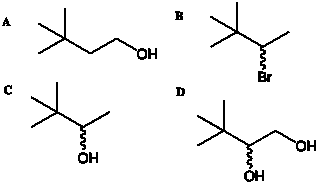
Q11. What is the major product of the following reaction sequence?
Background
Topic: Stereochemistry and Regioselectivity in Alkene Addition Reactions
This question tests your understanding of how different reagents add to alkenes, including the stereochemistry (syn vs. anti addition) and regioselectivity (Markovnikov vs. anti-Markovnikov).
Key Terms:
Markovnikov addition: The hydrogen adds to the carbon with more hydrogens, the other group adds to the more substituted carbon.
Syn addition: Both groups add to the same side of the double bond.
Anti addition: Groups add to opposite sides of the double bond.
Step-by-Step Guidance
Identify the reagents used in the reaction sequence and recall their typical addition patterns (syn or anti, Markovnikov or anti-Markovnikov).
Analyze the starting material and predict the intermediate formed after the first step.
Consider the stereochemistry and regioselectivity of the second step.
Compare the possible products (A, B, C, D) to the expected outcome based on the mechanism.
Try solving on your own before revealing the answer!
Final Answer: Product C is the major product of the reaction sequence.
The reaction sequence leads to syn addition, resulting in the product with both groups on the same side of the molecule.
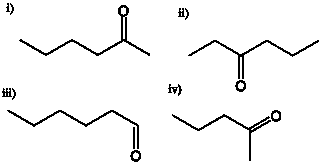
Q21. Which two Grignard and carbonyl compounds would you use to make pentan-2-ol?
Background
Topic: Grignard Reactions with Carbonyl Compounds
This question tests your ability to select the correct Grignard reagent and carbonyl compound to synthesize a specific alcohol (pentan-2-ol) via nucleophilic addition.
Key Terms:
Grignard reagent: An organomagnesium compound () used to add carbon chains to carbonyls.
Carbonyl compound: Aldehydes and ketones react with Grignard reagents to form alcohols.
Pentan-2-ol: A secondary alcohol with five carbons, hydroxyl group on the second carbon.
Step-by-Step Guidance
Recall the general reaction: after acid workup.
Determine which combination of Grignard reagent and carbonyl will give a five-carbon chain with the OH group on the second carbon.
Analyze the carbon skeletons of each option to see which matches pentan-2-ol.
Eliminate options that would produce primary or tertiary alcohols, or incorrect carbon chains.
Try solving on your own before revealing the answer!
Final Answer: Propylmagnesium bromide and ethanal will produce pentan-2-ol.
Propylmagnesium bromide () reacts with ethanal () to give pentan-2-ol after acid workup.
Q25. What clicker input would correspond to the electron flow arrows (mechanism arrows) needed for the reaction of HCl and water?
Background
Topic: Mechanism of Acid-Base Reactions
This question tests your understanding of electron flow in acid-base reactions, specifically the protonation of water by HCl and the resulting products.
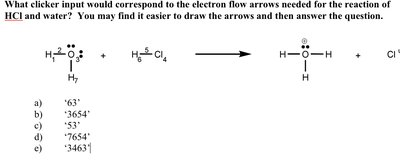
Key Terms:
Electron flow arrows: Indicate movement of electrons during a reaction.
Acid-base reaction: Transfer of a proton from acid (HCl) to base (water).
Hydronium ion: formed when water is protonated.
Step-by-Step Guidance
Draw the Lewis structures for HCl and water, showing lone pairs and charges.
Identify the electron pair on water that will attack the hydrogen on HCl.
Show the electron flow from water to HCl, breaking the H-Cl bond and forming Cl^-.
Match the electron flow arrows to the clicker input options provided.
Try solving on your own before revealing the answer!
Final Answer: The correct clicker input is '53'.
This input corresponds to the electron flow arrows showing water attacking HCl, forming hydronium ion and chloride ion.
