 Indietro
Organic Chemistry Exam Study Guide: IR Spectroscopy, Reactions, and Nomenclature
Guida di studio - Note intelligenti
 Appunti personalizzati basati sui tuoi materiali, ampliati con definizioni chiave, esempi e contesto.
Q6. Which of the compounds below would give the following IR spectrum?
Background
Topic: IR Spectroscopy and Functional Group Identification
This question tests your ability to interpret IR spectra and match them to the correct organic compound based on functional group absorptions.
Key Terms and Formulas
IR Spectroscopy: A technique used to identify functional groups in organic molecules by measuring absorption of infrared light at specific wavenumbers.
Wavenumber (cm-1): The frequency of IR light absorbed, characteristic of certain bonds.
Key absorptions:
C≡N (nitrile) stretch: cm-1
O-H (alcohol/phenol) stretch: cm-1
N-H stretch: cm-1
Step-by-Step Guidance
Examine the IR spectrum for prominent peaks. Notice the strong absorption near $2249$ cm-1, which is characteristic of a nitrile (C≡N) group.
Check for other significant peaks. There is no broad O-H stretch (which would appear around cm-1), nor is there a sharp N-H stretch near $3300$ cm-1.
Compare the spectrum to the possible compounds listed in the question. Look for the compound that contains a nitrile group (C≡N) and lacks O-H or N-H groups.
Review the molecular structure options and identify which one matches the functional groups indicated by the IR spectrum.
Try solving on your own before revealing the answer!
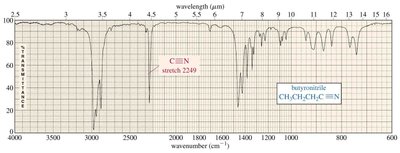
Final Answer: Compound with a nitrile group (butyronitrile)
The IR spectrum shows a strong absorption at $2249\text{CH}_3\text{CH}_2\text{CH}_2\text{C} \equiv \text{N}$).
This confirms the presence of a nitrile group and the absence of O-H or N-H stretches, so butyronitrile is the correct answer.
