 Indietro
Organic Chemistry Exam Study Guide: IR Spectra, Aromaticity, and Reaction Mechanisms
Guida di studio - Note intelligenti
 Appunti personalizzati basati sui tuoi materiali, ampliati con definizioni chiave, esempi e contesto.
Q1. Given a molecular formula of C10H13NO3, how do we calculate the elements of unsaturation (EU)?
Background
Topic: Elements of Unsaturation (Degree of Unsaturation)
This question tests your ability to determine the number of rings and/or pi bonds in a molecule based on its molecular formula.
Key Terms and Formulas:
Elements of Unsaturation (EU): Indicates the number of rings and/or double bonds in a molecule.
Formula for EU:
C = number of carbons, H = number of hydrogens, N = number of nitrogens, X = number of halogens
Step-by-Step Guidance
Identify the molecular formula: C10H13NO3.
Recall the formula for maximum hydrogens in a saturated hydrocarbon: .
Adjust for the presence of nitrogen and oxygen (oxygen does not affect EU, nitrogen increases max H by 1).
Plug the values into the EU formula: .
Calculate the numerator and set up the division, but stop before the final calculation.
Try solving on your own before revealing the answer!
Final Answer: 5 elements of unsaturation
This means the molecule has a combination of 5 rings and/or pi bonds (double/triple bonds).
Q2. Which of the dienes shown below is NOT a conjugated diene?
Background
Topic: Conjugation in Dienes
This question tests your ability to distinguish between conjugated, isolated, and cumulated dienes based on their structure.
Key Terms:
Conjugated diene: Two double bonds separated by a single bond (e.g., C=C–C=C).
Isolated diene: Double bonds separated by more than one single bond.
Cumulated diene: Double bonds directly adjacent (e.g., C=C=C).
Step-by-Step Guidance
Examine the structures of the dienes provided.
Identify the arrangement of the double bonds in each diene.
Determine which diene does not have alternating single and double bonds (not conjugated).
Set aside the structure that fits the definition of isolated or cumulated diene.
Try solving on your own before revealing the answer!
Final Answer: The diene with double bonds separated by more than one single bond is NOT conjugated.
Only conjugated dienes have alternating single and double bonds. Isolated or cumulated dienes do not fit this pattern.
Q3. Why is the trans, trans isomer of [10]-annulene NOT aromatic?
Background
Topic: Aromaticity and Planarity
This question tests your understanding of the requirements for aromaticity, including planarity, conjugation, and the Hückel rule.
Key Terms:
Aromaticity: A molecule is aromatic if it is cyclic, planar, fully conjugated, and follows the Hückel rule ( pi electrons).
Planarity: All atoms must be in the same plane for effective conjugation.
Hückel rule: pi electrons (where n is an integer).
Step-by-Step Guidance
Recall the requirements for aromaticity: cyclic, planar, conjugated, and pi electrons.
Consider the structure of trans, trans-[10]-annulene and whether it can be planar.
Think about the effect of trans double bonds on ring planarity.
Evaluate if the molecule can have a continuous array of p-orbitals.
Try solving on your own before revealing the answer!
Final Answer: It is not planar, so it cannot be aromatic.
The trans, trans isomer of [10]-annulene cannot achieve planarity due to steric strain, preventing full conjugation and aromaticity.
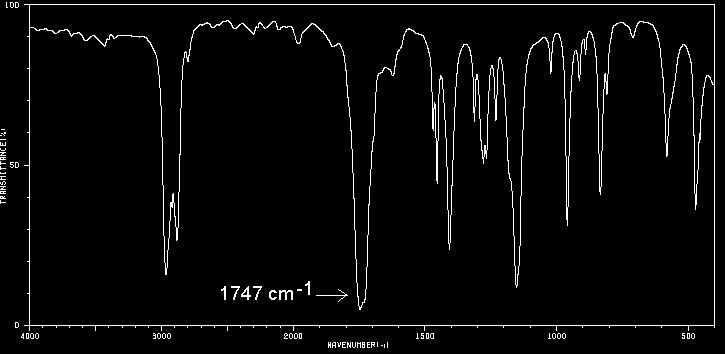
Q5. What must be the structure of the compound with two elements of unsaturation and whose IR spectrum is given at right?
Background
Topic: IR Spectroscopy and Degree of Unsaturation
This question tests your ability to interpret IR spectra and relate them to structural features, such as double bonds, rings, and functional groups.
Key Terms and Concepts:
Elements of Unsaturation: Indicates rings and/or pi bonds.
IR Spectrum: Functional group identification based on characteristic absorption bands.
Common IR peaks: C=O (around 1700 cm-1), O-H (broad, 3200–3600 cm-1), C=C (1600–1680 cm-1).
Step-by-Step Guidance
Analyze the IR spectrum for key peaks (e.g., strong absorption near 1747 cm-1).
Determine which functional group corresponds to this peak (e.g., ester or ketone).
Consider the molecular formula and elements of unsaturation (2 EU).
Combine the IR data and unsaturation to propose possible structures, but stop before drawing the final structure.
Try solving on your own before revealing the answer!
Final Answer: The compound is likely an ester with two elements of unsaturation.
The strong peak at 1747 cm-1 indicates a C=O group, typical of esters. With two elements of unsaturation, the structure could be a simple ester with one ring or two double bonds.
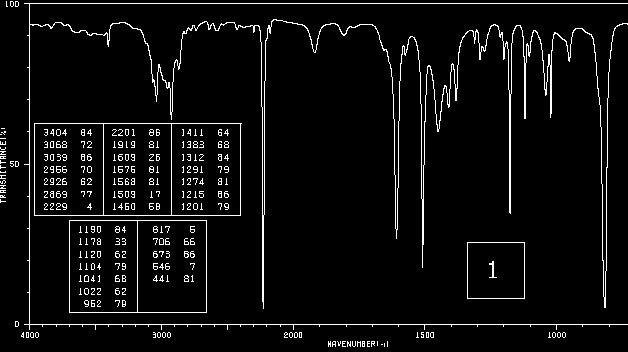
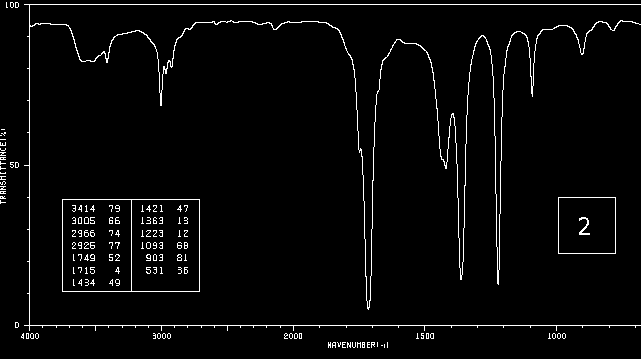
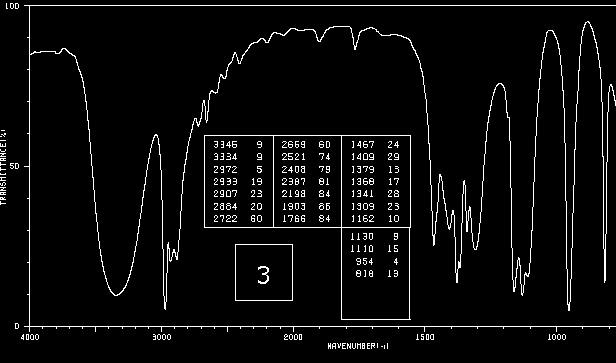
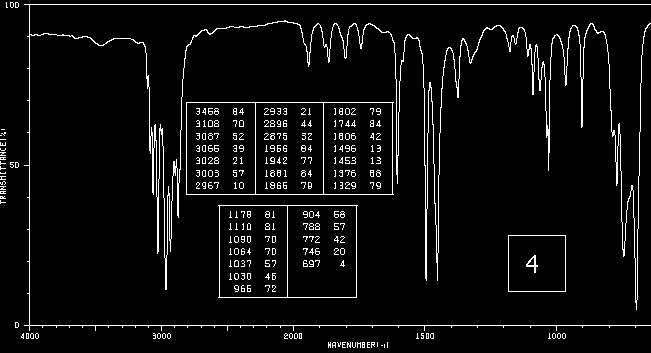
Q9. Match the IR spectra 1–4 with the structures W, X, Y, and Z below.
Background
Topic: IR Spectroscopy and Structure Identification
This question tests your ability to interpret IR spectra and match them to specific organic compounds based on functional group absorptions.
Key Terms:
IR Spectra: Used to identify functional groups (e.g., O-H, C=O, C-O, N-H).
Characteristic peaks: Alcohol (broad O-H), carboxylic acid (broad O-H and C=O), ether (C-O), nitrile (sharp C≡N).
Step-by-Step Guidance
Examine each IR spectrum for key peaks and their positions.
Identify the functional group present in each spectrum (e.g., broad O-H, sharp C=O).
Compare the spectra to the possible structures (W, X, Y, Z).
Set up the matching order based on the functional group evidence, but stop before stating the final match.
Try solving on your own before revealing the answer!
Final Answer: The spectra match the structures in the order 1, 3, 4, 2.
Each spectrum was matched to the structure based on the presence of characteristic IR peaks for the functional groups.
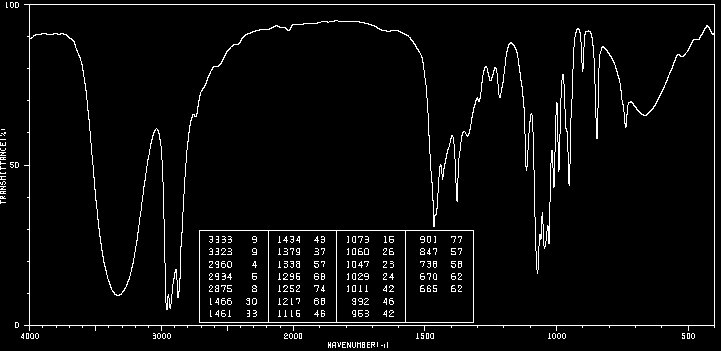
Q13. The IR spectrum given below belongs to which compound?
Background
Topic: IR Spectroscopy and Functional Group Identification
This question tests your ability to identify a compound based on its IR spectrum, focusing on functional group absorptions.
Key Terms:
IR Spectrum: Used to identify functional groups.
Key peaks: Alcohol (broad O-H), carboxylic acid (broad O-H and C=O), ether (C-O), alkene (C=C).
Step-by-Step Guidance
Examine the IR spectrum for major peaks (e.g., broad O-H, sharp C=O).
Compare the spectrum to the expected peaks for each compound listed.
Identify which compound's functional groups match the observed peaks.
Set up the reasoning for the match, but stop before stating the final answer.
Try solving on your own before revealing the answer!
Final Answer: The spectrum belongs to butanoic acid.
The IR spectrum shows both a broad O-H stretch and a strong C=O stretch, characteristic of carboxylic acids.
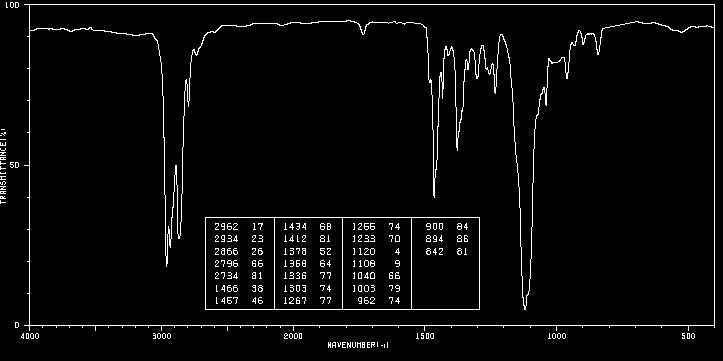
Q22. The IR spectrum of an oxygen-containing compound is given below…
Background
Topic: IR Spectroscopy and Functional Group Analysis
This question tests your ability to interpret IR spectra and determine the presence or absence of specific functional groups.
Key Terms:
Alcohol: Broad O-H stretch (3200–3600 cm-1).
Carboxylic acid: Broad O-H and strong C=O stretch (~1700 cm-1).
Ketone: Strong C=O stretch (~1700 cm-1), no O-H.
Step-by-Step Guidance
Analyze the IR spectrum for key peaks (O-H, C=O).
Determine if the spectrum shows a broad O-H stretch (alcohol or acid).
Check for a strong C=O stretch (acid or ketone).
Consider the molecular formula (8 carbons) and propose possible structures, but stop before drawing the final structure.
Try solving on your own before revealing the answer!
Final Answer:
a) It is not an alcohol because the O-H stretch is not broad enough.
b) It is not a carboxylic acid because the O-H stretch is not broad and the C=O is not strong enough.
c) It is a ketone because the spectrum shows a strong C=O stretch and no O-H stretch.
d) With 8 carbons, a possible structure is octan-2-one.
