 Indietro
Organic Chemistry I: Reaction Products, Mechanisms, and Stereochemistry
Guida di studio - Note intelligenti
 Appunti personalizzati basati sui tuoi materiali, ampliati con definizioni chiave, esempi e contesto.
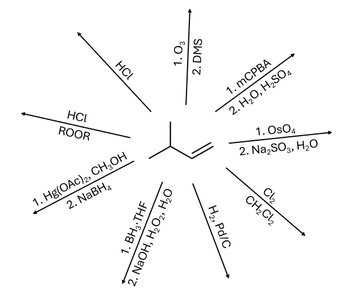
Q1. Draw all major organic product(s) for each of the following reactions. Include stereochemistry where relevant. Draw all enantiomers/diastereomers as necessary.
Background
Topic: Alkene Reactions and Stereochemistry
This question tests your understanding of the different types of reactions that alkenes undergo, including addition, oxidation, reduction, and halogenation. You are also asked to consider stereochemistry (cis/trans, enantiomers, diastereomers) in your product drawings.
Key Terms and Formulas
Markovnikov Addition: The hydrogen atom adds to the carbon with more hydrogens already attached.
Anti-Markovnikov Addition: The hydrogen atom adds to the carbon with fewer hydrogens (often in the presence of peroxides).
Syn Addition: Both groups add to the same face of the double bond.
Anti Addition: Groups add to opposite faces of the double bond.
Ozonolysis: Cleavage of double bonds by ozone, forming carbonyl compounds.
Hydroboration-Oxidation: Anti-Markovnikov, syn addition of water.
Oxymercuration-Demercuration: Markovnikov addition of water, no rearrangement.
Epoxidation: Formation of an epoxide (three-membered cyclic ether) from an alkene.
Step-by-Step Guidance
For each reaction, identify the reagents and recall the type of reaction they promote (e.g., addition, oxidation, reduction).
Determine the regiochemistry (Markovnikov or anti-Markovnikov) and stereochemistry (syn or anti addition) based on the reagents.
Draw the product(s) for each reaction, showing all possible stereoisomers (enantiomers/diastereomers) where relevant.
For reactions that generate chiral centers, indicate stereochemistry using wedge/dash notation or by drawing both enantiomers.
For each product, double-check if more than one product is possible due to regio- or stereochemistry, and include all major products.
Try solving on your own before revealing the answer!
Final Answer:
The major products for each reaction are as follows (stereochemistry and all possible isomers are included):
HCl: Markovnikov addition of H and Cl across the double bond.
HCl, ROOR: Anti-Markovnikov addition of H and Cl.
Hg(OAc)2, H2O; NaBH4: Markovnikov addition of H and OH, no rearrangement.
BH3, THF; NaOH, H2O2, H2O: Anti-Markovnikov, syn addition of H and OH.
O3, DMS: Ozonolysis, cleaving the double bond to form two carbonyl compounds.
mCPBA: Epoxidation, forming an epoxide ring.
OsO4; Na2SO3, H2O: Syn dihydroxylation, adding two OH groups to the same face.
H2, Pd/C: Catalytic hydrogenation, syn addition of H2 across the double bond.
Cl2, CH2Cl2: Anti addition of Cl2 across the double bond, forming a vicinal dihalide.
Each product should be drawn with correct stereochemistry. For syn/anti additions, show both possible enantiomers if chiral centers are formed. For ozonolysis, draw the two carbonyl fragments.
These reactions are classic examples of alkene reactivity and are fundamental to understanding organic synthesis.
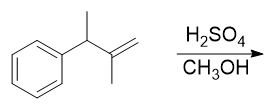
Q2. For the following reaction, predict the major product(s) and provide the correct arrow pushing mechanism to form the product(s). Indicate any stereochemistry or regiochemistry as necessary.
Background
Topic: Electrophilic Addition to Alkenes (Acid-Catalyzed Alkoxy Addition)
This question tests your understanding of the acid-catalyzed addition of alcohols to alkenes (alkoxy addition), which forms ethers via a carbocation intermediate. You must consider carbocation rearrangements and Markovnikov's rule.
Key Terms and Formulas
Markovnikov's Rule: The electrophile (H+) adds to the carbon with more hydrogens, forming the most stable carbocation intermediate.
Carbocation Rearrangement: Hydride or alkyl shifts may occur to form a more stable carbocation.
Arrow Pushing: Use curved arrows to show electron movement during bond formation and breaking.
Step-by-Step Guidance
Protonate the alkene with H2SO4 to generate the most stable carbocation intermediate (consider resonance and rearrangement).
Identify if a hydride or alkyl shift would lead to a more stable carbocation (e.g., tertiary over secondary).
Once the most stable carbocation is formed, the nucleophile (CH3OH) attacks the carbocation, forming a new C–O bond.
Deprotonate the oxonium ion to yield the final ether product.
Draw the full arrow-pushing mechanism, showing all intermediates and electron flow, and indicate any stereochemistry or regiochemistry in the product.
Try solving on your own before revealing the answer!
Final Answer:
The major product is the Markovnikov ether, where the methoxy group (OCH3) adds to the more substituted carbon of the double bond. If a carbocation rearrangement is possible (e.g., hydride shift to a tertiary carbocation), the product will reflect this rearrangement. The full arrow-pushing mechanism involves:
Protonation of the alkene to form the most stable carbocation (after any rearrangement).
Nucleophilic attack by CH3OH.
Deprotonation to yield the ether.
The product is a methyl ether attached to the benzylic position, with the most stable carbocation intermediate dictating regiochemistry.
