 Indietro
Organic Chemistry NMR Exam Study Guidance
Guida di studio - Note intelligenti
 Appunti personalizzati basati sui tuoi materiali, ampliati con definizioni chiave, esempi e contesto.
Q16. Evaluate the effect of spatial arrangement on NMR shielding of protons in CH3CH=CHCl and how it differentiates their signals.
Background
Topic: 1H NMR Spectroscopy & Diastereoisomerism
This question tests your understanding of how the spatial arrangement (E/Z isomerism) and proximity to electronegative atoms (like chlorine) affect the NMR shielding of protons, leading to distinct NMR signals.
Key Terms and Concepts:
NMR Shielding: The effect of electron density around a proton, which influences its resonance frequency.
Electronegativity: Atoms like Cl withdraw electron density, deshielding nearby protons and shifting their signals downfield (higher ppm).
Spatial Arrangement: E/Z isomerism creates different environments for protons, making them non-equivalent.
Diastereotopic Protons: Protons in different spatial environments due to restricted rotation or stereochemistry.
Step-by-Step Guidance
Consider the structure of CH3CH=CHCl. Identify the protons near the double bond and chlorine atom.
Think about how the chlorine atom, being electronegative, affects the electron density around nearby protons.
Recall that protons in different spatial environments (E/Z isomers) will experience different shielding effects, leading to distinct NMR signals.
Compare the environments of each proton: Are any protons equivalent, or are they in unique environments due to the spatial arrangement?
Set up your reasoning for which protons will have distinct signals and why, based on their proximity to chlorine and their spatial arrangement.
Try solving on your own before revealing the answer!
Final Answer:
c. The proximity to electronegative chlorine causes different shielding, leading to distinct NMR signals for protons.
Spatial arrangement and the presence of chlorine create non-equivalent environments for protons, resulting in distinct NMR signals.
Q17. How many different NMR signals will be observed in the NMR spectrum of each of the following compounds theoretically? Determine the approximate chemical shift for each proton and highlight any diastereotopic relationships. (i) PhCHClCH2Cl (ii) vinyl bromide
Background
Topic: 1H NMR Signal Counting & Chemical Shift Prediction
This question tests your ability to identify unique proton environments, estimate their chemical shifts, and recognize diastereotopic relationships in organic molecules.
Key Terms and Formulas:
Chemical Shift (δ): Position of NMR signal, measured in ppm, affected by electronic environment.
Diastereotopic Protons: Protons that are not equivalent due to stereochemistry or restricted rotation.
Signal Counting: Each unique proton environment gives a separate NMR signal.
Step-by-Step Guidance
Draw the structure for each compound and label all protons.
Identify which protons are equivalent and which are non-equivalent (diastereotopic).
Estimate the chemical shift for each unique proton based on its environment (aromatic, near halogen, vinyl, etc.).
Count the number of unique NMR signals for each compound.
Highlight any diastereotopic relationships and set up your reasoning for the expected chemical shifts.
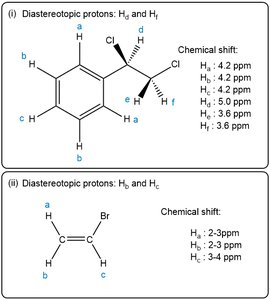
Try solving on your own before revealing the answer!
Final Answer:
(i) PhCHClCH2Cl: 6 different NMR signals, with diastereotopic protons Hd and Hf (see image_1 for chemical shifts).
(ii) Vinyl bromide: 3 different NMR signals, with diastereotopic protons Hb and Hc (see image_1 for chemical shifts).
The image shows the assignments and approximate chemical shifts for each proton.
Q18. If a compound has a molecular formula C4H10 and shows 3 signals in the proton NMR spectrum, what does this indicate about the molecule's symmetry?
Background
Topic: NMR and Molecular Symmetry
This question tests your ability to relate the number of NMR signals to the symmetry of a molecule, using the molecular formula as a clue.
Key Terms and Concepts:
Molecular Symmetry: Equivalent protons due to symmetry give fewer NMR signals.
NMR Signal Counting: The number of unique proton environments equals the number of NMR signals.
C4H10 Isomers: Butane and isobutane are possible structures.
Step-by-Step Guidance
Recall the possible isomers for C4H10 (n-butane and isobutane).
Draw both structures and identify the number of unique proton environments in each.
Compare the number of NMR signals for each isomer.
Relate the observed number of signals (3) to the symmetry present in the molecule.
Set up your reasoning for which structure matches the observed NMR data.
Try solving on your own before revealing the answer!
Final Answer:
d. The molecule has some symmetry.
Three NMR signals indicate that some protons are equivalent due to symmetry, which is consistent with isobutane (not a linear chain).
Q19. For the hydrogen indicated in red, sketch the expected 1H NMR signal showing its estimated chemical shift.
Background
Topic: 1H NMR Spin-Splitting and Chemical Shift Estimation
This question tests your ability to predict the appearance and chemical shift of a specific proton's NMR signal, considering its environment and spin-spin coupling.
Key Terms and Concepts:
Spin-Splitting: Coupling between neighboring protons causes multiplet patterns.
Chemical Shift: Estimated based on the proton's environment (e.g., near carbonyl, methyl groups).
Multiplicity: Number of peaks in the signal depends on the number of neighboring protons (n+1 rule).
Step-by-Step Guidance
Identify the hydrogen in red and its neighboring protons.
Estimate the chemical shift based on its proximity to functional groups (e.g., carbonyl).
Determine the number of neighboring protons to predict the multiplicity (n+1 rule).
Sketch the expected NMR signal shape (multiplet) and set up your reasoning for the estimated chemical shift.
Choose the most appropriate sketch from the options provided.
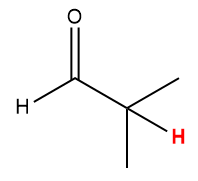
Try solving on your own before revealing the answer!
Final Answer:
a. The expected NMR signal is a multiplet centered at approximately 4.50 ppm (see image_6).
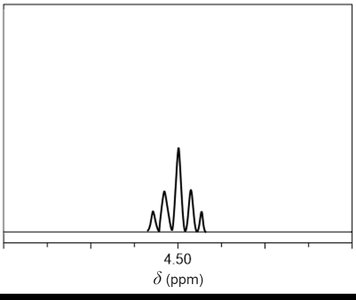
The red hydrogen is adjacent to a carbonyl and methyl group, resulting in a multiplet at this chemical shift.
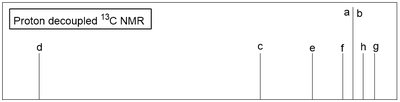
Q20. Draw the DEPT sequence spectra expected for the molecule given below.
Background
Topic: 13C NMR and DEPT Spectroscopy
This question tests your ability to interpret and draw DEPT spectra (DEPT-90 and DEPT-135) for a given molecule, distinguishing between CH, CH2, and CH3 carbons.
Key Terms and Concepts:
DEPT Spectroscopy: Distortionless Enhancement by Polarization Transfer, separates CH, CH2, and CH3 signals.
DEPT-90: Shows only CH carbons.
DEPT-135: CH and CH3 appear positive, CH2 appear negative.
Proton-Decoupled 13C NMR: Shows all carbon signals, regardless of attached protons.
Step-by-Step Guidance
Examine the molecular structure and label each carbon (CH, CH2, CH3, quaternary).
Recall the rules for DEPT-90 and DEPT-135 spectra.
Predict which carbons will appear in each spectrum and their relative intensities/signs.
Set up your reasoning for the expected DEPT spectra based on the structure.
Choose the most appropriate DEPT sequence from the options provided.
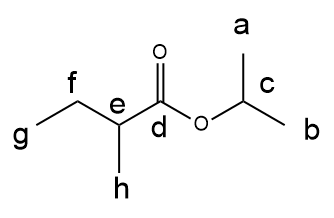
Try solving on your own before revealing the answer!
Final Answer:
a. The correct DEPT sequence spectra is shown in image_12.
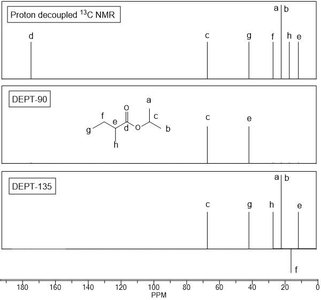
The DEPT-90 spectrum shows only CH carbons, while DEPT-135 distinguishes CH, CH2, and CH3 signals.
