 Indietro
Organic Chemistry Practice Exam Guidance: Spectroscopy, Acidity, Stereochemistry, and Equilibria
Guida di studio - Note intelligenti
 Appunti personalizzati basati sui tuoi materiali, ampliati con definizioni chiave, esempi e contesto.
Q1. For each of the following pairs of compounds, indicate which one has the weaker bond to hydrogen and/or which hydrogen is most acidic.
Background
Topic: Acidity and Bond Strength in Organic Molecules
This question tests your understanding of how different functional groups affect the strength of the bond to hydrogen and the acidity (pKa) of the hydrogen atom in organic compounds.
Key Terms and Concepts:
Bond Dissociation Energy (DHo): The energy required to break a bond; a smaller value means a weaker bond.
Acidity (pKa): Lower pKa means a stronger acid; the more easily a hydrogen is lost, the more acidic it is.
Functional Groups: Groups like -OH, -SH, and -O- affect acidity and bond strength due to electronegativity and resonance.
Step-by-Step Guidance
Examine the functional groups attached to hydrogen in each compound. Consider how electronegativity and resonance stabilization affect bond strength and acidity.
Recall that more electronegative atoms (like O vs S) generally make the bond to hydrogen weaker and the hydrogen more acidic.
Compare the pKa values for similar functional groups (e.g., alcohol vs thiol, ether vs alcohol) to determine which hydrogen is most acidic.
For each pair, identify which compound has the weaker bond to hydrogen (smaller DHo) and which hydrogen is most acidic (lower pKa).
Set up your answer by marking 'A' or 'B' for each pair, based on your analysis.
Try solving on your own before revealing the answer!
Final Answer:
For each pair, the compound with the more electronegative atom or greater resonance stabilization typically has the weaker bond to hydrogen and the more acidic hydrogen. For example, -OH is more acidic than -SH, and -O- is more acidic than -H.
Specific answers for each pair depend on the functional groups shown, but generally, the compound with oxygen (vs sulfur or carbon) will have the weaker bond and lower pKa.
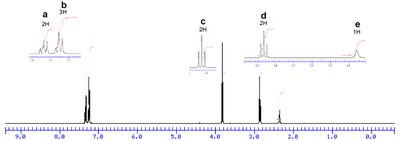
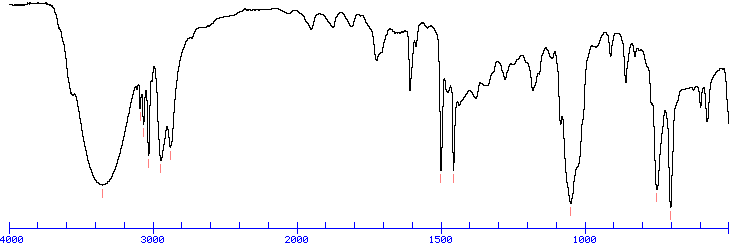
Q2. Molecule X has a molecular formula C8H10O. Below is the 1H-NMR, MS and IR spectra. a) Calculate the IHD for this compound. b) Propose the structure (Lewis structure okay) of molecule X that is consistent with all of the data provided and label each hydrogen using the corresponding labels given in the spectrum (a, b, c, etc.).
Background
Topic: Spectroscopic Analysis and Structure Determination
This question tests your ability to interpret NMR, IR, and MS data to deduce the structure of an organic molecule, including calculating the Index of Hydrogen Deficiency (IHD).
Key Terms and Formulas:
Index of Hydrogen Deficiency (IHD): Indicates the number of rings and/or double bonds in a molecule.
Formula for IHD:
NMR: Provides information about hydrogen environments.
IR: Identifies functional groups (e.g., O-H, C=O).
MS: Gives molecular weight and fragmentation pattern.
Step-by-Step Guidance
Calculate the IHD using the formula and the molecular formula C8H10O. Consider if there are any halogens or nitrogens present (none in this case).
Analyze the NMR spectrum: Look for the number of distinct hydrogen environments, integration values, and splitting patterns to infer the types of hydrogens present.
Examine the IR spectrum: Identify key peaks (e.g., O-H stretch, aromatic C-H, C=O) to determine functional groups.
Use the MS data to confirm the molecular weight and look for characteristic fragments.
Combine all spectral information to propose a structure that fits the formula, IHD, and spectral data. Label each hydrogen as indicated in the NMR spectrum (a, b, c, etc.).
Try solving on your own before revealing the answer!
Final Answer:
a)
b) The structure consistent with C8H10O, IHD = 4, and the spectra is likely para-methylphenol (p-cresol). The NMR and IR data support an aromatic ring with a methyl group and a hydroxyl group. Hydrogens are labeled as shown in the NMR spectrum.
Q3. Consider the following hexose molecules (a-f): Place the letter (a-f) in the boxes provided that correspond to cyclic forms of the same structures (note that all pyranoses are shown as the b anomer):
Background
Topic: Carbohydrate Structure and Anomeric Forms
This question tests your ability to recognize the relationship between open-chain and cyclic forms of hexose sugars, specifically identifying pyranose forms and their anomeric configurations.
Key Terms:
Hexose: A six-carbon sugar.
Pyranose: Six-membered ring form of a sugar.
Anomer: Isomers differing at the anomeric carbon (alpha or beta).
Step-by-Step Guidance
Identify the open-chain forms of the hexoses and their corresponding cyclic forms.
Determine which cyclic forms are pyranoses and which are the beta anomer (b anomer).
Match each open-chain structure to its cyclic form based on the arrangement of hydroxyl groups and the anomeric carbon.
Place the correct letter (a-f) in the box for each cyclic structure.
Try solving on your own before revealing the answer!
Final Answer:
The correct matching of open-chain and cyclic forms depends on the orientation of the hydroxyl groups and the configuration at the anomeric carbon. Each pyranose form shown as the beta anomer corresponds to a specific open-chain hexose.
Q4. Indicate whether the following pairs of molecules are the same compounds, enantiomers, diastereomers, conformers, or constitutional isomers. Then answer the second question for each pair.
Background
Topic: Stereochemistry and Isomerism
This question tests your ability to distinguish between different types of isomers and to analyze optical activity and chirality.
Key Terms:
Enantiomers: Non-superimposable mirror images.
Diastereomers: Stereoisomers that are not mirror images.
Constitutional Isomers: Same formula, different connectivity.
Conformers: Different spatial arrangements due to rotation.
Optical Activity: Ability to rotate plane-polarized light.
Chirality: A molecule is chiral if it has a non-superimposable mirror image.
Step-by-Step Guidance
Compare the connectivity and arrangement of atoms in each pair to determine the relationship (same, enantiomers, diastereomers, etc.).
For each pair, analyze the stereochemistry at each chiral center (R or S) using Cahn-Ingold-Prelog rules.
Determine if the molecule is optically active (has chiral centers and is not a racemic mixture).
Assess whether the molecule is chiral or achiral based on symmetry and presence of chiral centers.
Try solving on your own before revealing the answer!
Final Answer:
Each pair can be classified based on their structural and stereochemical relationship. For example, molecules with opposite configurations at all chiral centers are enantiomers, while those with some but not all centers different are diastereomers. Optical activity and chirality depend on the presence and arrangement of chiral centers.
Q5. a) Consider the following equilibrium: i) Do you expect the ΔGº of this reaction to be positive, negative, or about zero? ii) Would addition of a catalyst change Keq of this reaction? b) Consider the following molecule: Do you expect a larger 3J-coupling constant between Ha and Hb (Jab) or Hc and Hd (Jcd) in the 1H-NMR spectrum? c) Label the following alkenes as having the E or Z stereochemistry:
Background
Topic: Thermodynamics, Catalysis, NMR Coupling, and Alkene Stereochemistry
This question tests your understanding of reaction spontaneity (ΔGº), the effect of catalysts on equilibrium, NMR coupling constants, and alkene stereochemistry (E/Z).
Key Terms and Concepts:
ΔGº (Standard Free Energy Change): Indicates whether a reaction is spontaneous.
Keq (Equilibrium Constant): Describes the ratio of products to reactants at equilibrium.
Catalyst: Speeds up reaction but does not change Keq.
3J-coupling (Vicinal Coupling): Depends on dihedral angle between hydrogens; larger for trans (anti) than cis (syn).
E/Z Stereochemistry: E = opposite sides, Z = same side (based on priority groups).
Step-by-Step Guidance
For part a, analyze the reaction to determine if ΔGº is positive, negative, or zero based on product/reactant stability.
Recall that a catalyst does not change Keq; it only affects the rate.
For part b, draw the molecule in its most stable chair conformation and compare the dihedral angles for Ha-Hb and Hc-Hd to predict which coupling constant is larger.
For part c, assign E or Z stereochemistry to each alkene by prioritizing substituents and determining their relative positions.
Try solving on your own before revealing the answer!
Final Answer:
a) ΔGº is determined by the relative stability of products and reactants. A catalyst does not change Keq.
b) The larger 3J-coupling constant is typically found between hydrogens with a dihedral angle of 180° (trans).
c) E/Z assignment depends on the arrangement of priority groups across the double bond.
Q6. Consider the following equilibrium reaction: a) Which molecule has a higher pKa, Methanol (1) or Methanethiol (2)? b) At room temperature, the Keq for the reaction is expected to be (circle your answers) A: greater than 1 B: less than 1 C: about equal to 1. c) ΔSº of the reaction is expected to be A: large and positive B: large and negative C: negligible. d) ΔHº of the reaction is expected to be A: large and positive B: large and negative C: negligible. e) The pKa of CH3SH is expected to be A: greater than B: less than C: about equal to CH3OH.
Background
Topic: Acid-Base Equilibria and Thermodynamics
This question tests your understanding of acid-base properties, equilibrium constants, and thermodynamic parameters (ΔSº, ΔHº).
Key Terms and Concepts:
pKa: Lower pKa means stronger acid.
Keq: Indicates the direction and extent of equilibrium.
ΔSº (Entropy Change): Measures disorder.
ΔHº (Enthalpy Change): Measures heat absorbed or released.
Step-by-Step Guidance
Compare the acidity of methanol and methanethiol based on their pKa values.
Predict the direction of equilibrium based on relative acid strengths.
Assess the entropy and enthalpy changes based on the nature of the reaction (exchange of protons between similar molecules).
Determine whether the pKa of CH3SH is greater than, less than, or about equal to CH3OH.
Try solving on your own before revealing the answer!
Final Answer:
a) Methanol has a higher pKa than methanethiol.
b) Keq is expected to be less than 1.
c) ΔSº is negligible.
d) ΔHº is negligible.
e) The pKa of CH3SH is less than that of CH3OH.
Q7. Alcohols may react with hydrogen halides to generate haloalkanes. a) Using the table above, calculate ΔHº of the following reaction. Show your work. b) At 25°C, you would expect this equilibrium constant to be closest to 10 to what power (input the closest integer number)? c) Do you expect this reaction to be endergonic?
Background
Topic: Reaction Thermodynamics and Equilibrium
This question tests your ability to use bond dissociation energies to calculate reaction enthalpy (ΔHº), estimate equilibrium constants, and assess whether a reaction is endergonic or exergonic.
Key Terms and Formulas:
ΔHº (Enthalpy Change): Calculated from bond energies:
Keq: Related to ΔGº by
Endergonic: ΔGº > 0; reaction is not spontaneous.
Step-by-Step Guidance
Identify which bonds are broken and which are formed in the reaction: ROH + HX → RX + H2O.
Use the bond dissociation energies from the table to calculate ΔHº for the reaction.
Estimate the equilibrium constant (Keq) using ΔHº and the relationship between ΔGº and Keq.
Determine if the reaction is endergonic based on the calculated ΔGº.
Try solving on your own before revealing the answer!
Final Answer:
a) ΔHº is calculated by subtracting the sum of bond energies formed from those broken. The answer depends on the specific values from the table.
b) The equilibrium constant is closest to 10^x, where x is determined from ΔGº.
c) The reaction is not endergonic if ΔGº is negative.
