 Indietro
Organic Chemistry Spectroscopy Practice – Structure Elucidation Guidance
Guida di studio - Note intelligenti
 Appunti personalizzati basati sui tuoi materiali, ampliati con definizioni chiave, esempi e contesto.
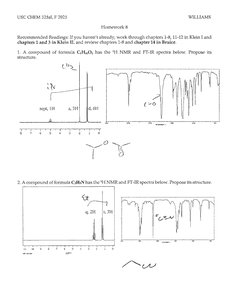
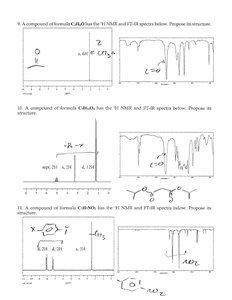
Q1. A compound of formula C3H6O2 has the 1H NMR and FT-IR spectra below. Propose its structure.
Background
Topic: Structure Elucidation Using NMR and IR Spectroscopy
This question tests your ability to interpret 1H NMR and FT-IR spectra to deduce the structure of an organic compound, given its molecular formula.
Key Terms and Formulas
1H NMR: Reveals the number and environment of hydrogen atoms in a molecule.
FT-IR: Identifies functional groups based on characteristic absorption bands.
Degree of Unsaturation:
Step-by-Step Guidance
Calculate the degree of unsaturation for C3H6O2 using the formula above. This will help you determine if there are rings or double bonds present.
Examine the FT-IR spectrum for key absorptions. Look for broad peaks (O-H), sharp peaks (C=O), and other characteristic signals.
Analyze the 1H NMR spectrum: count the number of signals, their integration (number of hydrogens), and splitting patterns (singlet, doublet, triplet, etc.).
Correlate the NMR signals with possible functional groups suggested by the IR spectrum and the degree of unsaturation.
Sketch possible structures that fit the formula and spectral data, but do not finalize the structure yet. Consider esters, acids, or other oxygen-containing groups.
Try solving on your own before revealing the answer!
Final Answer: Methyl acetate (CH3COOCH3)
The degree of unsaturation is 1, indicating a double bond or ring. The IR shows a strong C=O stretch (~1740 cm-1), and the NMR shows two singlets (3H each), consistent with a methyl ester.
Q2. A compound of formula C4H8O2 has the 1H NMR and FT-IR spectra below. Propose its structure.
Background
Topic: Structure Elucidation Using NMR and IR Spectroscopy
This question tests your ability to interpret 1H NMR and FT-IR spectra to deduce the structure of an organic compound, given its molecular formula.
Key Terms and Formulas
1H NMR: Reveals the number and environment of hydrogen atoms in a molecule.
FT-IR: Identifies functional groups based on characteristic absorption bands.
Degree of Unsaturation:
Step-by-Step Guidance
Calculate the degree of unsaturation for C4H8O2.
Identify key IR absorptions, especially for carbonyl (C=O) and O-H stretches.
Analyze the 1H NMR: note the number of signals, their integration, and splitting patterns.
Match the NMR data to possible structures, considering the functional groups suggested by IR.
Draw possible structures, but do not finalize yet. Consider esters, acids, or other oxygenated groups.
Try solving on your own before revealing the answer!
Final Answer: Ethyl acetate (CH3COOCH2CH3)
The degree of unsaturation is 1. The IR shows a strong ester C=O stretch, and the NMR shows a quartet and triplet (ethyl group) and a singlet (methyl on carbonyl), consistent with ethyl acetate.
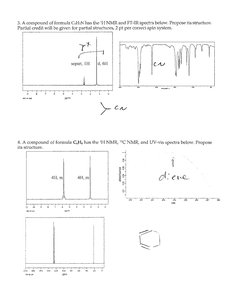
Q3. A compound of formula C4H8 has the 1H NMR and FT-IR spectra below. Propose its structure.
Background
Topic: Structure Elucidation Using NMR and IR Spectroscopy
This question tests your ability to interpret 1H NMR and FT-IR spectra to deduce the structure of an organic compound, given its molecular formula.
Key Terms and Formulas
1H NMR: Reveals the number and environment of hydrogen atoms in a molecule.
FT-IR: Identifies functional groups based on characteristic absorption bands.
Degree of Unsaturation:
Step-by-Step Guidance
Calculate the degree of unsaturation for C4H8.
Check the IR spectrum for the presence or absence of double bonds or rings.
Analyze the 1H NMR: count the number of signals, their integration, and splitting.
Consider possible isomers (alkenes, cycloalkanes) that fit the formula and spectral data.
Draw possible structures, but do not finalize yet. Focus on matching the NMR splitting and integration.
Try solving on your own before revealing the answer!
Final Answer: 1-butene (CH2=CHCH2CH3)
The degree of unsaturation is 1. The IR shows C=C stretch, and the NMR shows signals consistent with a terminal alkene.
Q4. A compound of formula C6H6 has the 1H NMR, 13C NMR, and UV-vis spectra below. Propose its structure.
Background
Topic: Aromaticity and Spectroscopy
This question tests your ability to recognize aromatic compounds using NMR and UV-vis data.
Key Terms and Formulas
Aromaticity: Compounds with conjugated pi systems and 4n+2 pi electrons (Hückel's rule).
UV-vis: Indicates conjugation and aromaticity by absorption in the UV region.
Step-by-Step Guidance
Calculate the degree of unsaturation for C6H6.
Examine the 1H NMR for the number and type of signals (multiplets, chemical shift range).
Check the 13C NMR for the number of unique carbon environments.
Analyze the UV-vis spectrum for absorption bands characteristic of aromatic systems.
Consider possible aromatic structures that fit the data, but do not finalize yet.
Try solving on your own before revealing the answer!
Final Answer: Benzene (C6H6)
The degree of unsaturation is 4. The NMR and UV-vis data are consistent with a highly symmetric aromatic compound, benzene.
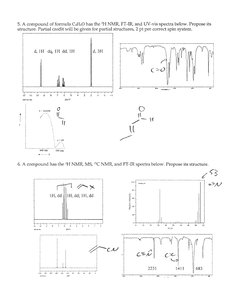
Q5. A compound of formula C6H10 has the 1H NMR, FT-IR, and UV-vis spectra below. Propose its structure.
Background
Topic: Structure Elucidation Using Multiple Spectroscopic Techniques
This question tests your ability to integrate NMR, IR, and UV-vis data to deduce the structure of a hydrocarbon.
Key Terms and Formulas
Degree of Unsaturation:
UV-vis: Indicates conjugation or aromaticity.
Step-by-Step Guidance
Calculate the degree of unsaturation for C6H10.
Analyze the IR spectrum for double bonds or rings.
Examine the 1H NMR for the number and type of signals, integration, and splitting.
Check the UV-vis for evidence of conjugation.
Draw possible structures, but do not finalize yet. Consider cycloalkenes or dienes.
Try solving on your own before revealing the answer!
Final Answer: 1,3-cyclohexadiene (C6H8)
The degree of unsaturation is 2. The NMR, IR, and UV-vis data are consistent with a conjugated diene in a six-membered ring.
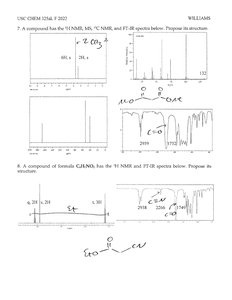
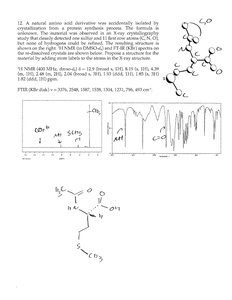
Q6. A compound has the 1H NMR, MS, 13C NMR, and FT-IR spectra below. Propose its structure.
Background
Topic: Structure Elucidation Using NMR, Mass Spectrometry, and IR
This question tests your ability to combine NMR, MS, and IR data to deduce the structure of an unknown compound.
Key Terms and Formulas
Mass Spectrometry (MS): Provides molecular weight and fragmentation pattern.
1H and 13C NMR: Reveal hydrogen and carbon environments.
FT-IR: Identifies functional groups.
Step-by-Step Guidance
Determine the molecular weight from the MS spectrum.
Analyze the IR spectrum for key functional groups (C=O, O-H, N-H, etc.).
Examine the 1H and 13C NMR for the number and type of signals, integration, and splitting.
Piece together the fragments and functional groups to propose possible structures.
Draw possible structures, but do not finalize yet. Ensure consistency with all spectral data.
Try solving on your own before revealing the answer!
Final Answer: 3-pentanone (CH3CH2COCH2CH3)
The MS gives the molecular weight, the IR shows a strong C=O stretch, and the NMR data fit a symmetric ketone.
