 Indietro
Organic Chemistry: Structure, Bonding, Acids & Bases, and Alkanes
Guida di studio - Note intelligenti
 Appunti personalizzati basati sui tuoi materiali, ampliati con definizioni chiave, esempi e contesto.
Structure and Bonding
Introduction to Organic Chemistry
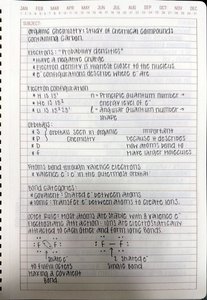
Organic chemistry is the study of chemical compounds containing carbon. The unique bonding properties of carbon allow for a vast diversity of organic molecules, which are the foundation of life and many materials.
Organic Compounds: Molecules primarily composed of carbon and hydrogen, often containing other elements such as oxygen, nitrogen, sulfur, and halogens.
Covalent Bonding: Organic compounds are characterized by covalent bonds, where electrons are shared between atoms.
Quantum Chemistry and Atomic Structure
The structure of atoms and the arrangement of electrons are fundamental to understanding chemical bonding in organic molecules.
Quantum Numbers: Describe the properties of atomic orbitals and the properties of electrons in orbitals.
Principal Quantum Number (n): Indicates the main energy level.
Angular Momentum Quantum Number (l): Indicates the shape of the orbital (s, p, d, f).
Magnetic Quantum Number (m): Indicates the orientation of the orbital.
Spin Quantum Number (s): Indicates the spin of the electron.
Electron Configuration: The arrangement of electrons in an atom's orbitals, following the Aufbau principle, Pauli exclusion principle, and Hund's rule.
Bonding and Molecular Structure
Covalent bonds form when atoms share electrons to achieve a stable electron configuration. The type and number of bonds influence molecular geometry and reactivity.
Single Bond: One sigma (σ) bond.
Double Bond: One sigma (σ) and one pi (π) bond.
Triple Bond: One sigma (σ) and two pi (π) bonds.
Lewis Structures: Diagrams that show the bonding between atoms and the lone pairs of electrons in a molecule.
Acids and Bases; Functional Groups
Acids and Bases in Organic Chemistry
Acids and bases play a crucial role in organic reactions. Their strength and behavior are determined by molecular structure and the stability of their conjugate forms.
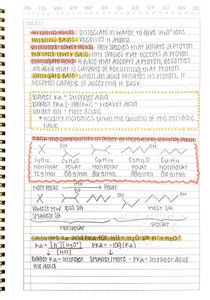
Brønsted-Lowry Acid: Proton donor.
Brønsted-Lowry Base: Proton acceptor.
Lewis Acid: Electron pair acceptor.
Lewis Base: Electron pair donor.
pKa: The negative logarithm of the acid dissociation constant; lower pKa indicates a stronger acid.
Factors Affecting Acidity:
Electronegativity of the atom bearing the negative charge
Resonance stabilization
Inductive effects
Hybridization
Functional Groups
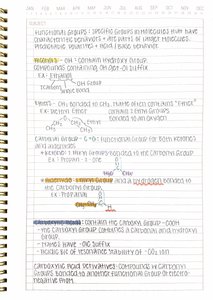
Functional groups are specific groups of atoms within molecules that are responsible for the characteristic chemical reactions of those molecules.
Hydroxyl Group (-OH): Found in alcohols.
Carbonyl Group (C=O): Found in aldehydes and ketones.
Carboxyl Group (-COOH): Found in carboxylic acids.
Amino Group (-NH2): Found in amines.
Alkyl Halides: Contain halogen atoms bonded to carbon.
Structure and Stereochemistry of Alkanes
Alkanes: Structure and Nomenclature
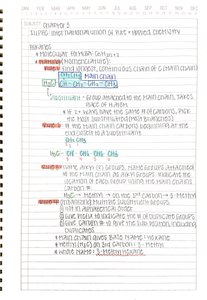
Alkanes are saturated hydrocarbons with only single bonds between carbon atoms. Their structure and naming follow systematic rules.
General Formula:
Linear (Normal) Alkanes: Straight-chain hydrocarbons.
Branched Alkanes: Contain alkyl substituents.
Naming: Based on the longest continuous carbon chain and the position of substituents.
Isomerism in Alkanes
Isomers are compounds with the same molecular formula but different structures. Structural isomers differ in the connectivity of atoms.
Constitutional Isomers: Differ in the order of attachment of atoms.
Stereoisomers: Same connectivity but different spatial arrangement.
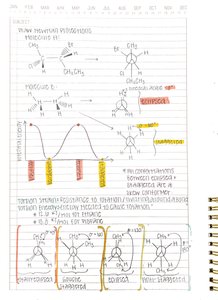
Conformations of Alkanes
Alkanes can adopt different spatial arrangements due to rotation around single bonds. The most common conformations are staggered and eclipsed.
Newman Projection: Visualizes the conformation of a molecule by looking along a bond axis.
Staggered Conformation: Lowest energy, atoms are as far apart as possible.
Eclipsed Conformation: Higher energy, atoms are aligned with each other.
The Study of Chemical Reactions
Reaction Mechanisms
Organic reactions proceed via specific mechanisms, which describe the step-by-step movement of electrons.
Initiation: Generation of reactive intermediates.
Propagation: Reactive intermediates react to form products and regenerate intermediates.
Termination: Reactive intermediates combine to end the reaction sequence.
Reaction Coordinate Diagrams: Illustrate the energy changes during a reaction, showing activation energy and the transition state.
Thermodynamics and Kinetics
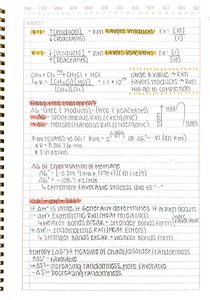
Thermodynamics determines the stability of products, while kinetics determines the rate at which products form.
ΔH (Enthalpy Change): Heat absorbed or released during a reaction.
ΔG (Gibbs Free Energy): Determines spontaneity of a reaction.
Activation Energy (Ea): Minimum energy required for a reaction to occur.
Rate Law: Expresses the relationship between the rate of a reaction and the concentration of reactants.
Stereochemistry
Chirality and Stereoisomers
Stereochemistry focuses on the spatial arrangement of atoms in molecules and its effect on chemical properties.
Chiral Center: A carbon atom bonded to four different groups.
Enantiomers: Non-superimposable mirror images.
Diastereomers: Stereoisomers that are not mirror images.
Fischer Projections: Two-dimensional representations of three-dimensional molecules, useful for depicting stereochemistry.
Summary Table: Common Functional Groups
Functional Group | General Structure | Example |
|---|---|---|
Alcohol | R-OH | Ethanol |
Aldehyde | R-CHO | Formaldehyde |
Ketone | R-CO-R' | Acetone |
Carboxylic Acid | R-COOH | Acetic Acid |
Amine | R-NH2 | Methylamine |
Alkyl Halide | R-X | Chloroethane |
Additional info:
Some explanations and context have been expanded for clarity and completeness, including definitions, examples, and summary tables. The images included are directly relevant to the adjacent explanations and reinforce key concepts in structure, bonding, acids and bases, functional groups, and alkane stereochemistry.
