 Indietro
Organic Chemistry Study Guidance: Stereochemistry, Isomerism, and Conformations
Guida di studio - Note intelligenti
 Appunti personalizzati basati sui tuoi materiali, ampliati con definizioni chiave, esempi e contesto.
Q1. In the following compound, identify each C=C unit as cis, trans, or not stereoisomeric.
Background
Topic: Stereochemistry of Alkenes
This question tests your ability to recognize the geometric (cis/trans) isomerism in alkenes, which depends on the substituents attached to the double-bonded carbons.
Key Terms:
Cis isomer: Substituents on the same side of the double bond.
Trans isomer: Substituents on opposite sides of the double bond.
Not stereoisomeric: If either double-bonded carbon has two identical groups, cis/trans isomerism is not possible.
Step-by-Step Guidance
Examine each C=C bond in the compound and identify the groups attached to each carbon of the double bond.
Determine if each double-bonded carbon has two different substituents. If so, cis/trans isomerism is possible.
If both carbons have two different groups, check their relative positions to decide if the configuration is cis or trans.
If either carbon has two identical groups, label that C=C as not stereoisomeric.
Try solving on your own before revealing the answer!
Final Answer:
For each C=C unit, identify as follows:
(a) [Your answer here]
(b) [Your answer here]
(c) [Your answer here]
Each double bond is classified based on the substituents attached. If both carbons have two different groups, cis/trans isomerism is possible; otherwise, it is not stereoisomeric.
Q2. Define a meso compound.
Background
Topic: Chirality and Stereochemistry
This question tests your understanding of meso compounds, which are special cases in stereochemistry.
Key Terms:
Meso compound: An achiral molecule with chiral centers and a plane of symmetry.
Chiral center: A carbon atom bonded to four different groups.
Plane of symmetry: A plane that divides the molecule into two mirror-image halves.
Step-by-Step Guidance
Recall the definition of a meso compound: it must have chiral centers but be overall achiral due to symmetry.
Consider why a plane of symmetry makes the molecule achiral, even if it has chiral centers.
Review examples of meso compounds, such as tartaric acid.
Try solving on your own before revealing the answer!
Final Answer:
A meso compound is an achiral molecule that contains chiral centers and has a plane of symmetry. It is not optically active because the symmetry cancels out the chirality.
Q3. How many 3° carbons are found in 5-ethyl-3,3,4-trimethylheptane?
Background
Topic: Alkane Structure and Carbon Classification
This question tests your ability to identify tertiary (3°) carbons in a branched alkane.
Key Terms:
Tertiary (3°) carbon: A carbon atom attached to three other carbon atoms.
Alkane: A saturated hydrocarbon with only single bonds.
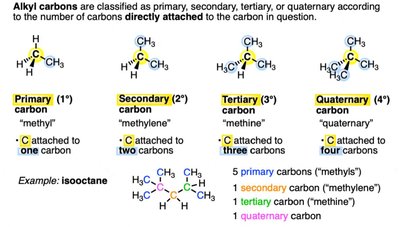
Step-by-Step Guidance
Draw the structure of 5-ethyl-3,3,4-trimethylheptane, labeling each carbon.
Identify all carbons that are attached to three other carbons (tertiary carbons).
Count the number of tertiary carbons in the molecule.
Compare your count to the answer choices provided.
Try solving on your own before revealing the answer!
Final Answer:
There are 3 tertiary carbons in 5-ethyl-3,3,4-trimethylheptane. Tertiary carbons are those bonded to three other carbons, typically at branching points.
