 Indietro
Organic Functional Groups and Alkanes: Structure, Properties, and Nomenclature
Guida di studio - Note intelligenti
 Appunti personalizzati basati sui tuoi materiali, ampliati con definizioni chiave, esempi e contesto.
Organic Functional Groups
Overview of Functional Groups
Functional groups are specific groups of atoms within molecules that are responsible for the characteristic chemical reactions of those molecules. Recognizing and understanding functional groups is essential for predicting the reactivity and properties of organic compounds.
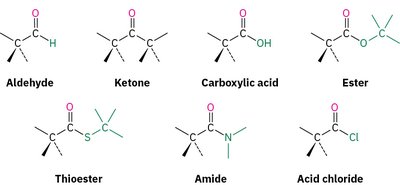
Alkyl halide (haloalkane): Contains a halogen atom (F, Cl, Br, I) bonded to an sp3 carbon.
Alcohol: Contains a hydroxyl group (-OH) bonded to an sp3 carbon.
Ether: Contains an oxygen atom bonded to two alkyl or aryl groups.
Phosphate: Contains a phosphorus atom bonded to four oxygen atoms, one of which is double-bonded.
Amine: Contains a nitrogen atom bonded to one or more alkyl or aryl groups.
Thiol: Contains a sulfhydryl group (-SH) bonded to a carbon atom.
Sulfide: Contains a sulfur atom bonded to two carbon atoms.
Disulfide: Contains two sulfur atoms bonded together, each attached to a carbon atom.
Aldehyde: Contains a carbonyl group (C=O) bonded to at least one hydrogen atom.
Ketone: Contains a carbonyl group (C=O) bonded to two carbon atoms.
Carboxylic acid: Contains a carbonyl group bonded to a hydroxyl group (-COOH).
Ester: Contains a carbonyl group bonded to an oxygen atom, which is bonded to another carbon atom.
Thioester: Contains a carbonyl group bonded to a sulfur atom, which is bonded to another carbon atom.
Amide: Contains a carbonyl group bonded to a nitrogen atom.
Acid chloride: Contains a carbonyl group bonded to a chlorine atom.


Alkanes and Isomerism
Structural (Constitutional) Isomers
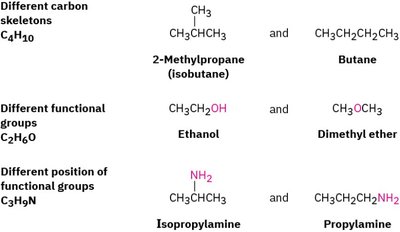
Isomers are compounds with the same molecular formula but different structures. Structural isomers (constitutional isomers) differ in the connectivity of their atoms. They can vary by carbon skeleton, functional group, or the position of the functional group.
Different carbon skeletons: Example: Butane (C4H10) and 2-methylpropane (isobutane).
Different functional groups: Example: Ethanol (C2H6O) and dimethyl ether.
Different positions of functional groups: Example: Isopropylamine and propylamine (C3H9N).
Physical Properties of Alkanes
Boiling and Melting Points
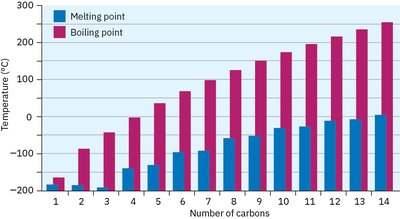
The boiling and melting points of alkanes increase with the number of carbon atoms due to greater van der Waals forces. Branching lowers boiling points because it reduces surface area and intermolecular interactions.
Boiling point trend: Increases with chain length; decreases with branching.
Melting point trend: Also increases with chain length, but less predictably due to packing effects.
Alkyl Groups and Nomenclature
Common Alkyl Groups
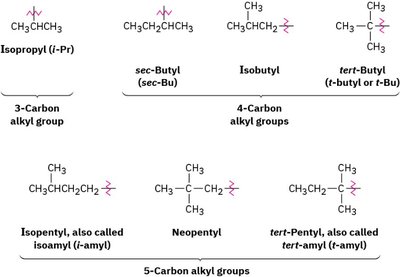
Alkyl groups are fragments of alkanes with one hydrogen removed, allowing them to attach to other atoms or groups. They are named based on the parent alkane.
Isopropyl (i-Pr): 3-carbon group, (CH3)2CH–
sec-Butyl (sec-Bu): 4-carbon group, CH3CH2CH(CH3)–
Isobutyl: (CH3)2CHCH2–
tert-Butyl (t-Bu): (CH3)3C–
Neopentyl: (CH3)3CCH2–
Degree of Alkyl Substitution
Carbons in alkanes are classified by the number of other carbons to which they are attached:
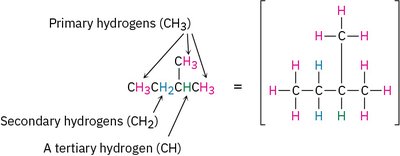
Primary (1°): Bonded to one other carbon.
Secondary (2°): Bonded to two other carbons.
Tertiary (3°): Bonded to three other carbons.
Quaternary (4°): Bonded to four other carbons.

Hydrogen Classification
Hydrogens are also classified based on the carbon to which they are attached (primary, secondary, tertiary).
Conformations of Alkanes
Newman Projections and Conformational Analysis
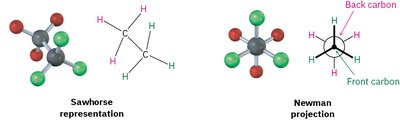
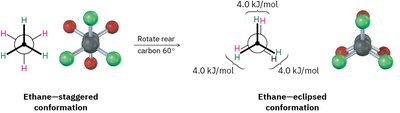
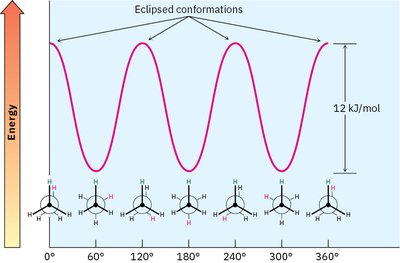
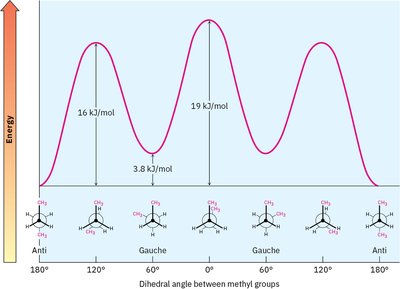
Newman projections are used to visualize the spatial arrangement of bonds around a carbon-carbon single bond. They help in analyzing different conformations (staggered, eclipsed, gauche, anti) and their relative energies.
Staggered conformation: Lowest energy; bonds are as far apart as possible.
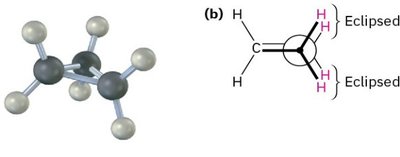
Eclipsed conformation: Highest energy; bonds are aligned, causing torsional strain.
Gauche conformation: Staggered but with bulky groups 60° apart, causing steric strain.
Anti conformation: Staggered with bulky groups 180° apart; most stable for butane.
Cyclic Alkanes
Physical Properties and Nomenclature
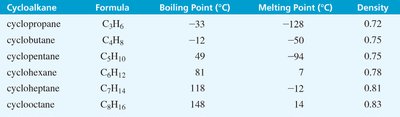
Cycloalkanes are saturated hydrocarbons with carbon atoms arranged in a ring. Their physical properties are similar to acyclic alkanes but are influenced by ring size and strain.
General formula: CnH2n
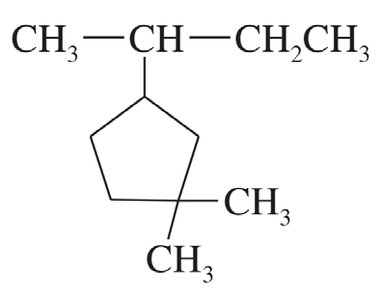
Naming: Prefix 'cyclo-' + alkane name; substituents are numbered to give the lowest possible numbers.

Cis-Trans Isomerism in Cycloalkanes
Cycloalkanes with two or more substituents can exhibit cis-trans (geometric) isomerism, depending on whether the substituents are on the same or opposite sides of the ring.

Ring Strain and Stability
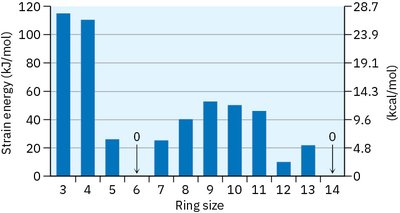
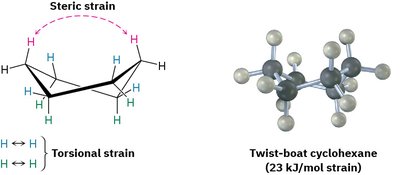
Ring strain arises from angle strain, torsional strain, and steric strain. The stability of cycloalkanes depends on their ring size and the ability to adopt conformations that minimize strain.
Angle strain: Deviation from ideal tetrahedral bond angles (109.5°).
Torsional strain: Eclipsing interactions between bonds on adjacent atoms.
Steric strain: Repulsion between atoms/groups that are too close.
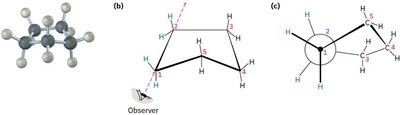
Conformations of Cycloalkanes
Cyclopropane and cyclobutane are highly strained due to angle and torsional strain. Cyclopentane and cyclohexane are much less strained, with cyclohexane being nearly strain-free in its chair conformation.
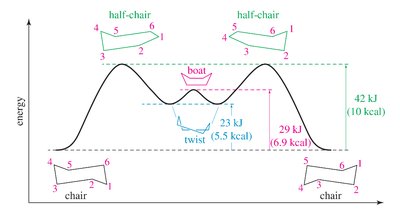
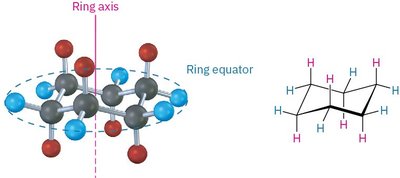
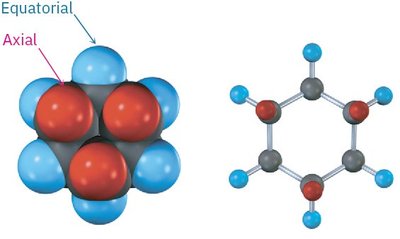
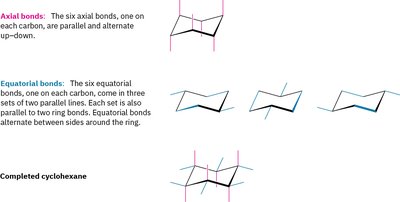
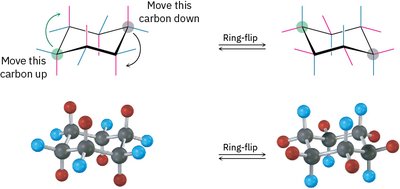
Cyclohexane: Adopts a chair conformation to minimize strain; can undergo ring flips that interchange axial and equatorial positions.
Axial and Equatorial Bonds
In the chair conformation of cyclohexane, each carbon has one axial (vertical) and one equatorial (slanted) bond. Substituents prefer the equatorial position to minimize 1,3-diaxial interactions (steric strain).
Ring Flip
A ring flip interconverts the two chair conformations of cyclohexane, exchanging axial and equatorial positions for all substituents.
Steric Strain in Monosubstituted Cyclohexanes
The 1,3-diaxial interaction causes steric strain when bulky groups occupy axial positions. The magnitude of this strain depends on the size of the substituent.
Y | kJ/mol | kcal/mol |
|---|---|---|
F | 0.5 | 0.12 |
Cl, Br | 1.0 | 0.25 |
OH | 2.1 | 0.5 |
CH3 | 3.8 | 0.9 |
CH2CH3 | 4.0 | 0.95 |
CH(CH3)2 | 4.6 | 1.1 |
C(CH3)3 | 11.4 | 2.7 |
C6H5 | 6.3 | 1.5 |
CO2H | 2.9 | 0.7 |
CN | 0.4 | 0.1 |
Bicyclic and Polycyclic Alkanes
Types of Bicyclic Compounds
Bicyclic alkanes contain two fused, bridged, or spirocyclic rings. Their nomenclature is based on the number of carbons in each bridge connecting the bridgehead carbons.
Fused bicyclic: Two rings share two adjacent carbons (e.g., decalin).
Bridged bicyclic: Two rings share non-adjacent carbons (e.g., norbornane).
Spirocyclic: Two rings share a single carbon atom (spiro atom).
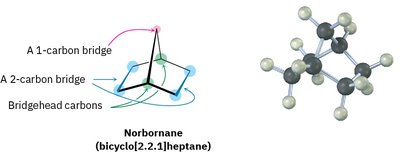
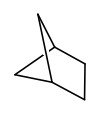
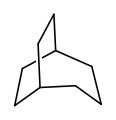
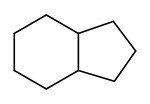
Additional info: The nomenclature for bicyclic alkanes uses the format bicyclo[a.b.c]alkane, where a, b, and c are the number of carbons in each bridge, listed in decreasing order.
