 Indietro
Organic Models II: Structure, Isomerism, and Functional Groups in Organic Chemistry
Guida di studio - Note intelligenti
 Appunti personalizzati basati sui tuoi materiali, ampliati con definizioni chiave, esempi e contesto.
Introduction to Organic Molecular Models
Purpose and Overview
Organic chemistry relies on understanding the three-dimensional structure and connectivity of molecules. This lab focuses on building ball-and-stick models, drawing various structural representations, and exploring isomerism and functional groups.
Ball-and-stick models help visualize atomic connectivity and geometry.
Dash-and-wedge structures represent 3D orientation on paper.
Line-angle (skeletal) structures simplify organic molecules for quick recognition.
Molecular formulas summarize atom counts in a compound.
Representations of Organic Molecules
Types of Structural Representations
Organic molecules can be depicted in several ways, each with its own advantages for clarity and communication.
Ball-and-stick model: Physical or visual model showing atoms (balls) and bonds (sticks).
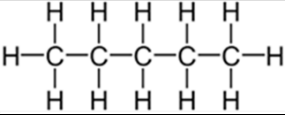
Complete structure: Shows all atoms and bonds explicitly.
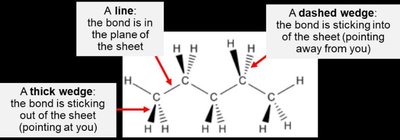
Dash-and-wedge (3D) structure: Uses lines, wedges, and dashed bonds to indicate spatial orientation.
Line-angle (skeletal) structure: Simplifies carbon chains; vertices represent carbon atoms, and hydrogens are often omitted.
Example: Pentane can be represented in all these formats. 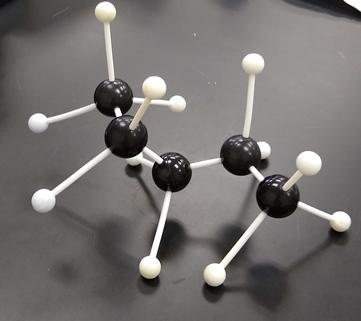
Functional Groups and Molecular Models
Identifying Atoms in Models
Atoms are distinguished by color and number of bonds in model kits:
Carbon (C): Black, four bonds (tetrahedral, trigonal planar, or linear depending on bonding).
Nitrogen (N): Blue, three bonds, smaller than C.
Oxygen (O): Red, two bonds, smaller than C.
Hydrogen (H): White, one bond, smallest atom.
Chlorine (Cl): Greenish-blue, one bond, largest atom.
Examples of Functional Groups
Alcohols: Contain -OH group (e.g., butan-1-ol).
Ethers: Contain -O- linkage (e.g., diethyl ether).
Amines: Contain -NH2 or -NHR group (e.g., propan-1-amine).
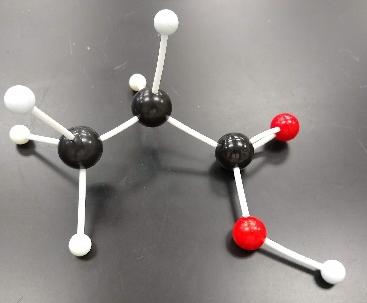
Carboxylic acids: Contain -COOH group (e.g., acetic acid).
Esters: Contain -COOR group (e.g., methyl acetate).
Isomerism in Organic Chemistry
Types of Isomers
Isomers are compounds with the same molecular formula but different structures or spatial arrangements.
Constitutional (structural) isomers: Same formula, different connectivity.
Stereoisomers: Same connectivity, different spatial arrangement.
Enantiomers: Non-superimposable mirror images (optical isomers).
Diastereomers: Stereoisomers that are not mirror images (e.g., cis/trans isomers).
Example: Cis-hex-2-ene and trans-hex-2-ene are diastereomers. 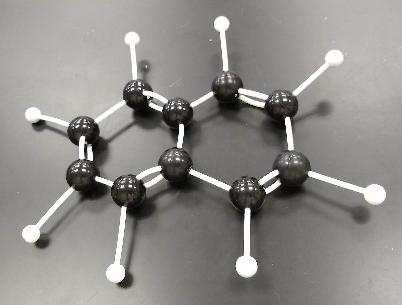
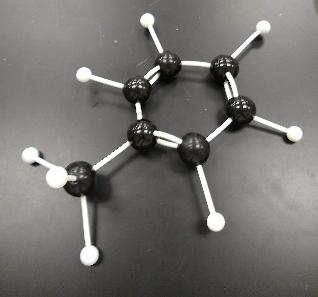
Building and Drawing Organic Molecules
Model Kit Carbon Types
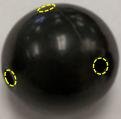
Tetrahedral carbon: Four evenly spaced holes, used for single bonds (alkanes).
Trigonal planar carbon: Two holes next to each other, used for double bonds (alkenes, arenes).
Linear carbon: Three holes next to each other, used for triple bonds (alkynes).
Recognizing Structural Isomers and Diastereomers
Comparison of Isomers
Compare molecular formulas to identify isomers.
Structural isomers differ in atom connectivity.
Diastereomers differ in spatial arrangement but are not mirror images.
Optical Isomerism (Chirality)
Chiral Centers and Enantiomers
Chirality arises when a carbon atom is bonded to four different groups, resulting in non-superimposable mirror images (enantiomers).
Chiral center: Tetrahedral carbon with four distinct substituents.
Enantiomers: Mirror images that cannot be superimposed.
Test for chirality: Build both mirror images and check for superimposability.
Fischer Esterification Reaction
Formation of Esters
Fischer esterification is a reaction between a carboxylic acid and an alcohol to form an ester and water.
General equation:
Remove the -OH from the acid and the H from the alcohol, combine to form water.
Connect the remaining fragments to form the ester.
Solubility of Organic Compounds in Water
Polarity and Solubility
The solubility of organic compounds in water depends on their polarity.
Polar compounds: Mix with water (e.g., acetone, acetic acid, acetamide).
Nonpolar compounds: Do not mix with water (e.g., benzene, toluene).
Rule: "Like dissolves like" – polar dissolves in polar, nonpolar in nonpolar.
Summary Table: Water Solubility of Organic Compounds
Compound | Polar or Not Polar | Mixes with Water? |
|---|---|---|
Acetone | Polar | Mixes with water |
Acetic acid | Polar | Mixes with water |
Acetamide | Polar | Mixes with water |
Benzene | Not polar | Does not mix with water |
Toluene | Not polar | Does not mix with water |
Model Kit Reference Table
Parts Needed for Building Models
Part | Quantity |
|---|---|
Black "C", equally spaced holes | 6 |
Black "C", two holes together | 6 (7 or 8 is okay) |
Black "C", three holes together | 2 |
Green "Cl" | 2 |
Red "O", two holes together | 2 |
Red "O", two holes apart | 2 |
Blue "N", three holes apart | 2 |
White H with a bond | 16 |
White bond, long | 14 |
White bond, short | 8 |
Pre-Lab and Post-Lab Assignments
Preparation and Review
Review structural representations and molecular formulas.
Draw complete and skeletal structures for listed compounds.
Check model kit parts before and after lab.
Additional info:
Understanding isomerism and functional groups is foundational for organic chemistry.
Model kits are essential for visualizing molecular geometry and stereochemistry.
Solubility and polarity concepts are critical for predicting chemical behavior in biological and laboratory contexts.
