 Indietro
Organic Molecules and Functional Groups: Physical Properties and Reactivity
Guida di studio - Note intelligenti
 Appunti personalizzati basati sui tuoi materiali, ampliati con definizioni chiave, esempi e contesto.
Organic Molecules and Functional Groups
Introduction to Functional Groups
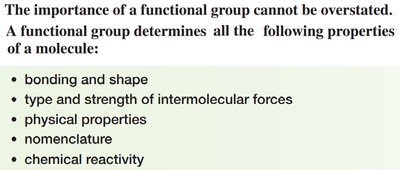
Functional groups are specific groups of atoms within molecules that are responsible for the characteristic chemical reactions of those molecules. The presence and type of functional group in an organic molecule determine its bonding, shape, physical properties, nomenclature, and chemical reactivity.
Functional Group: A specific arrangement of atoms that imparts characteristic properties to a molecule.
Carbon Skeleton: The main chain or ring of carbon atoms in an organic molecule.
Importance: Functional groups create reactive sites and influence intermolecular forces.

Classification of Organic Compounds by Functional Groups
Organic compounds are classified based on their functional groups. Hydrocarbons are the simplest, containing only carbon and hydrogen, while other groups include heteroatoms such as oxygen, nitrogen, or halogens.
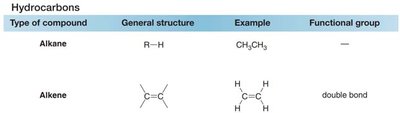
Hydrocarbons: Alkanes, alkenes, alkynes, and aromatic compounds.
C–Z Bonds: Compounds containing bonds between carbon and heteroatoms (Z = O, N, X).
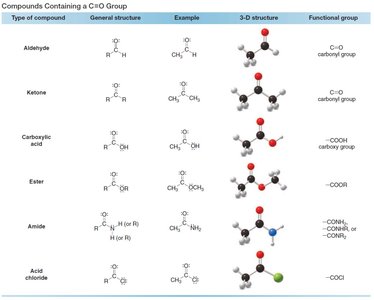
C=O Groups: Compounds containing carbonyl groups (aldehydes, ketones, carboxylic acids, esters, amides, acid chlorides).
Physical Properties of Organic Molecules
Intermolecular Forces
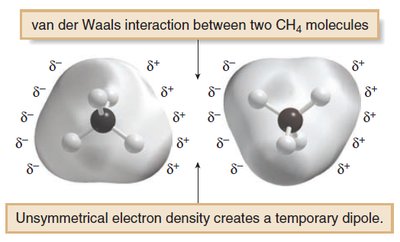
The physical properties of organic molecules, such as boiling point, melting point, and solubility, are determined by the strength and type of intermolecular forces present. These forces include van der Waals (London dispersion), dipole-dipole, hydrogen bonding, and ion-ion interactions.
Van der Waals Forces: Weak interactions caused by temporary dipoles; present in all molecules, especially nonpolar compounds.
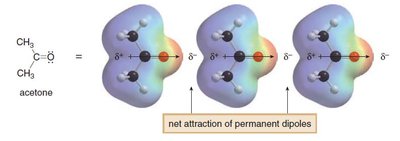
Dipole-Dipole Interactions: Moderate strength; occur between permanent dipoles in polar molecules.
Hydrogen Bonding: Strong; occurs when H is bonded to O, N, or F and interacts with lone pairs on these atoms in other molecules.
Ion-Ion Interactions: Very strong; occur between charged ions.
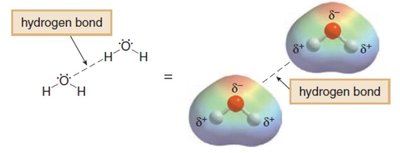
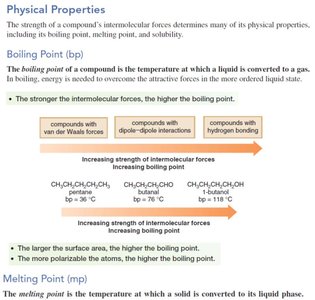
Boiling and Melting Points
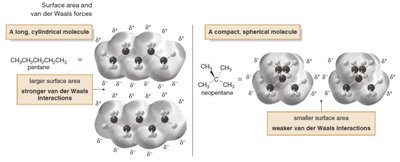
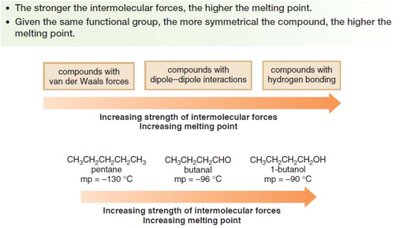
The boiling point (bp) and melting point (mp) of a compound are influenced by the strength of intermolecular forces, surface area, and polarizability. Stronger forces and larger surface area lead to higher bp and mp.
Boiling Point: Temperature at which a liquid becomes a gas.
Melting Point: Temperature at which a solid becomes a liquid.
Factors: Strength of intermolecular forces, surface area, polarizability, and symmetry.
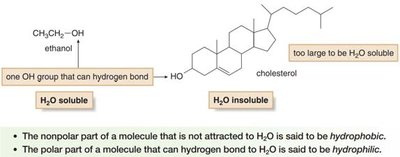
Solubility
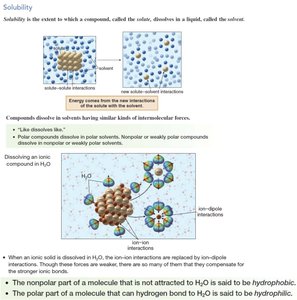
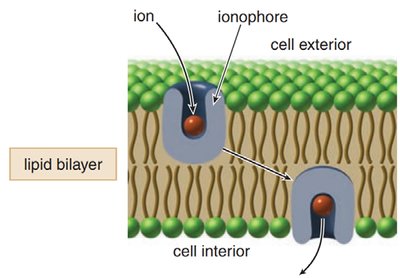
Solubility is the extent to which a compound dissolves in a solvent. Compounds dissolve best in solvents with similar intermolecular forces. Polar compounds dissolve in polar solvents, and nonpolar compounds dissolve in nonpolar solvents.
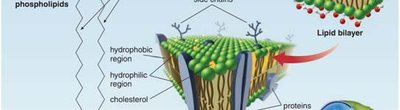
Hydrophilic: Polar parts of molecules that can hydrogen bond with water.
Hydrophobic: Nonpolar parts of molecules that do not interact with water.
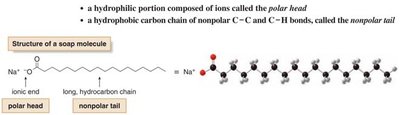
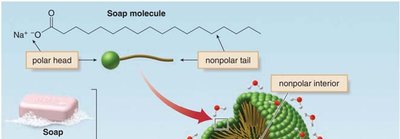
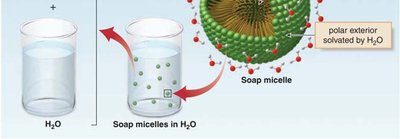
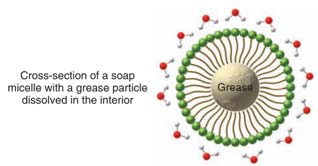
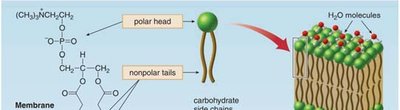
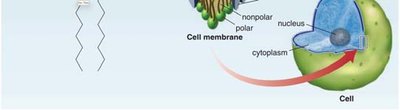
Soap Molecules: Contain both hydrophilic (polar head) and hydrophobic (nonpolar tail) regions, allowing them to form micelles and dissolve grease.

Reactivity of Organic Molecules
Nucleophiles and Electrophiles
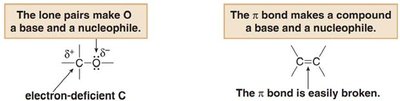
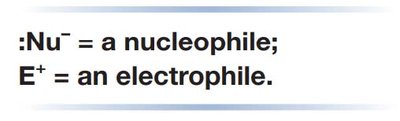
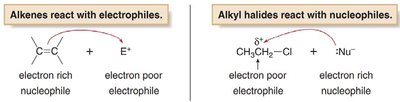
Reactivity in organic chemistry is largely determined by the interaction between nucleophiles (electron-rich species) and electrophiles (electron-poor species). Functional groups create reactive sites, and electron-rich sites react with electron-poor sites.
Nucleophile (:Nu-): An electron-rich species that donates electrons.
Electrophile (E+): An electron-poor species that accepts electrons.
Electronegative Heteroatoms: Atoms like N, O, or X make carbon atoms electrophilic.
Lone Pairs and π Bonds: Create nucleophilic sites; π bonds are more easily broken than σ bonds.

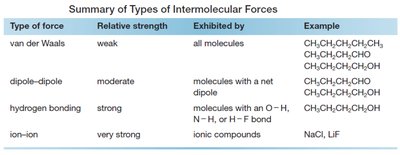
Summary Table: Types of Intermolecular Forces
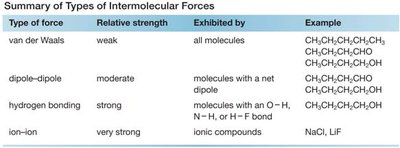
The following table summarizes the main types of intermolecular forces, their relative strength, the types of molecules they are exhibited by, and examples.
Type of force | Relative strength | Exhibited by | Example |
|---|---|---|---|
van der Waals | weak | all molecules | CH3CH2CH2CH2CH3 |
dipole-dipole | moderate | molecules with a net dipole | CH3CH2CH2CHO |
hydrogen bonding | strong | molecules with O–H, N–H, or H–F bond | CH3CH2CH2CH2OH |
ion-ion | very strong | ionic compounds | NaCl, LiF |
Summary Table: Hydrocarbon Types
Type of compound | General structure | Example | Functional group |
|---|---|---|---|
Alkane | R–H | CH3CH3 | — |
Alkene | C=C | H2C=CH2 | double bond |
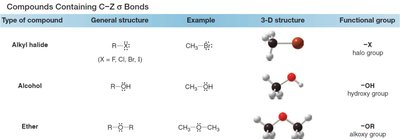
Summary Table: Compounds Containing C–Z Bonds
Type of compound | General structure | Example | 3-D structure | Functional group |
|---|---|---|---|---|
Alkyl halide | R–X | CH3CH2Br | [3-D model] | halo group |
Alcohol | R–OH | CH3CH2OH | [3-D model] | hydroxy group |
Ether | R–O–R | CH3CH2OCH3 | [3-D model] | alkoxy group |
Summary Table: Compounds Containing a C=O Group
Type of compound | General structure | Example | 3-D structure | Functional group |
|---|---|---|---|---|
Aldehyde | R–C=O–H | CH3CH2CHO | [3-D model] | carbonyl group |
Ketone | R–C=O–R | CH3COCH3 | [3-D model] | carbonyl group |
Carboxylic acid | R–COOH | CH3COOH | [3-D model] | carboxyl group |
Ester | R–COOR | CH3COOCH3 | [3-D model] | ester group |
Amide | R–CONH2 | CH3CONH2 | [3-D model] | amide group |
Acid chloride | R–COCl | CH3COCl | [3-D model] | acid chloride group |
Key Terms and Equations
Boiling Point Equation:
Melting Point Equation:
Nucleophile:
Electrophile:
Conclusion
Understanding functional groups and intermolecular forces is fundamental to predicting the physical properties and reactivity of organic molecules. These concepts are central to organic chemistry and provide the basis for further study of molecular structure, reactions, and applications.
